Summary
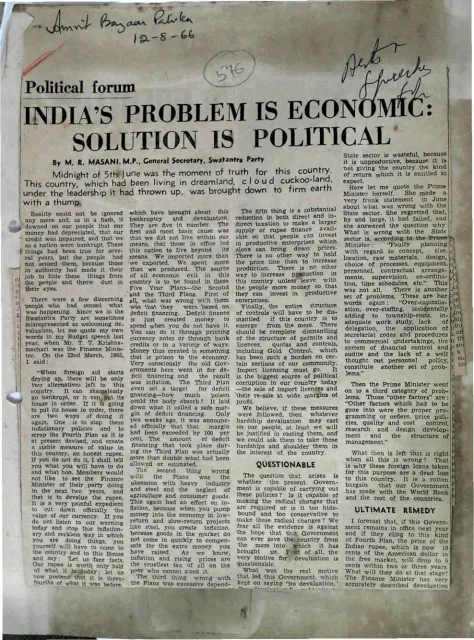
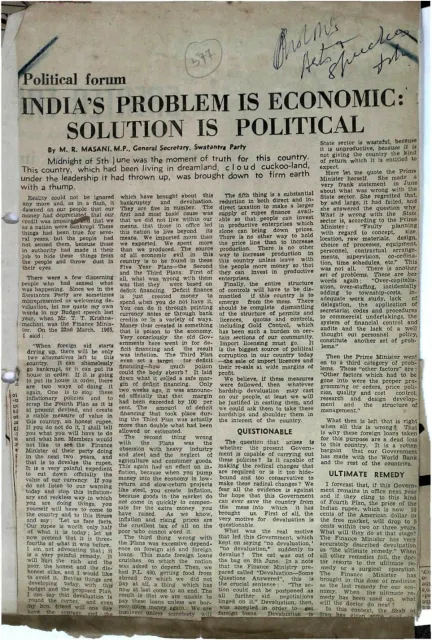
In this one-page political forum article, M. R. Masani argues that India’s economic crisis is the consequence of prolonged policy errors rather than an unavoidable national condition. He points to the June 5 devaluation, inflation, excessive dependence on foreign aid and loans, deficit financing, and the failure of successive Five-Year Plans. He also criticizes the emphasis on heavy industry at the expense of agriculture and consumer goods, as well as taxation that discourages investment and production.
Masani’s proposed remedy is political: dismantle the system of controls, licences, quotas, import restrictions, and state ownership that he believes has produced waste, overstaffing, corruption, and low productivity. He calls for an end to deficit financing, lower and more direct taxation, greater private investment, and a reorientation toward productive enterprise. The article closes by questioning whether the government is capable of making the radical changes required and warning that further devaluation and continued borrowing will deepen the crisis.
Key points
- Masani presents the June 5 devaluation as a moment when India’s underlying economic problems could no longer be concealed.
- He attributes inflation and financial instability to deficit financing, excessive taxation, and the policies of the Five-Year Plans.
- He criticizes heavy-industry planning for neglecting agriculture and consumer goods.
- He argues that dependence on foreign aid and loans has weakened India’s economic position and sovereignty.
- He advocates dismantling licences, quotas, import controls, and other restrictions that obstruct production and investment.
- He describes the state sector as wasteful and unproductive, and calls for greater scope for private enterprise.
- He questions whether the government can carry out the radical policy changes he considers necessary.
- He warns that another devaluation and continued borrowing would further reduce the value of the rupee.
Metadata and summary are AI-extracted from the source PDF and reviewed for editorial accuracy. The original work is available via the Read PDF tab above (where present); paragraph-level citation inside the PDF is deferred to a future engagement.