essay
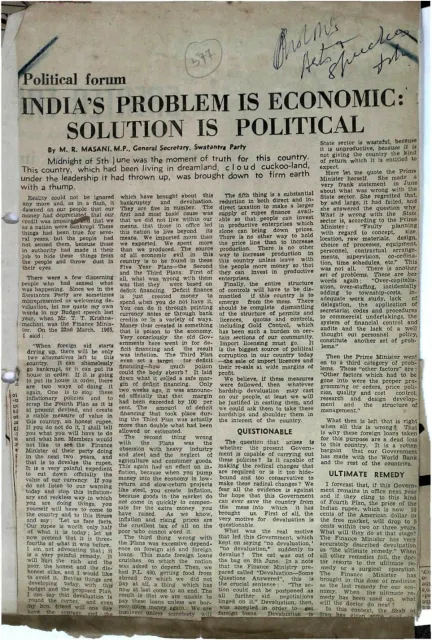
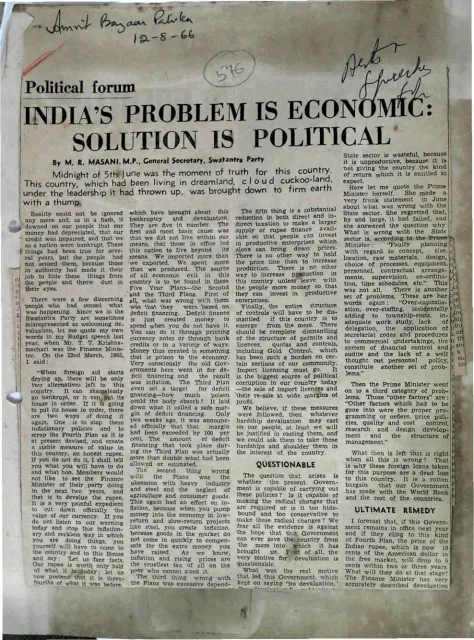
INDIA'S PROBLEM IS ECONOMIC: SOLUTION IS POLITICAL
By Minoo Masani
Amrit Bazar Patrika · 1966
1 pages
Summary
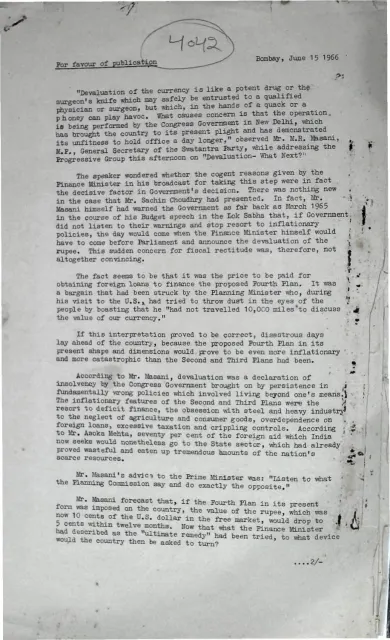
In this one-page 1966 newspaper essay, M. R. Masani argues that India’s economic crisis is the consequence of political choices rather than unavoidable circumstances. He attributes the crisis to currency depreciation, inflation, repeated deficit financing under the Second and Third Five Year Plans, excessive dependence on heavy industry at the expense of agriculture and consumer goods, and the expansion of a wasteful public sector. He presents these policies as failures of judgment by successive governments and warns that continued monetary expansion will deepen inflation and economic distress.
Masani proposes a substantially different policy direction: direct and indirect tax reduction to encourage investment, dismantling permits, licences, quotas, import controls, and gold controls, and transferring productive activity away from an inefficient state sector. He questions whether the government is willing to make the radical changes required, criticises the terms of foreign loans, and concludes that the ultimate remedy is political change. The clipping is complete as a one-page article, although its final paragraph is cut off at the bottom of the visible page.
Key points
- Masani presents India’s economic difficulties as the result of government policy and political leadership.
- He criticises deficit financing associated with the Second and Third Five Year Plans and links it to inflation.
- He argues that heavy-industry investment and neglect of agriculture and consumer goods have worsened inflationary pressures.
- He describes the state sector as wasteful and unproductive, and opposes further expansion of state control.
- He advocates reducing taxation, encouraging private investment, and dismantling permits, licences, quotas, import controls, and gold controls.
- He questions whether the government can undertake the radical changes required to restore economic stability.
- He treats political change as the necessary condition for implementing economic reform.
Metadata and summary are AI-extracted from the source PDF and reviewed for editorial accuracy. The original work is available via the Read PDF tab above (where present); paragraph-level citation inside the PDF is deferred to a future engagement.