essay · position paper
For favour of publication
Bombay · 1966
2 pages
Summary
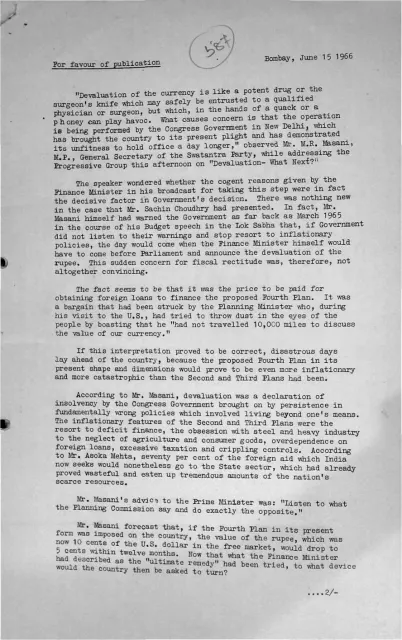
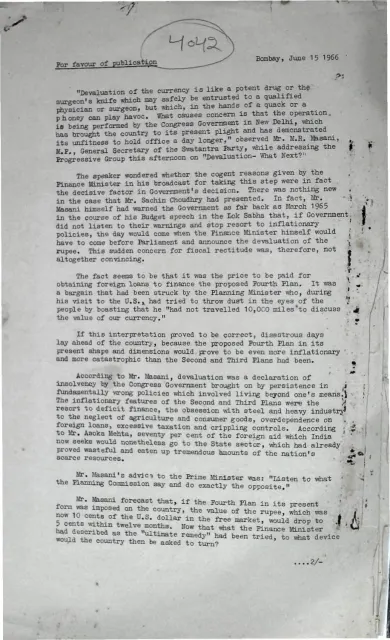
This two-page publication note, dated Bombay, June 15, 1966, reports M. R. Masani’s address to the Progressive Group on the recent devaluation of the rupee. Masani presents devaluation as a potentially dangerous instrument in the hands of an incompetent government and argues that the decision reflected the failure of the Congress Government’s inflationary policies rather than a genuinely unavoidable economic necessity. He links the crisis to deficit finance, excessive taxation and controls, neglect of agriculture and consumer goods, overinvestment in steel and heavy industry, and dependence on foreign loans to finance the proposed Fourth Plan.
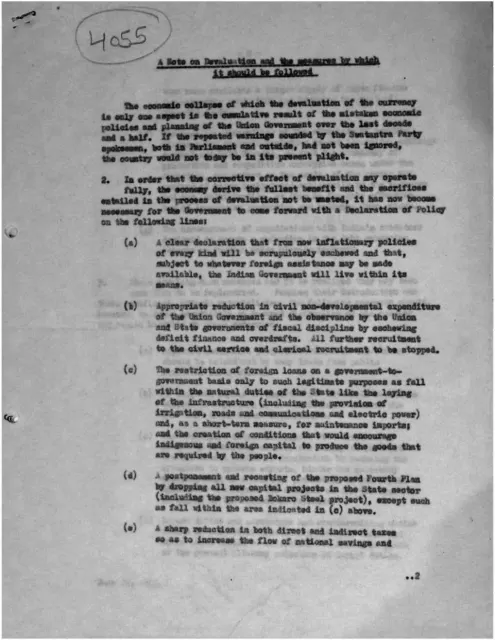
Masani argues that devaluation can be justified only if accompanied by a fundamental policy reversal. His proposed measures include reducing civil non-developmental expenditure and deficit financing, restricting government borrowing to infrastructure and emergency maintenance imports, postponing and recasting the Fourth Plan by abandoning State-sector capital projects, reducing taxation, and dismantling import licensing, exchange controls, and Gold Control in favour of competitive enterprise. He also calls for immediate relief for affected groups, including raw materials for exporters and easy loans for industrial projects stranded by devaluation. The note ends with a forecast of further depreciation if the Fourth Plan proceeds unchanged and expresses doubt that the Congress Government can implement the necessary programme.
Key points
- Masani describes devaluation as a hazardous policy instrument and questions the Finance Minister’s stated justification for it.
- The note attributes the currency crisis to inflationary planning, deficit finance, excessive taxation, industrial overinvestment, import controls, and foreign-loan dependence.
- The proposed Fourth Plan is presented as likely to intensify inflation unless it is postponed and substantially recast.
- Immediate relief measures include supplying raw materials to exporters, financing stranded industrial projects, and abolishing import duties on key inputs.
- Long-term remedies include expenditure cuts, limits on government borrowing, lower taxation, and dismantling import licensing, exchange controls, and Gold Control.
- Masani forecasts that the rupee could fall from ten cents to five cents against the U.S. dollar within twelve months if the Fourth Plan remains unchanged.
- The note questions whether the Congress Government possesses the integrity, courage, or capability to carry out the required reforms.
Metadata and summary are AI-extracted from the source PDF and reviewed for editorial accuracy. The original work is available via the Read PDF tab above (where present); paragraph-level citation inside the PDF is deferred to a future engagement.