Summary
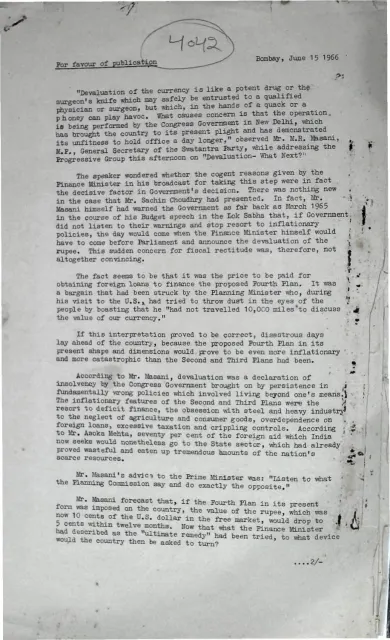
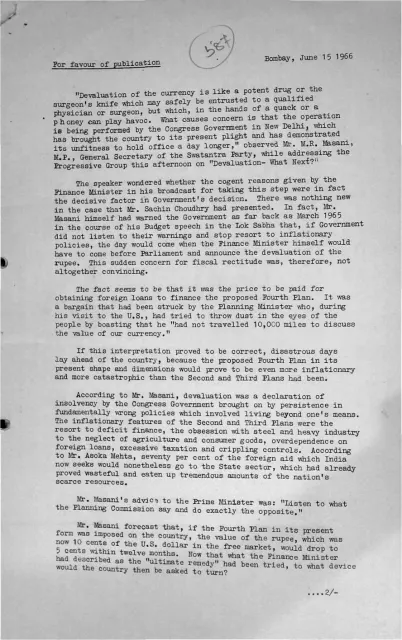
This two-page statement, prepared “For favour of publication” in Bombay on June 15, 1966, reports M. R. Masani’s criticism of the Congress Government’s decision to devalue the rupee. Masani argues that the Finance Minister’s stated reasons were unconvincing and that devaluation was effectively the price of foreign loans needed to finance the proposed Fourth Plan. He warns that the Plan’s existing form would intensify inflation and produce consequences more damaging than those of the Second and Third Plans. The statement attributes India’s economic crisis to deficit finance, excessive taxation and controls, overinvestment in heavy industry, neglect of agriculture and consumer goods, and dependence on foreign loans.
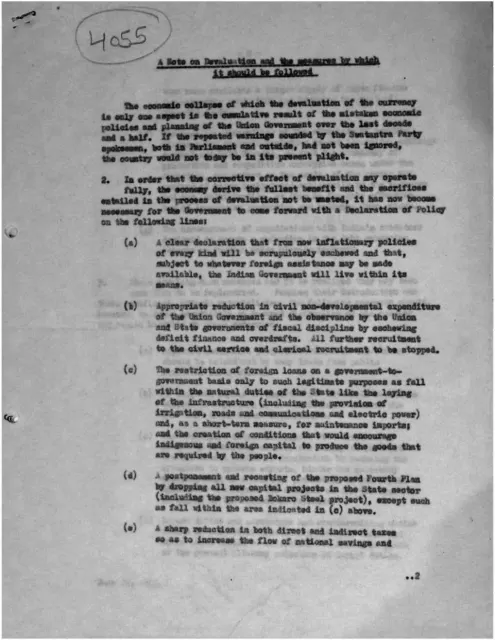
Masani proposes immediate relief for affected groups and exporters, loans for industrial projects stranded by devaluation, and the abolition of import duties and countervailing excise duties on essential inputs. His longer-term programme calls for reduced non-developmental expenditure, an end to deficit finance and overdrafts, limits on government borrowing, postponement and recasting of the Fourth Plan, lower taxation, and dismantling import licensing, exchange controls, and Gold Control. He maintains that devaluation would be justified only if accompanied by these measures, while doubting whether the Congress Government possessed the integrity, courage, and capacity to implement them.
Key points
- Masani describes devaluation as a potentially dangerous instrument when used by an unqualified government.
- He rejects the Finance Minister’s public justification for devaluation and links it to foreign borrowing for the Fourth Plan.
- The statement attributes inflation and insolvency to deficit finance, heavy-industry spending, excessive controls, and neglect of agriculture and consumer goods.
- Masani predicts that the Fourth Plan, in its proposed form, would be more inflationary and catastrophic than the preceding plans.
- Immediate remedies include assistance to affected groups, supplies for non-traditional exporters, loans for stranded industrial projects, and removal of duties on key inputs.
- Long-term remedies include spending cuts, restrictions on government loans, recasting the Fourth Plan, tax reduction, and economic deregulation.
- The statement concludes by questioning the Congress Government’s integrity and capacity to carry out the required reforms.
Metadata and summary are AI-extracted from the source PDF and reviewed for editorial accuracy. The original work is available via the Read PDF tab above (where present); paragraph-level citation inside the PDF is deferred to a future engagement.