speech · parliamentary
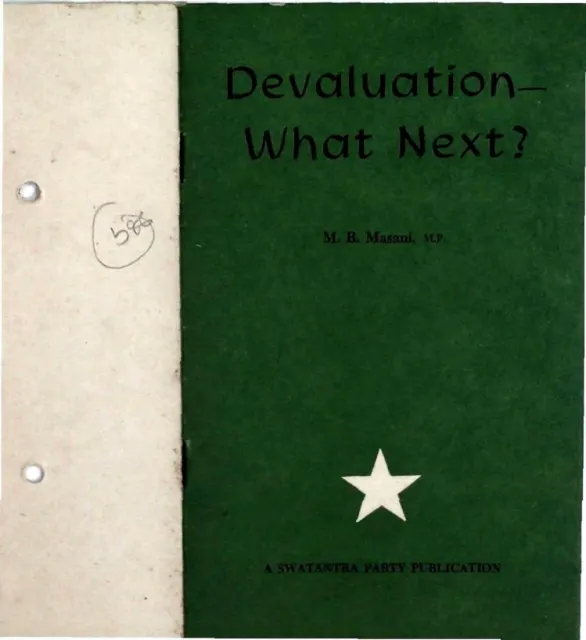
Devaluation—What Next?
By Minoo Masani
Printed by S. R. Krishnan at Inland Printers, 55 Gamdevi Road, Bombay 7 and published by S. V. Raju for the Swatantra Party, Central Office, 143 Mahatma Gandhi Road, Bombay 1. · Bombay · 1966
12 pages
Summary
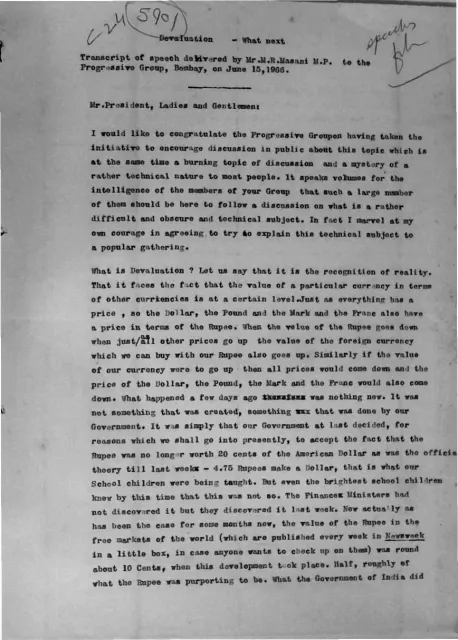
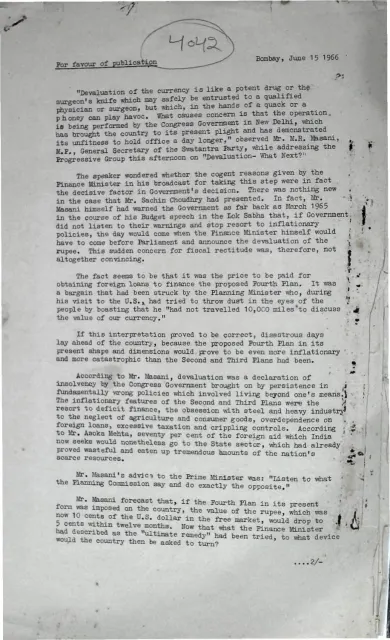
In this speech, delivered to the Progressive Group in Bombay on 15 June 1966, M. R. Masani explains devaluation as a recognition that the rupee had already lost value in international markets. He distinguishes the official claim that the rupee was devalued by 36.5 per cent from the roughly 57.5 per cent increase in the rupee cost of foreign currency. Masani argues that the policy was presented as a necessary response to inflation, declining exports, exhausted foreign-exchange reserves, and the loss of tourist earnings, but contends that these conditions resulted from earlier government policies.
Masani’s central criticism is that devaluation was less a carefully chosen economic remedy than a bargain made to secure foreign aid and preserve the Fourth Five-Year Plan. He compares the country to an insolvent debtor and attacks the Second, Third, and proposed Fourth Plans for excessive emphasis on heavy industry, deficit financing, foreign borrowing, public-sector waste, taxation, and pervasive controls. In place of the existing policy, he calls for fiscal restraint, reduced taxation, selective imports of essential raw materials and maintenance equipment, postponement or recasting of the Fourth Plan, and the dismantling of import licensing and foreign-exchange controls. He closes by warning that without such changes the rupee could fall further and that economic failure might ultimately require a change of government.
Key points
- Devaluation is presented as an official acknowledgment of the rupee’s prior loss of value rather than an entirely new economic event.
- Masani distinguishes the rupee’s 36.5 per cent official devaluation from the 57.5 per cent rise in the rupee price of foreign currencies.
- He attributes inflation, weak exports, depleted reserves, and distorted foreign-exchange earnings to earlier government policies.
- He argues that devaluation was tied to negotiations for foreign loans and aid and was intended partly to preserve the Fourth Five-Year Plan.
- The Second and Third Plans are criticized for Stalinist-style emphasis on heavy industry, excessive deficit financing, foreign debt, and bureaucratic controls.
- Masani recommends immediate relief for exporters and importers, including access to raw materials, machinery, and maintenance imports.
- His longer-term programme calls for living within the country’s means, cutting taxation and public expenditure, revising the Fourth Plan, and dismantling exchange controls.
- The speech ends with the warning that continued policy failure could reduce the rupee to five U.S. cents and produce a political crisis.
Metadata and summary are AI-extracted from the source PDF and reviewed for editorial accuracy. The original work is available via the Read PDF tab above (where present); paragraph-level citation inside the PDF is deferred to a future engagement.