Summary
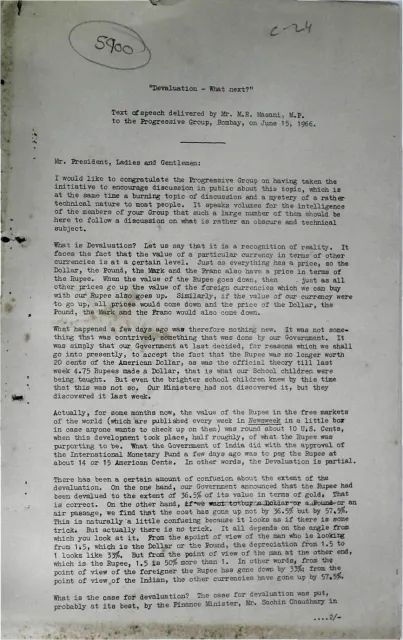
In this speech to the Progressive Group in Bombay on June 15, 1966, Minoo Masani explains devaluation as an official recognition of the rupee’s diminished value rather than the creation of a new economic reality. He distinguishes between the government’s statement that the rupee had lost 36.5 percent of its value in gold terms and the approximately 57.5 percent increase in the rupee cost of foreign currencies when measured from the Indian standpoint. Masani attributes the crisis to inflation, an unrealistic official exchange rate, the diversion of tourists’ foreign exchange into informal markets, declining exports, depleted reserves, and mounting foreign obligations. He argues that ordinary citizens, students, travellers, exporters, and businesses bear the costs of government mismanagement.
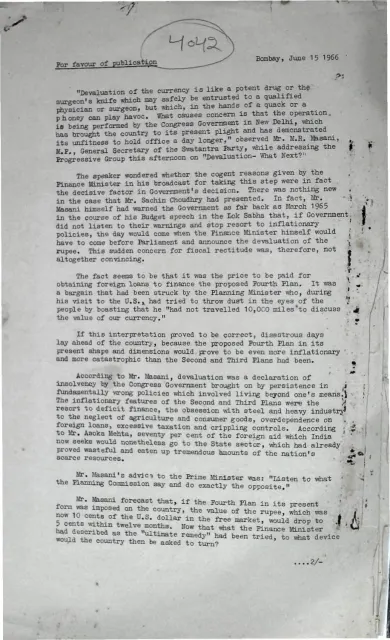
Masani rejects the Finance Minister’s account of devaluation as a sufficient corrective and portrays the measure as part of a bargain linking foreign aid to the preservation of the Fourth Five Year Plan. His central criticism is directed at India’s planning model: deficit finance, heavy-industry priorities, excessive foreign borrowing, over-taxation, state enterprise, and pervasive controls. He calls for living within the country’s means, abandoning inflationary finance, recasting the Fourth Plan, reducing taxation, limiting government borrowing to infrastructure and essential maintenance imports, and dismantling import licensing and foreign-exchange controls. He accepts devaluation as an unavoidable remedy but warns that its results depend on the competence and integrity of those administering it. The speech closes with immediate relief proposals for exporters and industrial projects, followed by the warning that continued mismanagement could force another devaluation and perhaps a change of government.
Key points
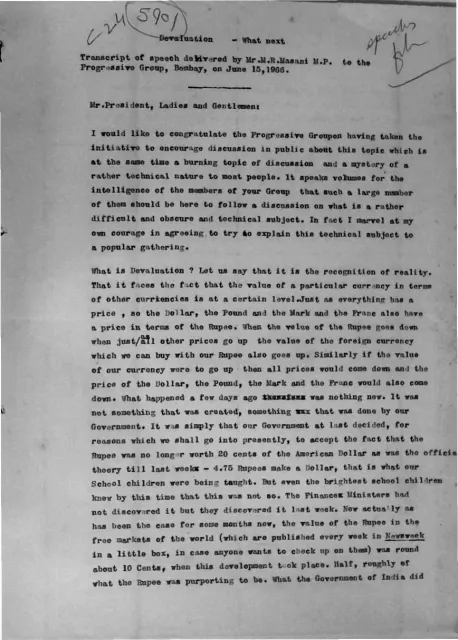
- Masani defines devaluation as recognition of the rupee’s actual value against foreign currencies.
- He explains the difference between the government’s 36.5 percent devaluation figure and the roughly 57.5 percent rise in foreign-currency costs.
- He links the crisis to inflation, unrealistic exchange controls, declining exports, depleted reserves, and unsustainable foreign obligations.
- He argues that devaluation imposes disproportionate hardships on people who did not create the underlying economic problems.
- He presents the measure as connected to foreign-aid negotiations and the preservation of the Fourth Five Year Plan.
- He criticises planning based on deficit finance, heavy industry, state enterprise, foreign borrowing, taxation, and bureaucratic controls.
- He recommends fiscal restraint, a smaller and revised Fourth Plan, tax reductions, infrastructure-focused borrowing, and the abolition of import licensing and foreign-exchange controls.
- He proposes immediate relief for exporters and industrial projects affected by the increased rupee cost of imported inputs and machinery.
Metadata and summary are AI-extracted from the source PDF and reviewed for editorial accuracy. The original work is available via the Read PDF tab above (where present); paragraph-level citation inside the PDF is deferred to a future engagement.