speech · convention address
Devaluation - What next?
Bombay · 1966
10 pages
Summary
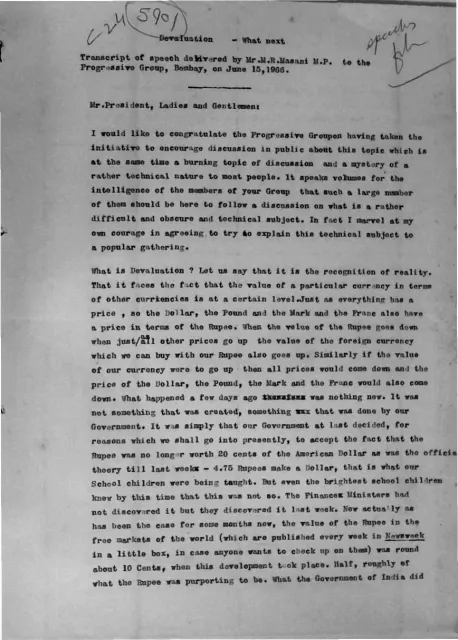
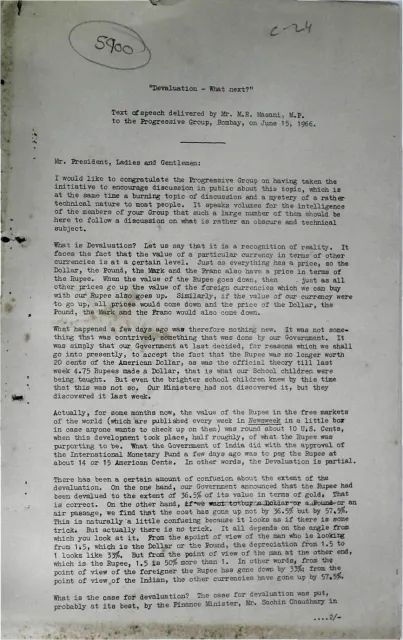
In this speech delivered to the Progressive Group in Bombay on June 15, 1966, M. R. Masani presents devaluation as an unavoidable recognition that the rupee had already lost value in the free market. He explains the difference between the official exchange rate and market reality, argues that the 36.5 per cent reduction measured against gold understates the rupee’s fall against foreign currencies, and reviews the Finance Minister Sachin Chaudhury’s stated reasons: distorted exchange practices, lost tourist income, uncompetitive exports, depleted reserves, and mounting external obligations.
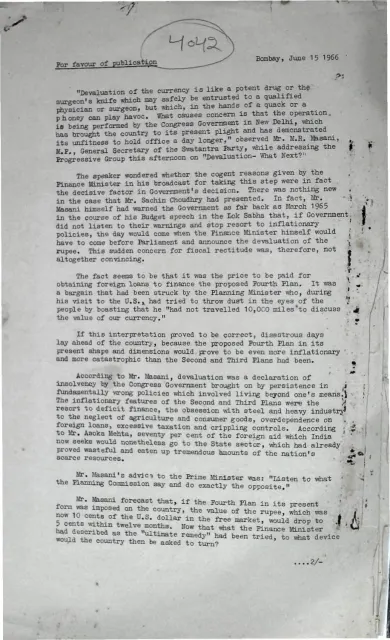
Masani accepts that devaluation may correct some distortions but stresses its unequal social costs, especially for students, travellers, patients, and businesses committed to foreign purchases. He characterises the policy as a form of national bankruptcy and challenges the Government’s public explanation, arguing instead that devaluation was a bargain struck to secure foreign aid and preserve the Fourth Five-Year Plan. The speech attacks deficit financing, excessive taxation, state enterprise, import licensing, foreign-exchange controls, and planning priorities, while proposing immediate relief for exporters and industrial projects and a broader shift toward balanced budgets, reduced controls, private investment, maintenance imports, infrastructure, and greater economic discipline. It concludes that without such reforms India may face another collapse and possibly a change of government.
Key points
- Devaluation is presented as an acknowledgement of the rupee’s actual market value rather than a wholly new economic event.
- Masani distinguishes the rupee’s fall against gold from the larger change in its value relative to the dollar, pound, mark, and franc.
- He reviews the Finance Minister’s arguments concerning tourist exchange, export competitiveness, depleted reserves, and foreign obligations.
- The speech argues that innocent citizens bear serious and unequal hardships as a result of devaluation.
- Masani contends that the immediate policy was driven by negotiations for foreign aid and by the desire to preserve the Fourth Five-Year Plan.
- He criticises deficit financing, Stalinist-style planning, heavy industry priorities, state enterprise, over-taxation, and extensive economic controls.
- His proposed remedies include exporter relief, easier financing for affected industrial projects, abolition of duties on essential inputs, reduced taxation, postponement and recasting of the Fourth Plan, and dismantling import and exchange controls.
- The speech links economic recovery to living within the country’s means and warns that another devaluation could produce collapse and political change.
Metadata and summary are AI-extracted from the source PDF and reviewed for editorial accuracy. The original work is available via the Read PDF tab above (where present); paragraph-level citation inside the PDF is deferred to a future engagement.