essay
REFLECTION ON REPUBLIC DAY, 1968
1968
4 pages
Summary
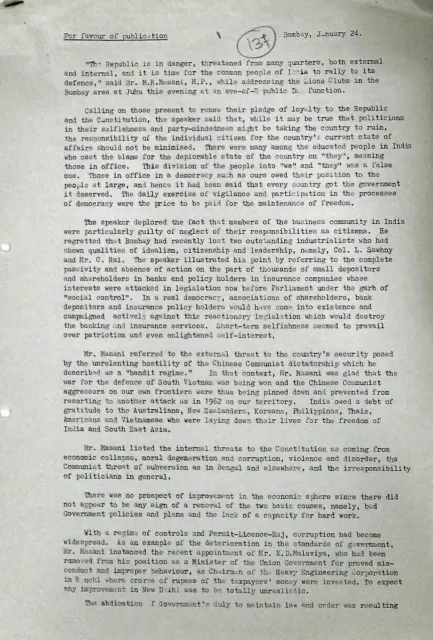
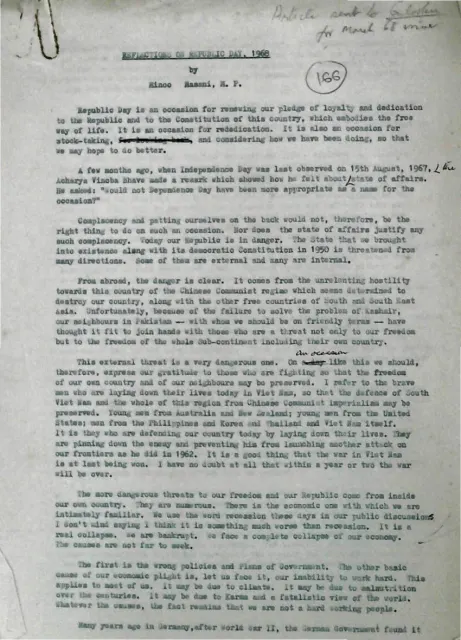
In this four-page Republic Day reflection, Minoo Masani treats the occasion as a prompt for renewed constitutional loyalty, rededication, and national self-criticism rather than complacent celebration. He identifies threats to India’s democratic Constitution from abroad—especially Chinese hostility and the unresolved Kashmir question—as well as from within: economic decline, corruption, violence, administrative failure, and political parties that place factional interests above the country. He argues that the state must protect citizens’ lives, property, and security, while citizens must resist passivity and participate actively in defending freedom.
Masani links political liberty to discipline and civic responsibility, invoking Mahatma Gandhi’s view that discipline and freedom are complementary. He criticizes the Congress Party but also argues that non-Congress governments have not demonstrated a clear alternative, leaving a political vacuum that could be exploited by Communists or authoritarian forces. The essay closes with an appeal to India’s educated, business, industrial, professional, and working citizens to abandon passivity and lead a renewal of public spirit. Its economic argument attributes national decline both to mistaken government policies and to inadequate willingness to work hard, while its defense of democracy draws on Winston Churchill’s formulation that democracy is the worst form of government except all the others.
Key points
- Republic Day should renew loyalty to the Republic and Constitution rather than encourage complacency.
- Masani presents Chinese hostility and the Kashmir issue as major external threats to Indian freedom and regional security.
- He condemns corruption, violence, administrative abdication, and the failure of governments to protect citizens.
- The essay connects freedom with discipline, drawing on Mahatma Gandhi and Vinoba Bhave.
- Masani criticizes both Congress factionalism and the weak performance of non-Congress governments.
- He warns that political vacuums may enable Communist or military-authoritarian rule.
- Economic decline is attributed to poor government policies and a broader failure to work hard.
- The educated, business, industrial, and professional classes are urged to take public responsibility and oppose passivity.
Metadata and summary are AI-extracted from the source PDF and reviewed for editorial accuracy. The original work is available via the Read PDF tab above (where present); paragraph-level citation inside the PDF is deferred to a future engagement.