letter
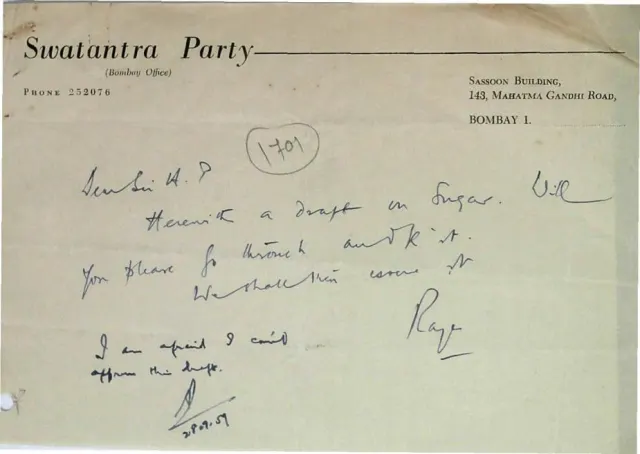
Letter to A P
Swatantra Party (Bombay Office) · Bombay · 1959
3 pages
Summary
This undated-title draft letter, prepared on Swatantra Party (Bombay Office) letterhead and signed “Ranga” on 28 September 1959, argues that Bombay’s sugar crisis was produced by administrative failure rather than an actual national shortage. It criticizes the government’s brief experiment with rationing, noting that the measure imposed unnecessary hardships before officials allowed sugar sales in the free market. The draft attributes the city’s shortages to inefficient release orders issued to sugar manufacturers and inadequate transport to bring sugar to market.
The letter broadens its criticism from sugar administration to economic policy. It argues that rumours of scarcity encourage hoarding, high prices, and public fear, while bureaucratic controls increase government power and create opportunities for corruption. It links sugar prices to food-grain prices and blames inflationary monetary policy for putting more money into circulation without corresponding increases in production. The proposed remedy is timely imports and the maintenance of large buffer stocks, rather than improvised rationing and controls.
Key points
- The draft rejects rationing as an effective solution to Bombay’s sugar shortage.
- It claims that the country produced slightly more than 19 lakh tons of sugar in the 1958–59 season and held a carry-over stock of 3,20,000 tons.
- It attributes Bombay’s shortage to inefficient government release orders and inadequate transport facilities.
- It argues that rumours of scarcity lead to hoarding, high prices, and public panic.
- It connects sugar prices with food-grain prices and criticizes inflationary monetary policy.
- It recommends timely imports and large buffer stocks to manage food-grain prices.
- It presents bureaucratic controls as a source of increased political power and corruption.
Metadata and summary are AI-extracted from the source PDF and reviewed for editorial accuracy. The original work is available via the Read PDF tab above (where present); paragraph-level citation inside the PDF is deferred to a future engagement.