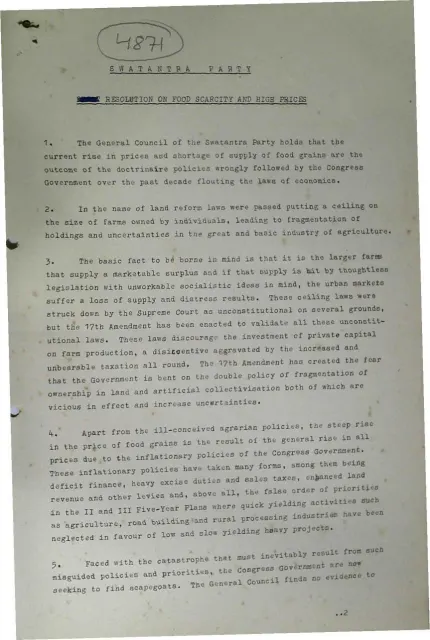
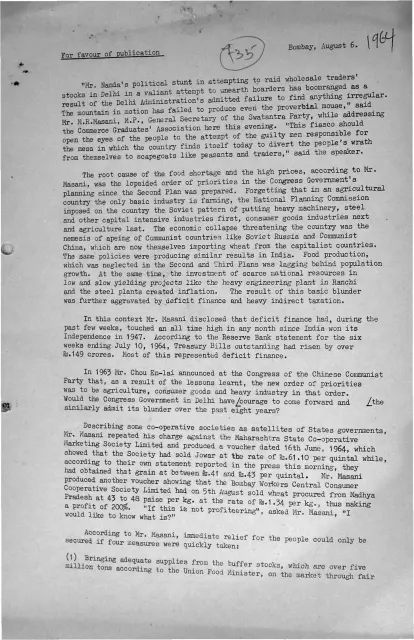
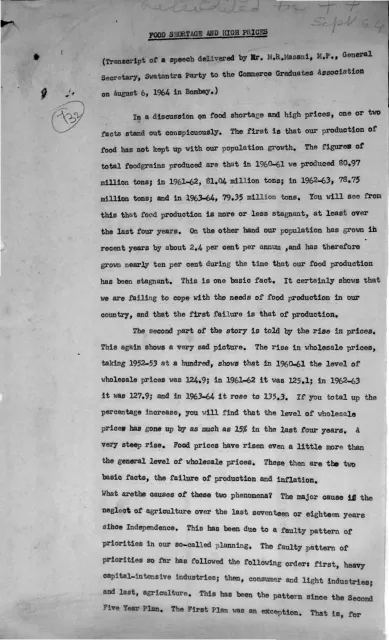
speech · convention address
Food Shortage and High Prices
Bombay · 1964
19 pages
Summary
In this transcript of a speech delivered in Bombay on 6 August 1964, M. R. Masani attributes India’s food shortage and high prices primarily to stagnant food production, rapid population growth, inflation, and a planning system that has placed heavy industry before agriculture. He argues that the figures for foodgrain production had remained broadly stagnant while population grew by roughly 2.4 per cent annually, and that wholesale prices had risen by about 15 per cent over four years. The speech treats the resulting crisis as a failure of production aggravated by inflationary public expenditure.
Masani sharply criticises the Planning Commission’s preference for steel, machinery, and other capital-intensive projects, citing losses at Hindustan Steel and the delayed returns from heavy industry. He also attacks deficit finance, state-controlled cooperatives, compulsory procurement, grain controls, and zonal restrictions, arguing that these policies burden peasants and create opportunities for profiteering. His proposed remedies are to redirect development expenditure toward land, irrigation, fertilisers, seeds, roads, credit, and floor prices; release government buffer stocks; abolish zonal restrictions; stop food exports temporarily; and move away from the existing planning framework. The transcript closes by calling for public opinion to assert itself against what Masani describes as inherited statist and socialist policies.
Key points
- Foodgrain production is presented as stagnant while population growth has increased demand.
- Masani links high prices to both production failure and inflation caused by excessive monetary expansion and deficit finance.
- The speech blames planning priorities that favour heavy industry and steel over agriculture.
- Hindustan Steel and other capital-intensive projects are cited as examples of wasteful public investment and delayed returns.
- Masani criticises government-backed cooperatives, compulsory procurement, state trading, and zonal restrictions as sources of consumer exploitation and political patronage.
- The speech defends the peasant’s right to retain grain when official prices do not cover rising living costs.
- Short-term remedies proposed include releasing buffer stocks, removing zonal restrictions, decontrol, and suspending food exports.
- The long-term remedy is agricultural rehabilitation and a fundamental change, or abolition, of the existing planning system.
Metadata and summary are AI-extracted from the source PDF and reviewed for editorial accuracy. The original work is available via the Read PDF tab above (where present); paragraph-level citation inside the PDF is deferred to a future engagement.