Summary
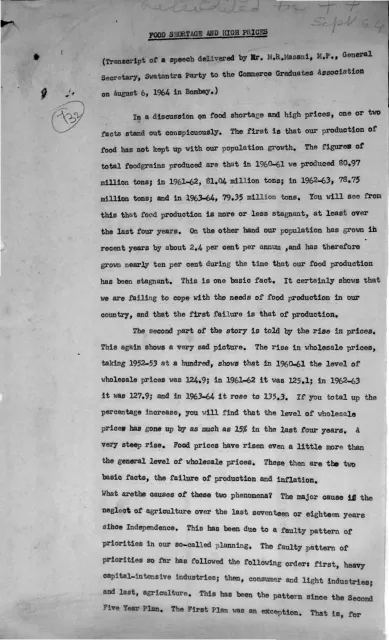
In the rendered page, Minoo Masani identifies two linked features of India’s food crisis: food production has stagnated while population has continued to grow, and prices have risen sharply. He cites foodgrain production figures declining from 80.97 million tons in 1960–61 to 79.35 million tons in 1963–64, alongside population growth of approximately 2.4 per cent annually. Wholesale prices, using 1952–53 as the base year, rose from 124.9 in 1960–61 to 135.3 in 1963–64, an increase of about 15 per cent.
In the rendered page, Masani attributes these problems primarily to the neglect of agriculture since Independence and to what he calls a faulty pattern of planning priorities. He describes the sequence as heavy capital-intensive industries first, consumer and light industries next, and agriculture last, while noting that the First Five Year Plan was an exception. The supplied page ends as he begins to discuss that exception; the remainder of the speech is not visible.
Key points
- The speech links food shortage to stagnant foodgrain production and rapid population growth.
- Foodgrain output is reported as 80.97 million tons in 1960–61, 81.04 million in 1961–62, 78.75 million in 1962–63, and 79.35 million in 1963–64.
- Population growth is given as approximately 2.4 per cent per year, or nearly 10 per cent over the period discussed.
- Wholesale prices rose from 124.9 in 1960–61 to 135.3 in 1963–64, with 1952–53 as the base year.
- Masani presents production failure and inflation as the two basic facts behind the crisis.
- He attributes the crisis chiefly to the neglect of agriculture since Independence.
- He criticizes planning priorities that placed heavy capital-intensive industry before consumer and light industry, with agriculture last.
- The page ends at the beginning of a qualification concerning the First Five Year Plan.
Metadata and summary are AI-extracted from the source PDF and reviewed for editorial accuracy. The original work is available via the Read PDF tab above (where present); paragraph-level citation inside the PDF is deferred to a future engagement.