
essay
THE THIRD PLAN: AN ALTERNATIVE
1963
4 pages
Summary
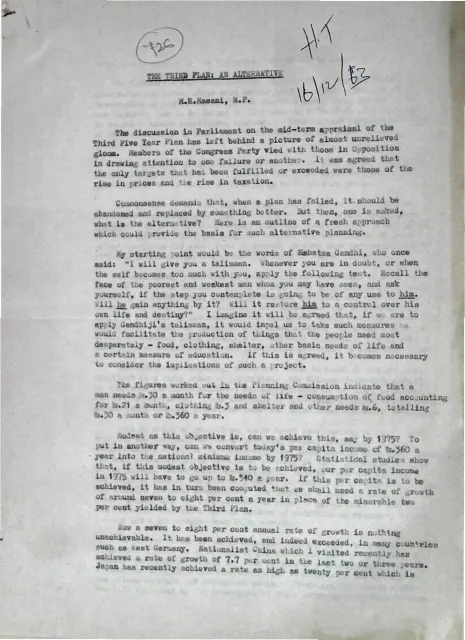
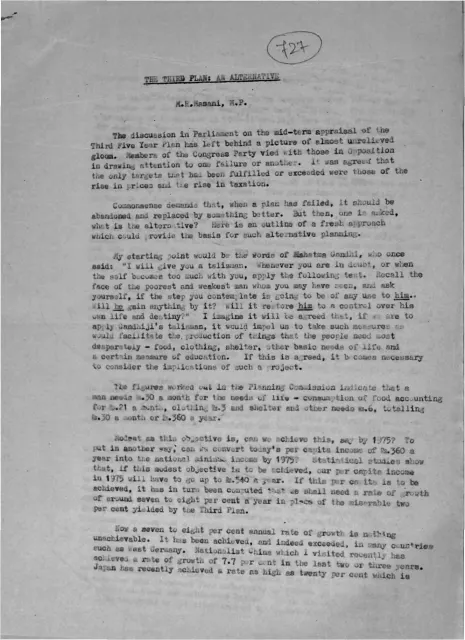
In the rendered pages, H. R. Masani argues that the Third Five Year Plan has failed and should be replaced by an alternative approach to planning. He begins from Mahatma Gandhi’s “talisman,” using the needs of the poorest person as the test for policy. The paper translates that test into concrete targets: adequate food, clothing, shelter, basic needs, and education. It cites Planning Commission figures for the required increase in per-capita income, food-grain consumption, and cloth consumption, and contends that achieving these goals would require annual economic growth of roughly seven to eight per cent rather than the Third Plan’s two per cent.
Key points
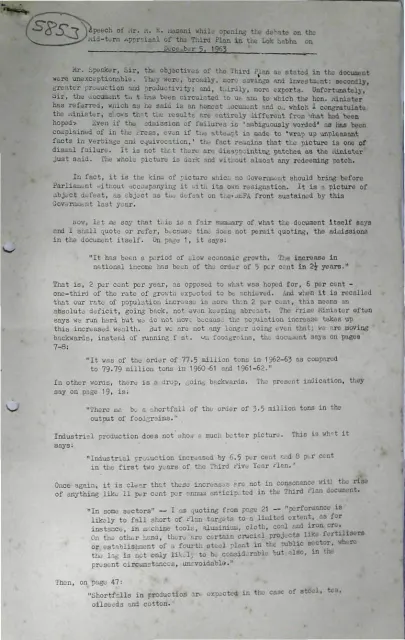
- The Third Five Year Plan is presented as having failed, with its only fulfilled or exceeded targets being price and taxation increases.
- Gandhi’s test of judging policy by its effect on the poorest person supplies the paper’s ethical and political starting point.
- Masani identifies food, clothing, shelter, other basic needs, and education as the immediate priorities of planning.
- The paper estimates that per-capita income would need to rise from Rs. 360 a year to Rs. 540 by 1975, requiring annual growth of seven to eight per cent.
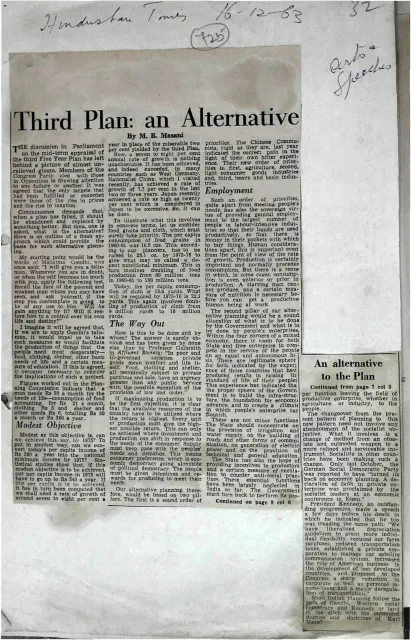
- It argues that food-grain production would need to double from 80 million tons in 1960–61 to 160 million tons by 1975–76, while cloth production would need to rise from 9 million yards to 18 million yards.
- The proposed alternative rests on a hierarchy of priorities: agriculture first, light consumer-goods industries second, and heavy and basic industries third.
- The state should concentrate on infrastructure, irrigation, water supply, communications, power, education, incentives, and regulation against anti-social practices, while leaving productive enterprise to the people.
- The paper presents consumer preference, incentives, and competition between state and private enterprise as compatible with the socialist objective but preferable to obsolete centralized planning.
Metadata and summary are AI-extracted from the source PDF and reviewed for editorial accuracy. The original work is available via the Read PDF tab above (where present); paragraph-level citation inside the PDF is deferred to a future engagement.
Related across the archive
 Primary workTHE THIRD PLAN: AN ALTERNATIVE
 Primary workThird Plan: an Alternative
 Primary workSpeech of Mr. M. R. Masani while opening the debate on the mid-term appraisal of the Third Plan in the Lok Sabha on December 5, 1963
 ExcerptFifteen Years of Indian Planning
 ThePrintSocialist planners aggravated unemployment problem