
Summary
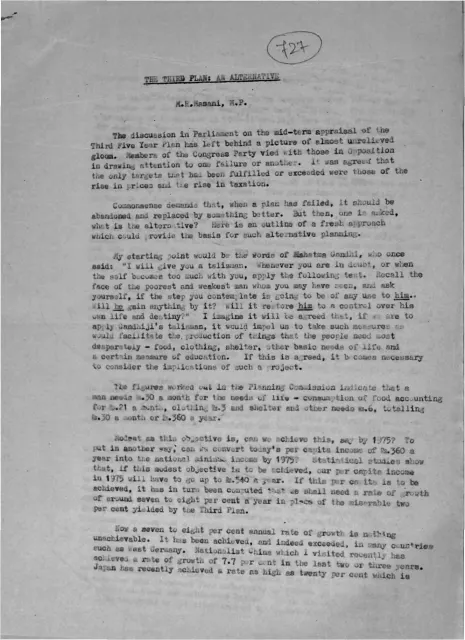
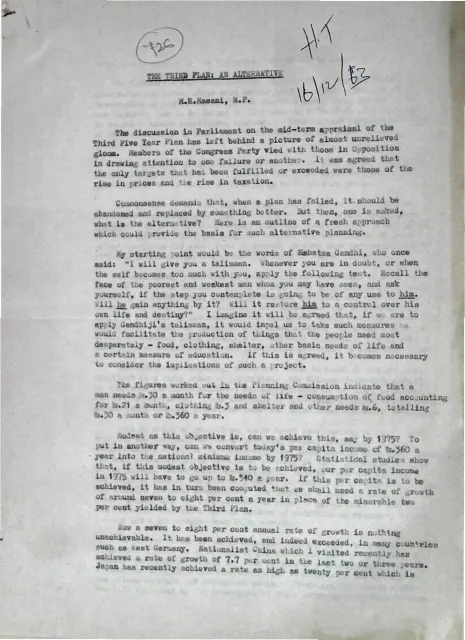
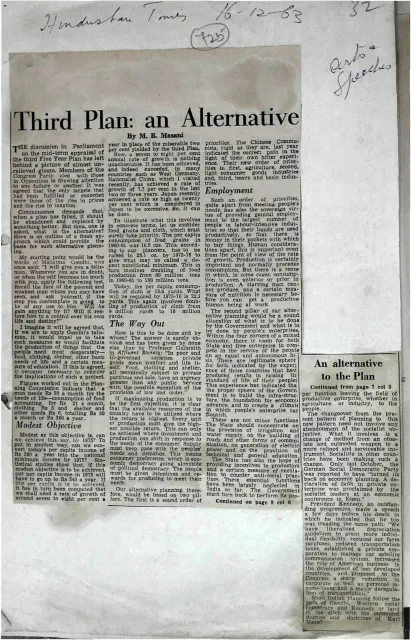
M. R. Masani argues that the Third Five Year Plan has failed and should be replaced by an alternative form of planning rather than simply abandoned. Using Mahatma Gandhi’s test of judging policy by its effect on the poorest and weakest person, he defines the immediate objective as ensuring food, clothing, shelter and basic education. He contends that meeting this minimum would require a substantial increase in per-capita income and an annual growth rate of roughly 7–8 per cent, which he presents as demanding but achievable in light of post-war examples from West Germany, China and Japan.
The alternative rests on two pillars: a clear order of priorities and a division of responsibilities between government and private enterprise. Agriculture should come first, followed by consumer-goods industries and then heavy and basic industries. The state should concentrate on irrigation, water supply, roads, communications, electricity, education, production incentives and limited regulation against anti-social practices, while allowing enterprise and consumer demand to guide production. Masani presents this as a mixed-economy approach compatible with the socialist objective of raising living standards, and closes by contrasting the proposed path with the planning doctrines associated with Gandhi, Western social democracy, John F. Kennedy and Karl Marx.
Key points
- Masani describes the Third Five Year Plan as having failed, with price rises and taxation among the few targets fulfilled or exceeded.
- He applies Gandhi’s poorest-person test to planning and identifies food, clothing, shelter and education as basic priorities.
- He calculates that the minimum objective would require higher per-capita income and annual growth of approximately 7–8 per cent.
- He argues that food-grain and cloth production would need to rise dramatically to meet projected 1975–76 consumption levels.
- The proposed priority order is agriculture, consumer-goods industries, and finally heavy and basic industries.
- Masani advocates consumer preference, private enterprise and production incentives within a mixed economy.
- Government should focus on infrastructure, education, incentives and essential regulation rather than displacing productive enterprise.
- The essay frames this approach as a revision of planning methods rather than abandonment of the socialist objective.
Metadata and summary are AI-extracted from the source PDF and reviewed for editorial accuracy. The original work is available via the Read PDF tab above (where present); paragraph-level citation inside the PDF is deferred to a future engagement.
People in this work
Related across the archive
 Primary workTHE THIRD PLAN: AN ALTERNATIVE
 Primary workThird Plan: an Alternative
 Primary workSpeech of Mr. M. R. Masani while opening the debate on the mid-term appraisal of the Third Plan in the Lok Sabha on December 5, 1963
 ThePrintSocialist planners aggravated unemployment problem
 ExcerptFifteen Years of Indian Planning