speech
Speech of Mr. M. R. Masani while opening the debate on the mid-term appraisal of the Third Plan in the Lok Sabha on December 5, 1963
By Minoo Masani
1963
8 pages
Summary
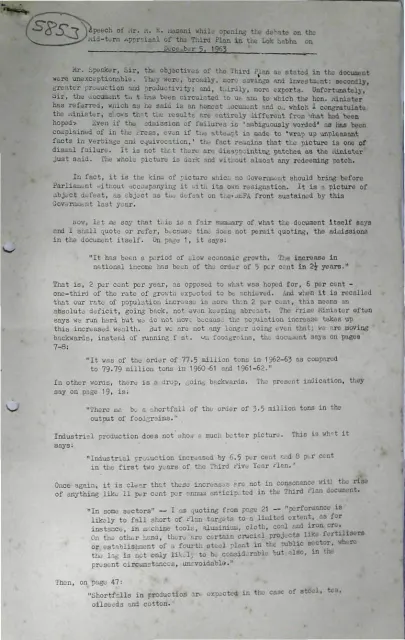
In this speech opening the Lok Sabha debate on the mid-term appraisal of the Third Five-Year Plan, Minoo Masani argues that the Plan has produced a “dismal failure” rather than the promised savings, investment, production, productivity, and exports. He cites the official appraisal’s figures to show slow economic growth, falling food-grain output, shortfalls in steel, aluminium, machine tools, fertilizers, and employment, alongside rising prices and taxation. Masani treats the government’s own admissions as evidence that the problem is not merely defective implementation: the Plan itself is “wrong-minded,” built against economic realities and sustained by excessive intervention and state direction.
Masani attacks the Planning Commission as a parallel government and calls for the Plan to be scrapped. In its place, he proposes a reordering of priorities around food, clothing, shelter, basic education, nutrition, and productive employment. His alternative retains a limited role for the state—building infrastructure, irrigation, water supply, power, roads, communications, and education—while rejecting state capitalism, bureaucratic monopolies, and the state’s direct manufacture of goods that private enterprise can supply. He invokes Mahatma Gandhi’s “talisman,” John Kenneth Galbraith’s warning against excessive emphasis on growth, the German Social Democratic Party’s turn away from centralized economic planning, and John F. Kennedy’s account of economic liberalization. The speech closes with a warning that public patience and faith in parliamentary democracy are being exhausted.
Key points
- Masani uses the Third Plan’s official mid-term appraisal to document low growth and shortfalls in agriculture, industry, employment, and investment targets.
- He emphasizes that food-grain production is declining and that the Plan is failing to meet basic economic needs.
- He argues that rising prices and increased taxation are among the only measurable areas in which the government has exceeded expectations.
- He criticizes the Planning Commission for duplicating government functions and operating as a parallel authority outside ordinary democratic accountability.
- He calls for immediate priorities to be food, clothing, shelter, nutrition, education, and productive employment.
- He advocates a mixed economy in which the state provides infrastructure and minimum regulation while private enterprise supplies consumer goods and services.
- He presents the rejection of state capitalism as compatible with, rather than opposed to, the socialist objective of a more prosperous and equitable society.
- He warns that public frustration may develop into political desperation and weaken confidence in parliamentary democracy.
Metadata and summary are AI-extracted from the source PDF and reviewed for editorial accuracy. The original work is available via the Read PDF tab above (where present); paragraph-level citation inside the PDF is deferred to a future engagement.