
speech
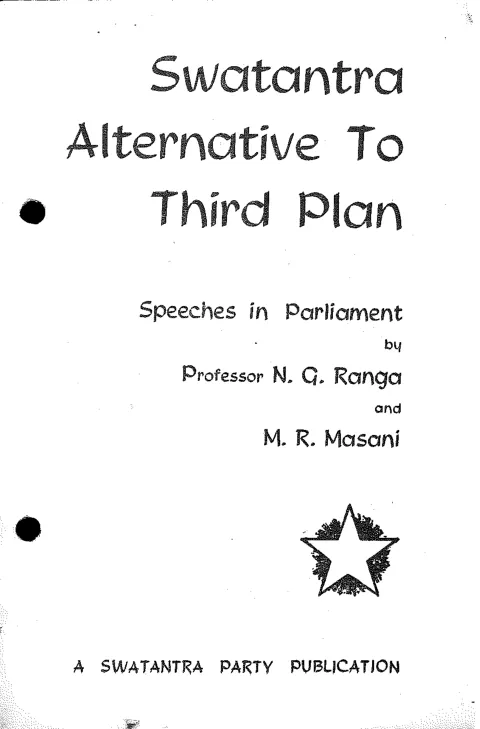
Swatantra Alternative to the Third Plan
Speeches in Parliament
By Acharya N. G. Ranga, Minoo Masani
Swatantra Party · Bombay · 1963
17 pages
Part of Swatantra Party
Swatantra Alternative to the Third Plan
By Prof. N. G. Ranga and M. R. Masani (Swatantra Party) — Speeches in Parliament
Summary
Swatantra Alternative to the Third Plan is a Swatantra Party pamphlet collecting speeches delivered in the Lok Sabha by M. R. Masani (5 December 1963) and Professor N. G. Ranga (11 December 1963) during the debate on the mid-term appraisal of the Third Five Year Plan, together with the substitute motion Ranga had moved against the Plan in August 1960. Issued to answer the charge that the party had “no alternative to the current pattern of planning,” it presents the Swatantra case that the Plan had failed and that a wholly different economic approach was needed.
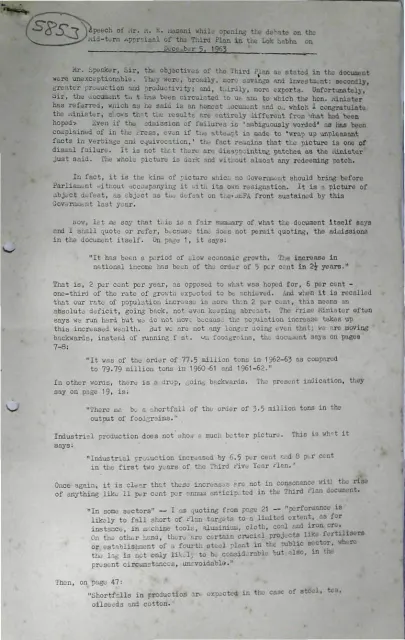
Opening the debate, Masani reads the Government’s own appraisal document as an honest confession of “dismal failure”: national income had risen only about 2 per cent a year against a hoped-for 6 per cent — below the rate of population growth, so that the country was moving backwards — with foodgrain output falling and shortfalls admitted in steel, aluminium, machine tools and fertilisers. The only two things the Plan had raised, he says, were prices and taxes. He argues the Plan should be scrapped because the whole approach, not merely its implementation, is “wrong-minded,” and attacks the Planning Commission as a “Moscow Gosplan” and parallel government that has no place in a democracy and should be purely advisory.
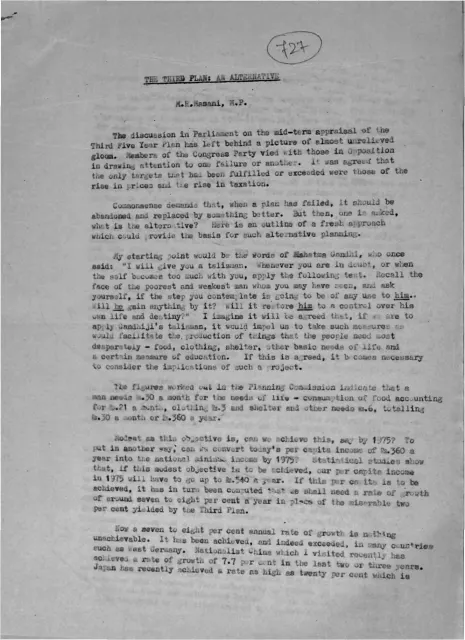
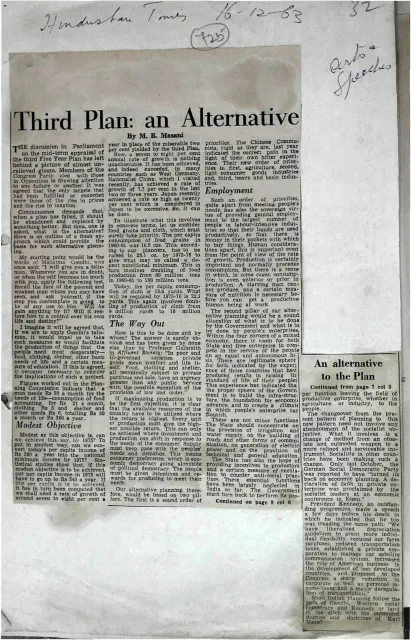
Masani’s alternative is to concentrate resources on what people need immediately — food, clothing, shelter and some education — roughly doubling the production of foodgrains and cloth by 1975-76, providing gainful employment, and letting consumer preference guide production, which he calls “economic democracy going alongside of political democracy.” This requires ending the “State Capitalist,” bureaucratic and monopolistic system in favour of a mixed economy in which the State builds the infra-structure — irrigation, power, roads and education — but leaves the production of goods to free enterprise. He insists this is not a surrender of the socialist objective but a rejection of an outdated Statist path, citing Galbraith, the Chinese Communists’ reversal towards agriculture-first priorities, the German Social Democrats’ break with Marxism and President Kennedy’s pro-market measures.
Ranga, replying later in the debate, rejects the Prime Minister’s claim that Swatantra is opposed to planning as such: the party favours “democratic planning” carried out within constitutional freedoms, not the centralised, top-heavy, Soviet-type planning being imposed from above. He charges that the Planning Commission functions in practice as a mandatory “super-cabinet” coercing State governments, and that agriculture and the peasant — long neglected in favour of “white elephant” steel plants — must be the base of any genuine national plan. Speaking for the small peasants he says he represents, he opposes forced co-operative and collective farming, the Constitution (Seventeenth Amendment) Bill’s expropriation of land and the Company Law Amendment Bill, and demands remunerative and parity prices for farmers and minimum wages for agricultural workers.
Key points
-
A Swatantra Party pamphlet collecting Lok Sabha speeches by M. R. Masani (5 December 1963) and Professor N. G. Ranga (11 December 1963) on the mid-term appraisal of the Third Five Year Plan, with Ranga’s August 1960 substitute motion appended.
-
Masani reads the Government’s own appraisal as an honest confession of “dismal failure”: national income grew only about 2 per cent a year against a 6 per cent target, below population growth, with shortfalls in foodgrains, steel, aluminium, machine tools and fertilisers.
-
He says the only two things the Plan raised were prices and taxes, and that the Plan must be scrapped because the whole approach — not merely its implementation — is “wrong-minded.”
-
He attacks the Planning Commission as a “Moscow Gosplan” and parallel government with no place in a democracy, while welcoming belated signs that Nehru now calls agriculture the base of all progress.
-
Masani’s alternative: concentrate on food, clothing and shelter, roughly doubling foodgrain and cloth output by 1975-76, with gainful employment and consumer sovereignty — “economic democracy going alongside of political democracy.”
-
He urges ending “State Capitalism” for a mixed economy in which the State builds infrastructure (irrigation, power, roads, education) but leaves production to free enterprise, insisting this keeps the socialist objective — citing Galbraith, China’s reversed priorities, the German SPD’s break with Marxism, and Kennedy.
-
Ranga argues Swatantra is not against planning but against centralised, Soviet-type planning; the Planning Commission acts as a coercive “super-cabinet” bullying State governments, and agriculture and the peasant must be the base of any real national plan.
-
Ranga opposes forced co-operative and collective farming, the Constitution (Seventeenth Amendment) land expropriation and the Company Law Amendment Bill, demanding remunerative and parity prices for peasants and minimum wages for agricultural workers.
Ingested 2026-07-21 from the CCS source archive. AI-drafted summary awaiting editorial review.
Metadata and summary are AI-extracted from the source PDF and reviewed for editorial accuracy. The original work is available via the Read PDF tab above (where present); paragraph-level citation inside the PDF is deferred to a future engagement.
People in this work
Related across the archive
 Primary workSpeech of Mr. M. R. Masani while opening the debate on the mid-term appraisal of the Third Plan in the Lok Sabha on December 5, 1963
 Primary workTHE THIRD PLAN: AN ALTERNATIVE
 Primary workThird Plan: an Alternative
 ExcerptCONSUMER SOVEREIGNTY LEADS TO RAPID ECONOMIC DEVELOPMENT
 ThePrintPlanning for the free market, not state control, will lift India out of poverty: BR Shenoy