
essay
Review of "Road Transport in India"
1968
2 pages
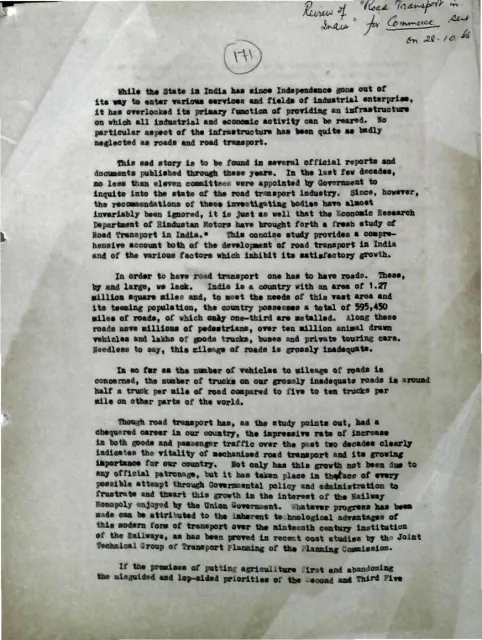
Summary
This two-page review argues that post-Independence India has neglected its primary responsibility to provide infrastructure, particularly roads and road transport, while expanding the state’s role in industrial and economic enterprise. Drawing on the Economic Research Department of Hindustan Motors’ study Road Transport in India, it highlights the country’s inadequate road network: roughly 595,450 miles of roads, only one-third of them metalled, serving a large population and a rapidly growing vehicle fleet. The review contrasts India’s low road capacity with much higher truck-per-mile ratios elsewhere and presents road transport as essential to economic development.
The review links the sector’s weakness to policy choices that privilege agriculture and the railways while obstructing the growth of mechanised road transport. It argues that road revenues are diverted into general expenditure instead of being reinvested in roads, and cites taxation, check-posts, weigh-bridges, road restrictions, load limits, and licensing rules as additional impediments. It calls for a major reduction and simplification of road-transport taxation, the abolition of miscellaneous taxes and administrative obstacles, and the redirection of road revenues toward infrastructure development.
Key points
- The state has expanded into industrial enterprise while neglecting infrastructure provision, especially roads and road transport.
- India is described as having approximately 595,450 miles of roads, only one-third of which are metalled.
- The review presents road transport as vital to economic development and anticipates rising demand from agricultural surpluses and increased trade.
- India’s road-vehicle ratio is portrayed as substantially lower than that of other countries.
- Government policy and the Union railway monopoly are criticized for restraining the development of mechanised road transport.
- Road-transport revenues are said to be diverted into general government expenditure rather than reinvested in roads.
- The review recommends reducing and simplifying taxation and removing check-posts, weigh-bridges, road restrictions, load limits, and burdensome licensing rules.
Metadata and summary are AI-extracted from the source PDF and reviewed for editorial accuracy. The original work is available via the Read PDF tab above (where present); paragraph-level citation inside the PDF is deferred to a future engagement.
Related across the archive
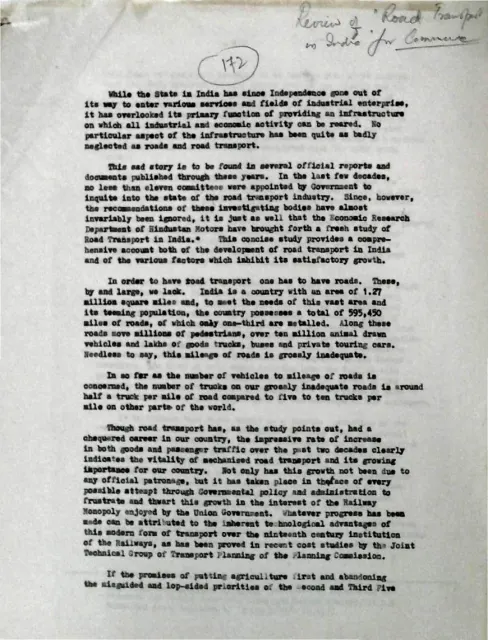 Primary workThe Review of Road Transport in India
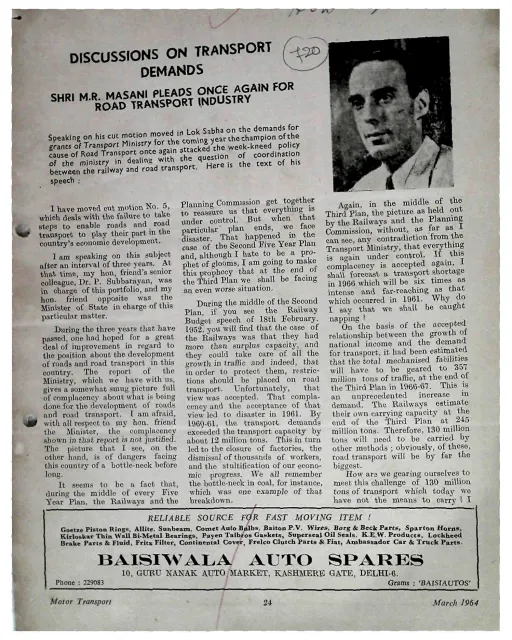 Primary workMotor Transport
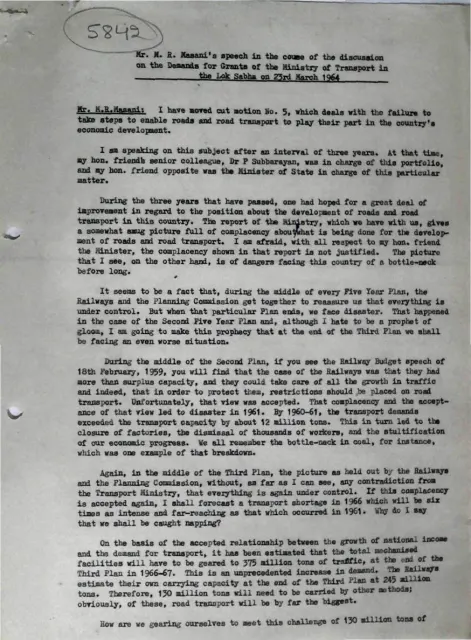 Primary workMr. M. R. Masani's speech in the course of the discussion on the Demands for Grants of the Ministry of Transport in the Lok Sabha on 23rd March 1964
 ExcerptThe Liberal Budget: Building an Equitable Society
 ExcerptSocialism or State Capitalism