essay
The Review of Road Transport in India
4 pages
Summary
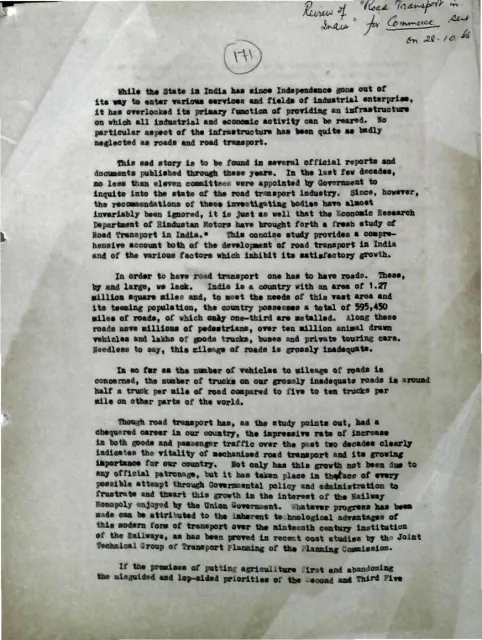
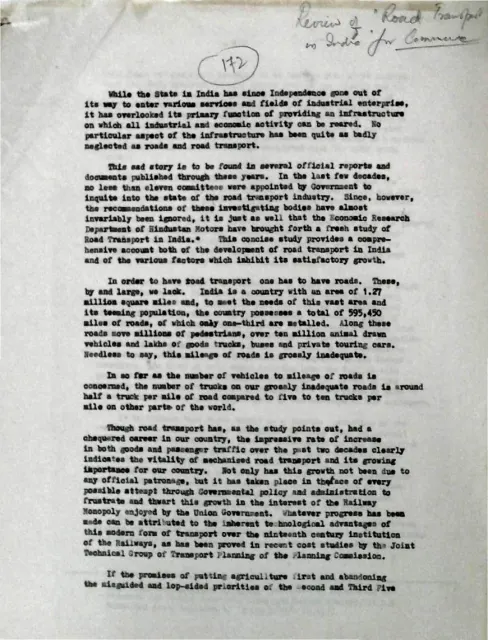
This untitled review examines Road Transport in India – A Study, credited to the Economic Research Department of Hindustan Motors. It argues that post-Independence India has neglected the State’s basic infrastructural responsibility while expanding into industrial and service activities. The review highlights the inadequacy of the road network: India’s 1.27 million square miles and growing population were served by 595,450 miles of roads, only one-third of them metalled, while traffic included millions of pedestrians, animal-drawn vehicles, buses, private cars, and lorries.
The review presents road transport as economically vital but disadvantaged by policy and taxation. It claims that railway interests and government administration have constrained road development, while road revenues have been diverted into general expenditure rather than reinvested in roads. The text calls for a network of motorable village roads linked to trunk routes, a major reduction and simplification of road-transport taxation, abolition of petrol and wheel taxes and certain administrative impediments, and greater public attention to the industry’s potential. The document is complete as supplied, but its formal title, author, publication year, and publisher are not visible; the handwritten heading identifies it as a review of the Hindustan Motors study rather than providing secure bibliographic details.
Key points
- The State has neglected roads and road transport while expanding into other services and industrial enterprises.
- India’s road mileage is described as inadequate for its large area, population, and volume of traffic.
- Road transport has grown despite governmental policies and administrative measures said to favour the railway monopoly.
- Road-derived revenues are criticised for being diverted to general expenditure instead of being reinvested in road development.
- The review cites a 54.5 per cent annual tax element in the basic operating cost of a medium-sized goods vehicle.
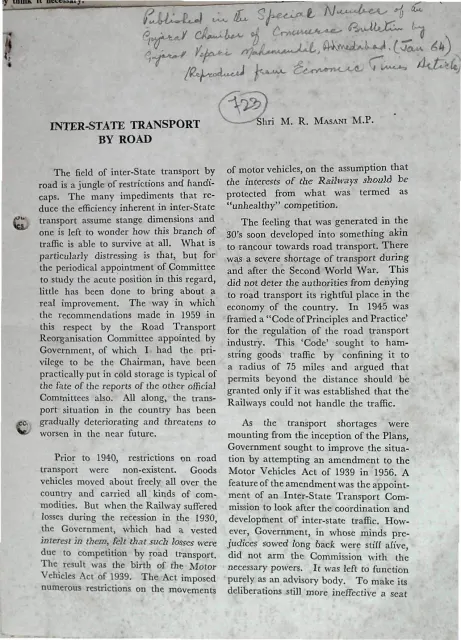
- It advocates simpler and lower taxation, abolition of petrol and wheel taxes, removal of check-posts and weigh-bridges, and relaxation of operating restrictions.
- Agricultural surpluses and the priorities of the Second and Third Five Year Plans are presented as reasons to develop motorable village-road networks.
Metadata and summary are AI-extracted from the source PDF and reviewed for editorial accuracy. The original work is available via the Read PDF tab above (where present); paragraph-level citation inside the PDF is deferred to a future engagement.