letter
Letter to Mr C Rajagopalachari
New Delhi · 1959
5 pages
Summary
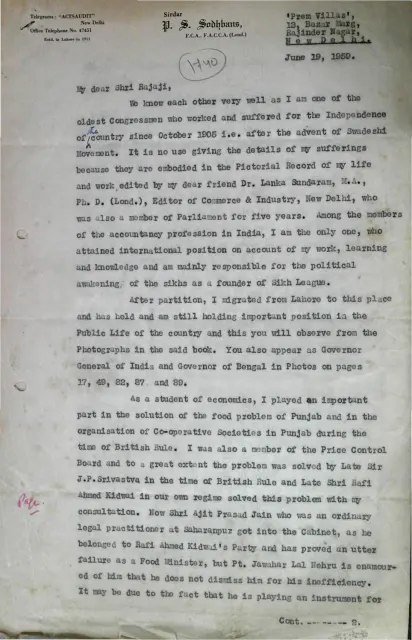
In this five-page letter dated June 19, 1959, Sirdar P. S. Sodhians writes to C. Rajagopalachari (“Rajaji”) from New Delhi, recalling his work in the independence movement, his role in the political awakening of Sikhs, and his involvement in Punjab’s food policy and cooperative institutions. He presents himself as an economist and former public figure with experience in price control, economic planning, and oil prospecting, and contrasts that experience with what he regards as the incompetence of contemporary ministers and officials.
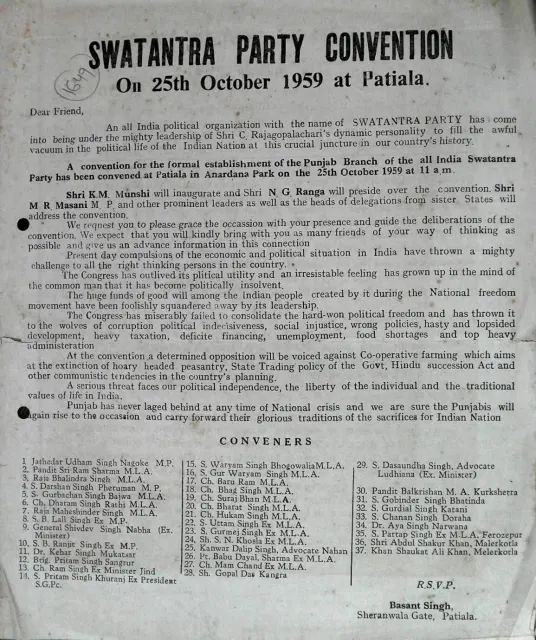
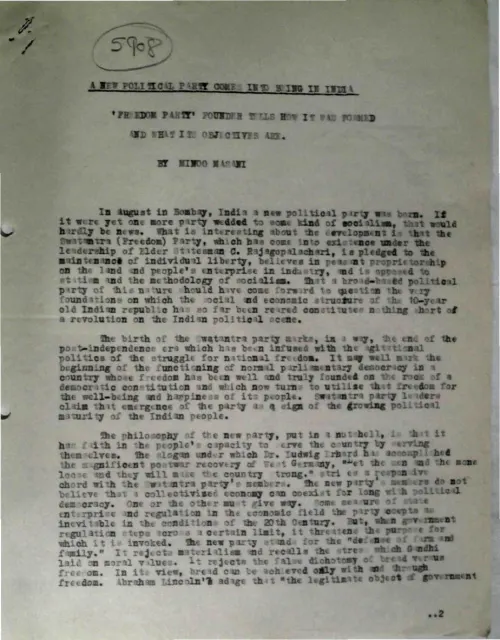
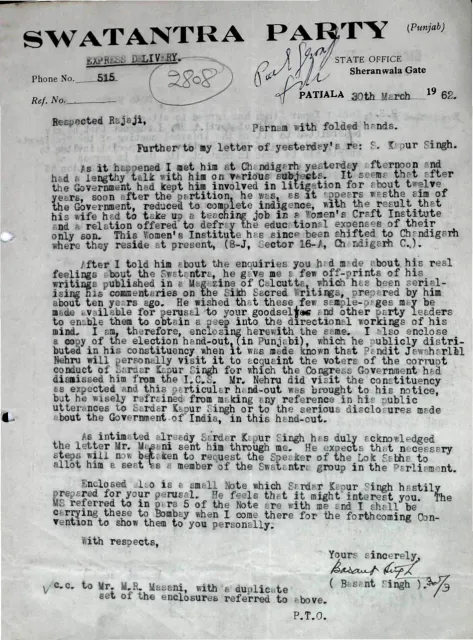
Sodhians attacks Jawaharlal Nehru’s advocacy of cooperative farming, the Food Grains Corporation, and the public sector, arguing that these policies encourage state mismanagement and disregard practical agricultural and business knowledge. He criticizes the appointment of inexperienced officials and politically connected individuals to public-sector companies, and alleges that Congress leaders suppress disagreement. The letter then turns to the formation of the Swatantra Party: Sodhians congratulates Rajaji, Minoo Masani, and Prof. N. G. Ranga, offers to assist with its organization and funding, and urges a program to oppose Congress policies. He closes by recalling his opposition to the Lucknow Pact, expressing Punjabi grievances after Partition, and describing himself as a displaced person receiving no assistance from the Nehru government.
Key points
- Sodhians describes his long involvement in the independence movement, Congress politics, Sikh political organization, and public life.
- He cites his work on Punjab’s food problem, cooperative societies, price control, and economic planning.
- He opposes cooperative farming and the Food Grains Corporation, which he associates with anarchy and communist ideology.
- He condemns Nehru’s leadership style and argues that dissenting Congressmen are pressured to resign.
- He criticizes public-sector management, alleging that inexperienced officials and political appointees caused substantial losses.
- He welcomes the formation of the Swatantra Party and offers to help Rajaji, Minoo Masani, and Prof. N. G. Ranga organize and finance it.
- He links his political position to earlier opposition to the Lucknow Pact and to the post-Partition plight of Punjabis.
Metadata and summary are AI-extracted from the source PDF and reviewed for editorial accuracy. The original work is available via the Read PDF tab above (where present); paragraph-level citation inside the PDF is deferred to a future engagement.