essay
A NEW POLITICAL PARTY COMES INTO BEING IN INDIA
'FREEDOM PARTY' FOUNDER TELLS HOW IT WAS FORMED AND WHAT ITS OBJECTIVES ARE.
By Minoo Masani
34 pages
Summary
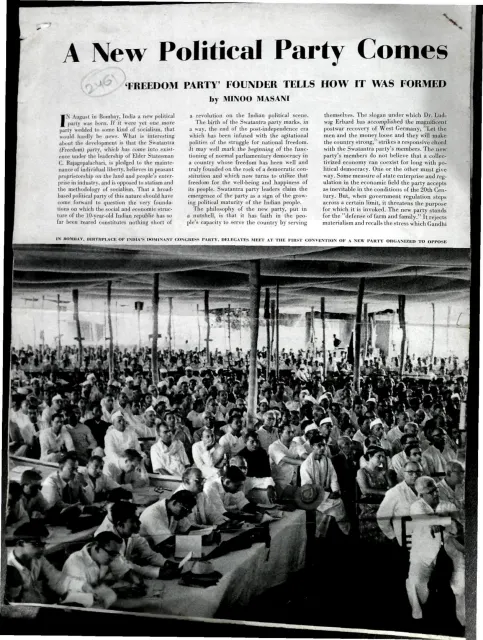
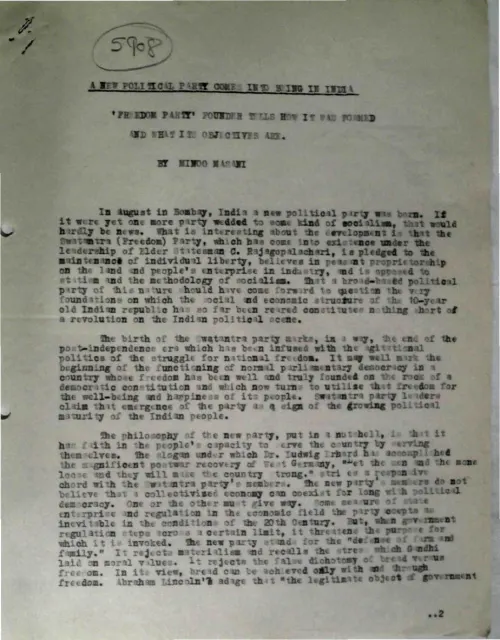
In the rendered pages, Minoo Masani presents the formation of the Swatantra (Freedom) Party under C. Rajagopalachari as a major challenge to India’s post-independence political and economic settlement. The party is described as committed to individual liberty, peasant proprietorship, private enterprise, and parliamentary democracy, while rejecting state socialism, collectivised agriculture, and what Masani sees as excessive economic regulation. Its social philosophy combines economic freedom with moral responsibility, family life, and Gandhi’s insistence that material prosperity cannot be separated from freedom.
In the rendered pages, Masani’s principal target is the Nehru government’s Soviet-influenced planning regime, which he associates with high taxation, licensing, bureaucratic interference, uncertainty, and the erosion of political independence. He attacks the Congress party’s Nagpur Resolution for its proposed land ceilings, cooperative farming, and state monopoly in food-grain trade, arguing that these measures threaten peasant proprietorship and rural autonomy. The alternative he sketches favours incentives for small farmers, competitive enterprise with safeguards against monopoly, limited state involvement in essential heavy industries and national services, and a broad coalition of peasants and urban middle classes. The essay also frames the Swatantra Party as an anti-Communist democratic force and argues that its immediate importance may lie less in winning office than in breaking the Congress-versus-Communist electoral choice. The rendered set does not include the remaining 14 PDF pages.
Key points
- The Swatantra Party is presented as a new liberal alternative to India’s dominant Congress and socialist political currents.
- Its programme combines individual liberty, peasant proprietorship, private enterprise, and parliamentary democracy.
- Masani criticises Nehruvian economic planning for taxation, licensing, bureaucratic control, and uncertainty.
- The essay attacks the Nagpur Resolution’s land ceilings, cooperative farming, and proposed food-grain monopoly.
- Agricultural policy should strengthen self-employed peasant proprietors through fair prices, credit, water, tools, seed, and fertiliser.
- The party supports competitive enterprise, limits state enterprise to essential heavy industries and national services, and opposes monopoly.
- Masani presents anti-Communism and the defence of democratic freedom as central to the party’s political purpose.
- The party’s prospective value may be to give voters an alternative to a Congress-versus-Communist choice, even without a guaranteed electoral victory.
Metadata and summary are AI-extracted from the source PDF and reviewed for editorial accuracy. The original work is available via the Read PDF tab above (where present); paragraph-level citation inside the PDF is deferred to a future engagement.