essay
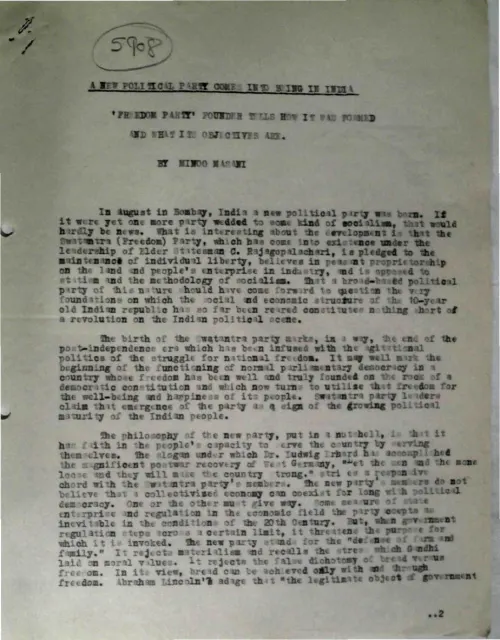
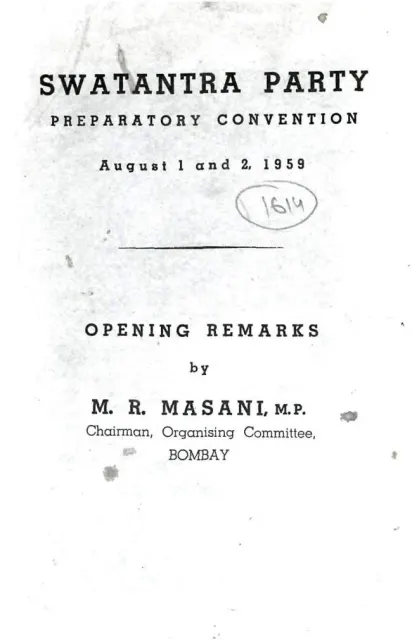
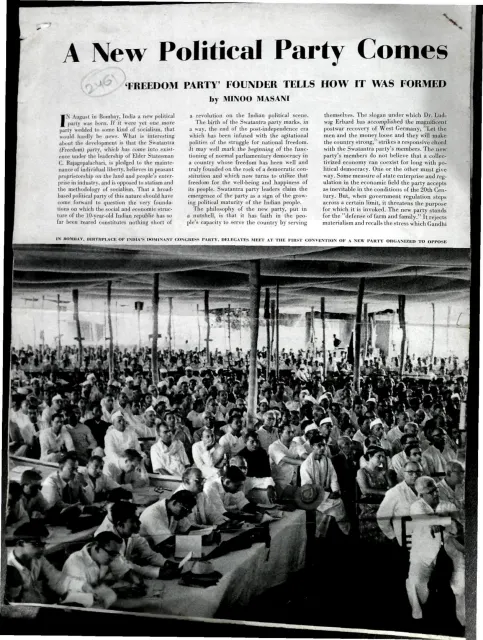
A New Political Party Comes into Being in India
'FREEDOM PARTY' FOUNDER TELLS HOW IT WAS FORMED AND WHAT ITS OBJECTIVES ARE
By Minoo Masani
8 pages
Summary
In this article, Minoo Masani presents the formation of the Swatantra (Freedom) Party as a liberal challenge to the Congress party’s socialist economic direction. He describes the new party as committed to individual liberty, peasant proprietorship, private enterprise, parliamentary democracy, and moral values, while rejecting both statist socialism and excessive government regulation. The party’s philosophy, he argues, rests on confidence in people’s capacity to serve the country through voluntary effort rather than through rigid party control.
Masani’s central target is the economic programme associated with Prime Minister Jawaharlal Nehru, especially land ceilings, cooperative farming, state monopolies in food-grain trading, heavy-industry planning, licensing, taxation, and bureaucratic interference. He argues that these policies burden farmers, consumers, middle-class taxpayers, investors, and entrepreneurs, while risking the concentration of political and economic power. The article also frames the Swatantra Party as an anti-Communist alternative: it seeks to draw together peasants, middle classes, and others dissatisfied with the Congress-Communist binary, while limiting state enterprise to essential heavy industries and public services. Masani closes by presenting the party’s prospects as uncertain but historically significant, since its emergence gives Indian voters a clearer non-socialist alternative.
Key points
- The Swatantra Party is presented as a new parliamentary alternative to Congress socialism and Communist politics.
- Masani links economic liberty to individual liberty, private enterprise, peasant proprietorship, and voluntary initiative.
- The article criticizes landholding ceilings, joint cooperative farming, state grain monopolies, licensing, taxation, and bureaucratic regulation.
- The party supports a limited role for state enterprise in heavy industry and essential public services, while opposing state control of trade and agriculture.
- Masani argues that small farmers and the urban middle class form the social base for resistance to the Congress economic programme.
- The article invokes West Germany and Japan as examples of economic expansion based on enterprise rather than restrictive planning.
- The Swatantra Party is positioned as an explicitly anti-Communist force that could break the existing Congress-versus-Communist political choice.
- Masani acknowledges that electoral success is uncertain but argues that the party’s existence itself expands democratic choice.
Metadata and summary are AI-extracted from the source PDF and reviewed for editorial accuracy. The original work is available via the Read PDF tab above (where present); paragraph-level citation inside the PDF is deferred to a future engagement.