speech · convention address
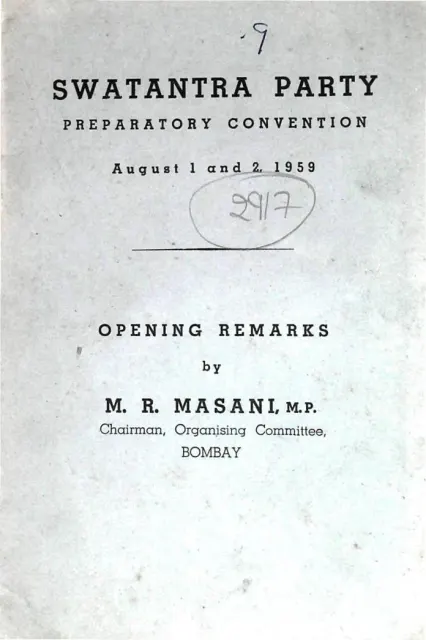
OPENING REMARKS
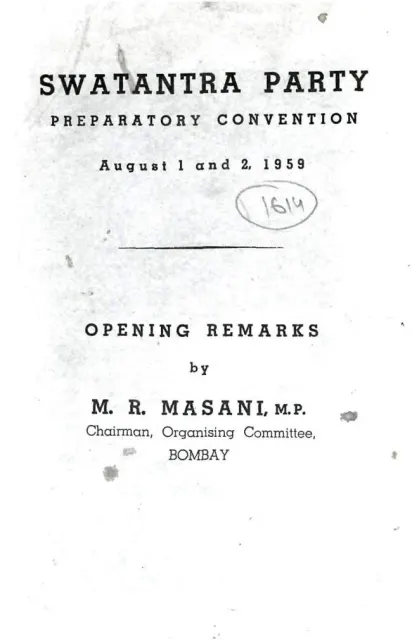
By Minoo Masani
INLAND PRINTERS, BOMBAY 7. · Bombay · 1959
13 pages
Summary
In this opening address to the Swatantra Party’s August 1959 Preparatory Convention, M. R. Masani presents the party as a democratic and liberal alternative to the Congress government’s socialist and increasingly interventionist policies. He describes the party’s emergence as a response to the absence of an effective parliamentary opposition, defending individual freedom, freedom of choice, private enterprise, and a constitutional political order against what he calls “State Capitalism.” The address links this critique to opposition to joint farming, land ceilings, state monopolies, excessive taxation, inflation, bureaucratic interference, and ideological planning.
Masani argues that the party must build a broad coalition joining peasants, workers, professionals, the urban middle class, and responsible businesspeople. He insists that its support should rest primarily on ordinary citizens rather than Big Business, and rejects the charge that Swatantra is merely a capitalist interest group. The speech also frames the party as an uncompromising opponent of communism, while arguing that a credible non-Communist alternative can prevent anti-Congress discontent from flowing into Communist channels. In its closing sections, the address defends criticism as the necessary starting point for a constructive programme and invokes Gandhi, Rajaji, Indian cultural traditions, and Abraham Lincoln in articulating a politics centered on liberty, initiative, thrift, and personal responsibility.
Key points
- Masani introduces the Swatantra Party as a new national movement for democratic liberties and personal freedom.
- The address criticizes Congress dominance for weakening parliamentary democracy and producing an ineffective opposition.
- Joint farming, land ceilings, state monopolies, high taxation, inflation, and bureaucratic controls are presented as threats to agricultural production and economic liberty.
- The party is defined as a broad coalition of peasants, workers, professionals, the middle class, and businesspeople, grounded primarily in small contributions from ordinary supporters.
- Masani rejects the accusation that Swatantra represents Big Business and argues that controlled economic conditions have made business dependent on state licences and permits.
- The party’s opposition to communism is presented as both ideological and strategic: it offers voters a non-Communist alternative and seeks to prevent political polarisation.
- The speech defends opposition as a necessary democratic function through which a constructive programme can emerge.
- The closing appeal combines individual initiative, freedom of choice, private enterprise, and moral responsibility with references to Gandhi, Rajaji, Indian traditions, and Abraham Lincoln.
Metadata and summary are AI-extracted from the source PDF and reviewed for editorial accuracy. The original work is available via the Read PDF tab above (where present); paragraph-level citation inside the PDF is deferred to a future engagement.