speech · convention address
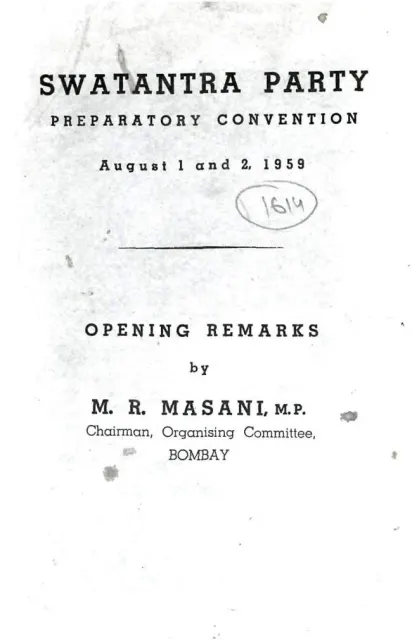
OPENING REMARKS
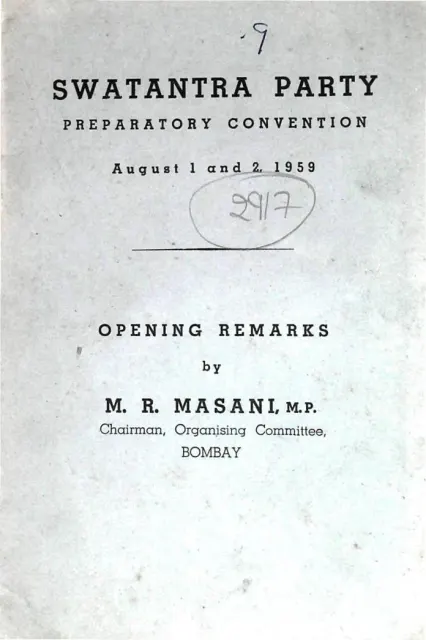
By Minoo Masani
SWATANTRA PARTY · BOMBAY · 1959
15 pages
Summary
In these opening remarks for the Swatantra Party’s preparatory convention in Bombay on August 1–2, 1959, M. R. Masani presents the party as a new national movement for democratic liberties and personal freedom. He describes its emergence as a response to the post-Independence dominance of the Congress, the absence of an effective parliamentary opposition, and what he calls the government’s “State Capitalism.” The party is meant to provide a broad-based alternative centred on individual rights rather than socialism, collectivism, or ideological conformity.
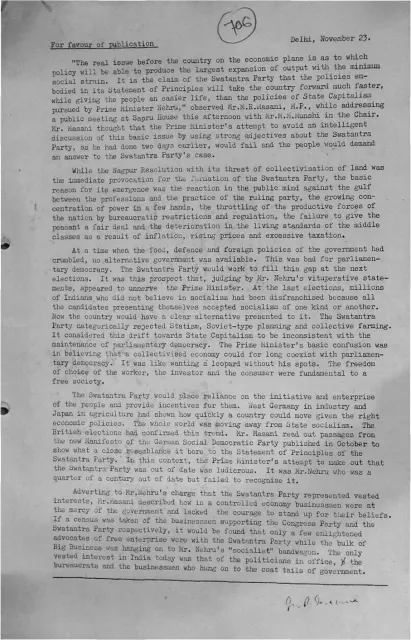
Masani links political freedom to economic freedom. He defends private property, freedom of choice, enterprise, and the interests of peasants, workers, professionals, and small traders, while criticising excessive taxation, bureaucratic control, licences and permits, joint or collective farming, and the concentration of political and economic power. He argues that the Swatantra Party should rely primarily on ordinary citizens and small contributions rather than big business. The address also frames the party as an uncompromising opponent of communism and as a means of preventing discontent from being channelled exclusively into Communist politics. In its concluding pages, Masani invokes C. Rajagopalachari’s leadership, Gandhi’s values, India’s cultural heritage, and universal “eternal verities.”
Key points
- The Swatantra Party is presented as a national movement for democratic liberties, personal freedom, and normal parliamentary democracy.
- Masani argues that Congress dominance has produced an unhealthy imbalance by leaving India without an effective opposition.
- The party’s alternative is centred on individual rights and rejects socialism, collectivism, and State Capitalism.
- Economic freedom is linked to property rights, freedom of choice, enterprise, and protection against bureaucratic control.
- The Nagpur Resolution and the question of land ownership are presented as an opportunity to build a broad-based democratic party with roots among peasants.
- Masani insists that the party should depend chiefly on ordinary people and small contributions rather than on large business donations.
- The Swatantra Party is described as an anti-communist force that can draw dissent away from both Congress and Communist channels.
- The speech closes by associating the party with Rajaji, Gandhi, Indian cultural traditions, and universal moral principles.
Metadata and summary are AI-extracted from the source PDF and reviewed for editorial accuracy. The original work is available via the Read PDF tab above (where present); paragraph-level citation inside the PDF is deferred to a future engagement.