press note
For Favour of Publication
Delhi · 1959
3 pages
Summary
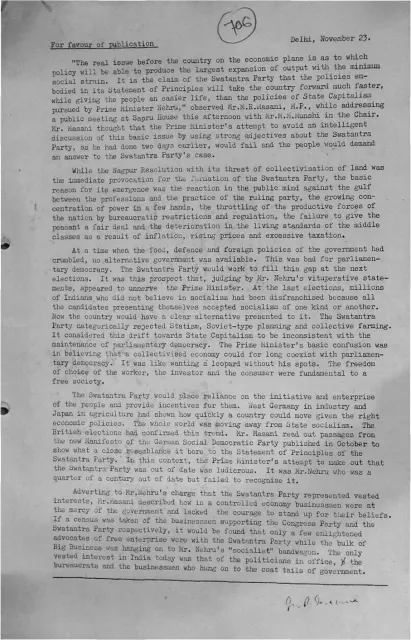
This three-page English press communication, dated Delhi, November 23, reports remarks by M. R. Masani at a public meeting at Sapru House, with K. M. Munshi in the chair. Masani presents the economic choice as one between the Swatantra Party’s program of initiative, enterprise, incentives, and individual choice, and Prime Minister Jawaharlal Nehru’s “State Capitalism,” which he associates with Soviet-type planning, collective farming, bureaucracy, regulation, inflation, rising prices, and excessive taxation.
The statement explains the Swatantra Party’s emergence as a reaction to the Nagpur Resolution’s threat of land collectivisation, the concentration of power, restrictions on productive forces, and the absence of a non-socialist electoral alternative. It argues that parliamentary democracy requires freedom of choice for workers, investors, and consumers, and cites West Germany, Japan, and the British elections as evidence of movement away from state socialism. Masani also rejects Nehru’s charge that the party represents vested business interests, arguing instead that controlled economic conditions make businessmen dependent on government and that the principal vested interests are politicians, bureaucrats, and businesses attached to the state.
Key points
- Masani frames the central economic question as how to expand output with the least social strain.
- The Swatantra Party claims its policies would produce faster growth and an easier life than Nehru’s State Capitalism.
- The party’s emergence is linked to opposition to land collectivisation, bureaucratic restrictions, concentration of power, inflation, and excessive taxation.
- Swatantra rejects Statism, Soviet-type planning, and collective farming as incompatible with sustained parliamentary democracy.
- Freedom of choice for workers, investors, and consumers is presented as fundamental to a free society.
- West Germany, Japan, and the British elections are cited as examples of economic or political movement away from state socialism.
- The statement contests the charge that Swatantra chiefly represents vested business interests, locating such interests primarily among politicians, bureaucrats, and dependent businesses.
Metadata and summary are AI-extracted from the source PDF and reviewed for editorial accuracy. The original work is available via the Read PDF tab above (where present); paragraph-level citation inside the PDF is deferred to a future engagement.