essay
THE SWATANTRA PARTY
By S. V. Raju
Published By RESEARCH PUBLICATIONS in Social Sciences, 2/44, Ansari Road, Daryaganj, DELHI-6. · DELHI-6 · 1971
36 pages
Summary
In the rendered pages, S. V. Raju presents the Swatantra Party as a response to a broader crisis in Indian politics rather than merely to the Congress Party’s 1959 resolution on co-operative farming. He describes the party as an alternative to what its founders regarded as the Congress’s statist and socialist direction, and traces its formation through the Madras meeting of June 1959 and the Preparatory Convention in Bombay. The party’s central commitments are individual initiative, freedom of choice, social justice without compulsory collectivism, and a state limited by constitutional rights and public purpose.
In the rendered pages, Raju sets out the party’s twenty-one principles and develops its policy programme across agriculture, industry, taxation, public administration, planning, labour, education, the press, foreign policy, electoral reform, and party organisation. The programme combines a defence of private property, competitive enterprise, peasant proprietorship, and reduced state interference with support for social welfare, labour rights, rural development, minority protection, public services, and safeguards against monopoly. It invokes Gandhi’s principle of trusteeship and non-violence while opposing centralised planning, excessive taxation, bureaucratic controls, collectivisation, restrictions on speech, and constitutional amendments that weaken fundamental rights. The final rendered pages also describe the party’s membership reforms and its pyramidal organisational structure; the continuation of the essay beyond the rendered set was not visible.
Key points
- Raju explains the Swatantra Party’s formation in 1959 as the product of wider dissatisfaction with Congress policies, with the Nagpur Resolution serving as a trigger rather than the sole cause.
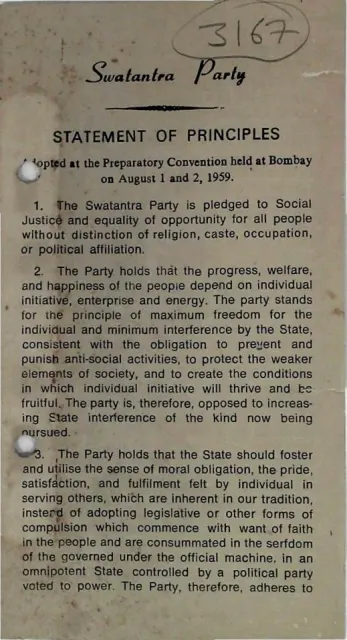
- The party’s twenty-one principles link social justice and equality of opportunity to individual initiative, enterprise, freedom of choice, and limited state interference.
- Its economic programme defends peasant ownership, voluntary co-operation, private enterprise, free choice for producers and consumers, and restrictions on state trading and bureaucratic management.
- The party opposes collectivisation, centralised Soviet-style planning, excessive taxation, deficit financing, inflation, foreign borrowing beyond repayment capacity, and an expanding public-sector bureaucracy.
- The programme supports labour organisation, collective bargaining, fair wages, employment-generating industrialisation, rural industries, and safeguards for workers.
- Raju presents constitutionalism, fundamental rights, judicial independence, press freedom, educational autonomy, minority protection, and freedom of opinion within the party as central political commitments.
- The foreign-policy section advocates reassessing non-alignment, strengthening regional security arrangements, confronting Communist China, and pursuing a more active defence policy.
- The later pages describe changes to membership categories and subscriptions and outline a unified, nationally directed organisation built from constituency or taluka committees through district and state or regional councils.
Metadata and summary are AI-extracted from the source PDF and reviewed for editorial accuracy. The original work is available via the Read PDF tab above (where present); paragraph-level citation inside the PDF is deferred to a future engagement.