essay · statement of principles
REVISED STATEMENT OF PRINCIPLES
8 pages
Summary
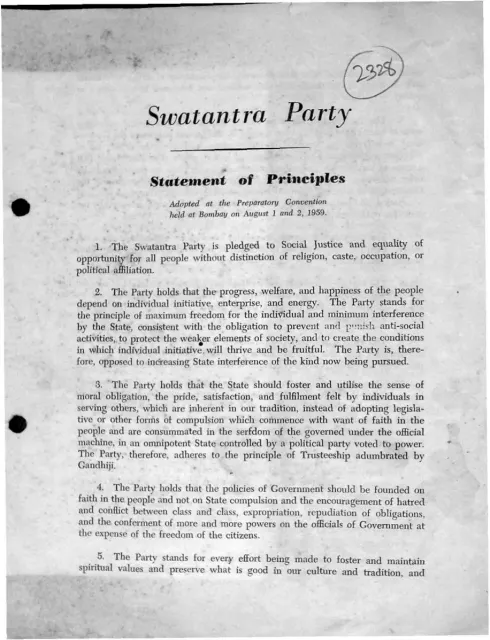
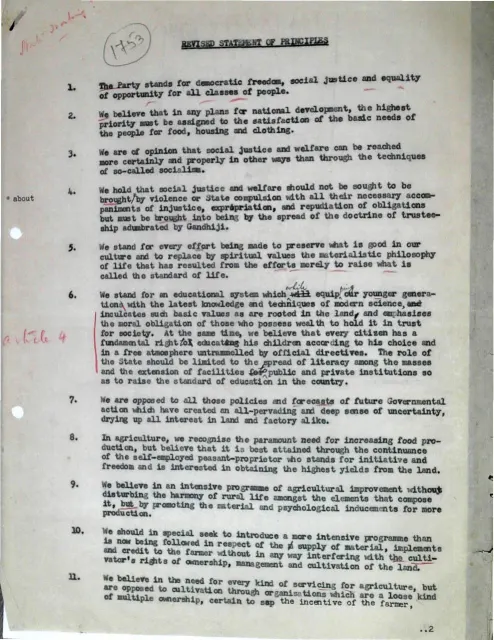
The document presents a revised statement of principles centred on democratic freedom, social justice, equality of opportunity, and individual initiative. It rejects achieving welfare through violence, expropriation, State compulsion, or expansive bureaucracy, instead invoking Gandhi’s doctrine of trusteeship and asking those who possess wealth to use it for social, cultural, and civic improvement. It also supports education combining modern scientific knowledge with moral values, while limiting the State’s educational role largely to literacy and the provision of facilities.
Across its agricultural and economic principles, the statement favours family farming, self-employed peasant proprietors, fair producer prices, competitive enterprise, and democratic planning that stimulates rather than displaces private initiative. It opposes State-sponsored joint farming, collectivisation, monopolies, excessive regulation, intrusive State participation in trade and distribution, crippling taxation, deficit financing, and foreign borrowing beyond the country’s repayment capacity. The document also defends property, trade, employment, and compensation guarantees; calls for clean, efficient, decentralised administration; supports collective bargaining and the right to strike; and endorses the rule of law, an independent judiciary, judicial review, and peaceful reconciliation of social conflicts. Pages 1–4 and pages 5–8 contain separately numbered 23-point and 27-point formulations, respectively, with substantial overlap but some differences in wording and emphasis.
Key points
- The principles combine democratic freedom and social justice with equality of opportunity and individual initiative.
- Social welfare is to be pursued without violence, expropriation, or excessive State compulsion, with Gandhi’s trusteeship offered as an alternative framework.
- The agricultural programme prioritises food production, family farming, farmer incentives, fair prices, and rural stability, while rejecting compulsory joint farming and collectivisation.
- The economic programme favours competitive enterprise, limited and justified State participation, democratic planning, decentralisation, and opposition to monopolies and bureaucratic statism.
- The statement calls for moderate taxation, responsible borrowing, monetary stability, protection of property and trade, and restoration of constitutional guarantees.
- Labour rights are to be protected through free trade unions, collective bargaining, voluntary arbitration, and the right to strike.
- The constitutional programme supports the rule of law, an independent judiciary, judicial review, official integrity, and a limited regulatory State.
Metadata and summary are AI-extracted from the source PDF and reviewed for editorial accuracy. The original work is available via the Read PDF tab above (where present); paragraph-level citation inside the PDF is deferred to a future engagement.