essay · statement of principles
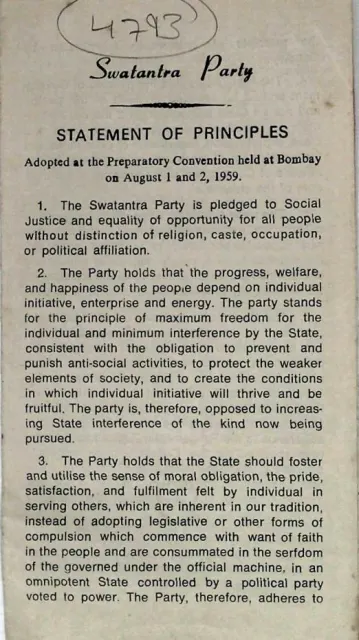
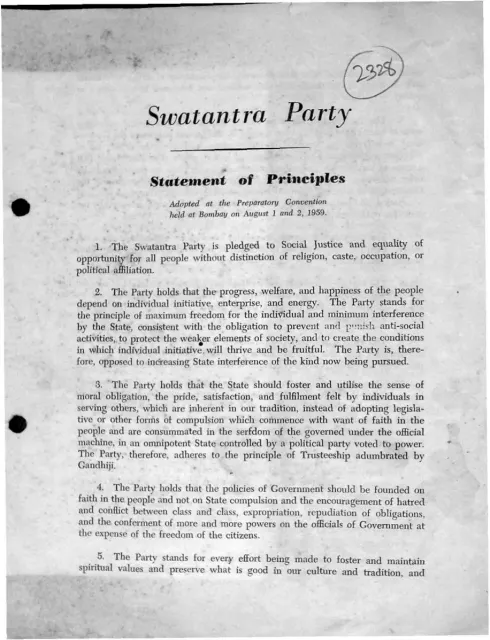
Statement of Principles
INLAND PRINTERS, BOMBAY 7. · Bombay · 1959
4 pages
Summary
Adopted at the Swatantra Party’s Preparatory Convention in Bombay on August 1–2, 1959, this Statement of Principles sets out a programme combining social justice with individual freedom and limited government. It affirms equality of opportunity without distinction of religion, caste, occupation, or political affiliation, while arguing that public welfare depends on individual initiative, enterprise, and energy. The State is assigned responsibility for preventing anti-social activity, protecting weaker sections, and providing essential services, but is cautioned against expanding interference, compulsion, and bureaucratic control.
The statement applies this framework to agriculture, industry, taxation, public administration, labour, and constitutional government. It defends private ownership and self-employed cultivation, opposes collectivisation and bureaucratic management of the rural economy, and favours competitive enterprise, free distribution, and consumer and producer choice. It calls for restraint in public expenditure, taxation, deficit financing, foreign borrowing, inflation, and the expansion of State enterprise. The final principles support decentralised industry, full employment, labour organisation and collective bargaining, the rule of law, an independent judiciary, judicial review, truth and non-violence in the tradition of Gandhi, and freedom of opinion for party members outside the party’s fundamental principles.
Key points
- The Swatantra Party links social justice and equality of opportunity with maximum individual freedom and minimal State interference.
- The statement endorses individual initiative, private enterprise, property rights, and constitutional guarantees against compulsory acquisition without just compensation.
- It prioritises food, water, housing, clothing, and education, while favouring agricultural improvement through incentives, private ownership, and better irrigation, inputs, credit, and marketing.
- It opposes collectivisation, bureaucratic rural management, State control of trade, and the extension of State enterprise beyond strategic or difficult-to-finance sectors.
- The programme calls for thrift in public expenditure, moderate taxation, opposition to excessive inflation and imprudent borrowing, and a smaller, more efficient bureaucracy.
- It supports balanced industrialisation, decentralised production, full employment, labour rights, collective bargaining, and the reconciliation of capital and labour.
- It defends the rule of law, an independent judiciary, judicial review, constitutional freedoms, non-violence, and internal freedom of opinion within the party.
Metadata and summary are AI-extracted from the source PDF and reviewed for editorial accuracy. The original work is available via the Read PDF tab above (where present); paragraph-level citation inside the PDF is deferred to a future engagement.