essay
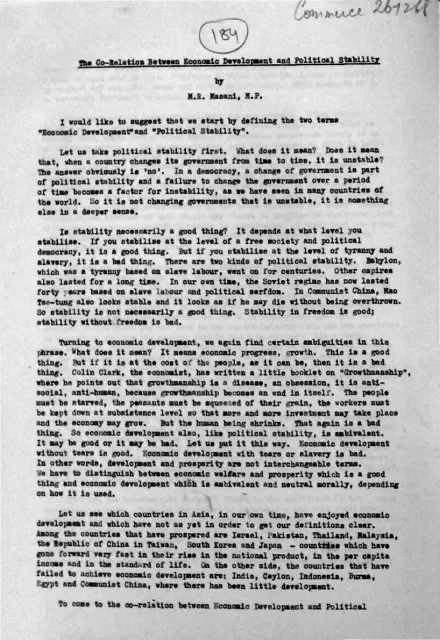
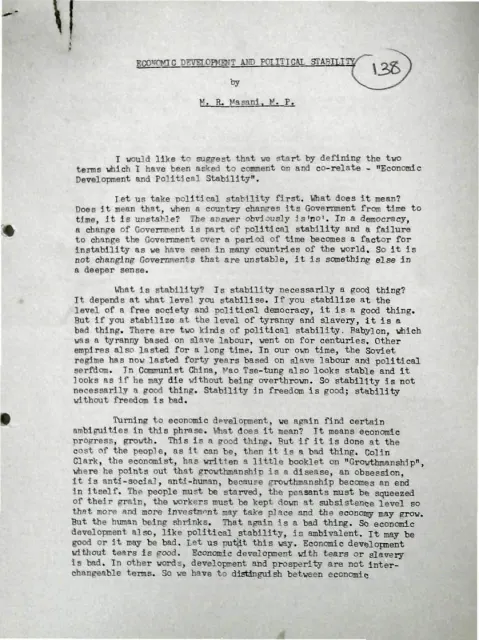
The Co-Relation Between Economic Development and Political Stability
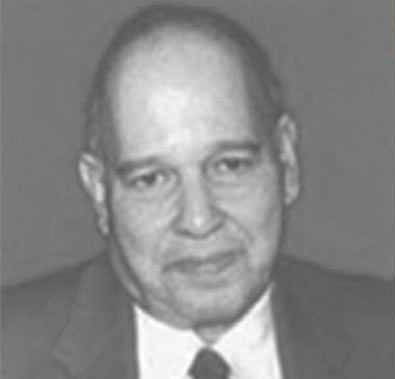
By Minoo Masani
1968
6 pages
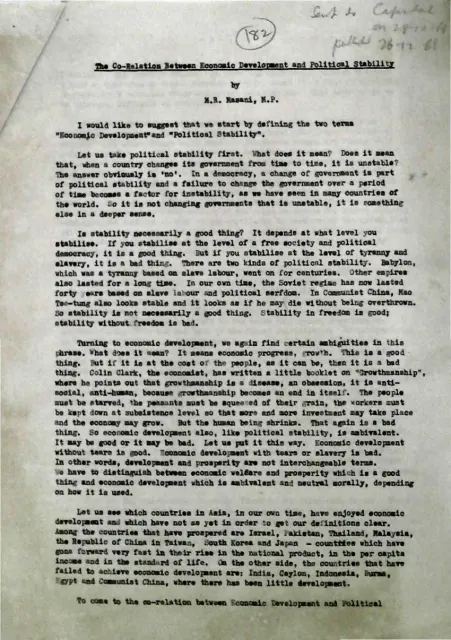
Summary
In this six-page essay, M. R. Masani examines whether economic development and political stability are causally related. He distinguishes stability in a free, democratic society from stability imposed by tyranny or slavery, and similarly distinguishes economic welfare from economic development, which he regards as morally neutral unless directed toward human welfare. He argues that prosperity generally supports political stability, but rejects the idea that poverty automatically produces communism or that prosperity alone guarantees freedom or democratic government. Historical, ethnic, linguistic, and emotional factors can be more important than economic conditions in generating instability.
Masani identifies one dependable relationship: some measure of political stability is necessary for economic progress, whether under a parliament or a military regime. Beyond that, he argues that economic development and political stability can exist independently and should be pursued as separate, intrinsically desirable objectives. His practical prescription is a liberal “free competitive economy” alongside parliamentary democracy, with the state acting as an impartial referee rather than an economic participant. The essay concludes by urging Indian liberals to defend freedom, private property, competitive enterprise, and a locally rooted liberal tradition associated especially with Mahatma Gandhi, while communicating liberal ideas to peasants and the wider population.
Key points
- Political stability is not inherently desirable: stability grounded in freedom is good, while stability grounded in tyranny or slavery is bad.
- Economic development means economic progress and growth, but development can be morally good or bad depending on how it is used.
- Masani rejects a simple equation in which prosperity produces stability and poverty produces revolution or communism.
- Non-economic factors—including historical, racial, linguistic, and emotional conditions—can be decisive in political instability.
- Political stability is presented as a necessary precondition for economic progress, although the reverse relationship is not essential.
- Economic progress and political stability are both desirable in themselves and should not be treated merely as means to one another.
- Masani advocates a free competitive economy, private property in land, limited state intervention, and a state that acts as an impartial referee.
- Indian liberals should combine constitutional democracy with an indigenous and international liberal inheritance, communicate with ordinary people, and turn belief into organised effort.
Metadata and summary are AI-extracted from the source PDF and reviewed for editorial accuracy. The original work is available via the Read PDF tab above (where present); paragraph-level citation inside the PDF is deferred to a future engagement.