interview · report
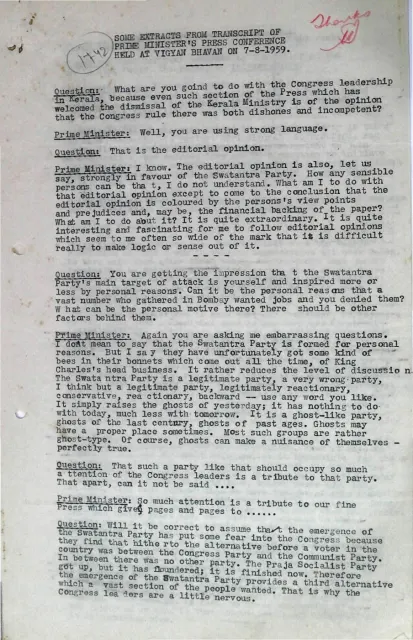
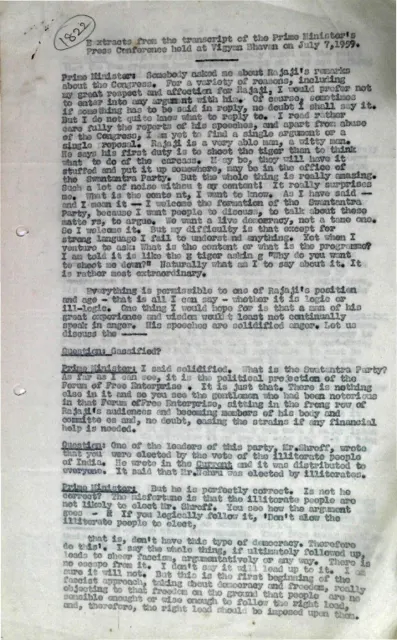
Extracts from the transcript of the Prime Minister's Press Conference held at Vigyan Bhavan on July 7, 1959.
New Delhi · 1959
3 pages
Summary
This three-page document reproduces extracts from the Prime Minister's question-and-answer press conference at Vigyan Bhavan on July 7, 1959. The discussion focuses on the newly formed Swatantra Party, its relationship to Congress, and the Prime Minister's assessment of C. Rajagopalachari (Rajaji). He says he welcomes the party as a means of encouraging public discussion and a “live democracy,” while criticizing what he regards as its narrow economic programme and its attachment to ideas associated with the nineteenth century.
The transcript also addresses allegations of corruption, administrative inefficiency, judicial and ministerial conduct, and the proposal that judges should contest elections on a Congress ticket. The Prime Minister distinguishes criticism of Congress from direct accusations of corruption, argues that administrative delays are a broader problem rather than a partisan one, and praises the efficiency of the Madras and Bombay state governments while acknowledging that no government is free of failures. The pages end with a warning that the Swatantra Party's political and economic positions should be taken seriously, but not accepted uncritically.
Transcript
Summary
This three-page document reproduces extracts from the Prime Minister’s question-and-answer press conference at Vigyan Bhavan on July 7, 1959. The discussion focuses on the newly formed Swatantra Party, its relationship to Congress, and the Prime Minister’s assessment of C. Rajagopalachari (Rajaji). He says he welcomes the party as a means of encouraging public discussion and a “live democracy,” while criticizing what he regards as its narrow economic programme and its attachment to ideas associated with the nineteenth century.
The transcript also addresses allegations of corruption, administrative inefficiency, judicial and ministerial conduct, and the proposal that judges should contest elections on a Congress ticket. The Prime Minister distinguishes criticism of Congress from direct accusations of corruption, argues that administrative delays are a broader problem rather than a partisan one, and praises the efficiency of the Madras and Bombay state governments while acknowledging that no government is free of failures. The pages end with a warning that the Swatantra Party’s political and economic positions should be taken seriously, but not accepted uncritically.
Key points
- The Prime Minister welcomes the Swatantra Party as an additional political force and as a possible contribution to democratic debate.
- He regards Rajaji as an able and witty politician but says Rajaji’s economic programme remains rooted in nineteenth-century thinking.
- The transcript contrasts political democracy and freedom of enterprise with the party’s broader political programme.
- Questions about corruption, preferential administration, and criminal cases prompt distinctions between isolated failures and systemic conditions.
- The Prime Minister rejects the idea that judges should be drawn into Congress electoral politics.
- Madras and Bombay are presented as comparatively efficient state administrations, although the Prime Minister acknowledges failures everywhere.
Metadata and summary are AI-extracted from the source PDF and reviewed for editorial accuracy. The original work is available via the Read PDF tab above (where present); paragraph-level citation inside the PDF is deferred to a future engagement.