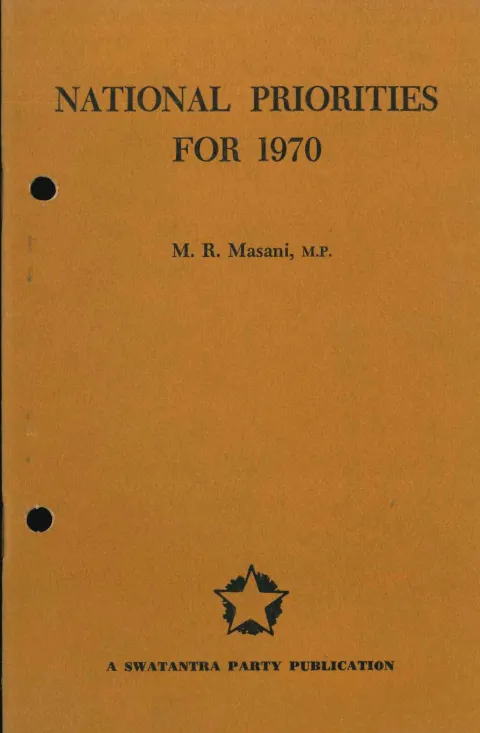
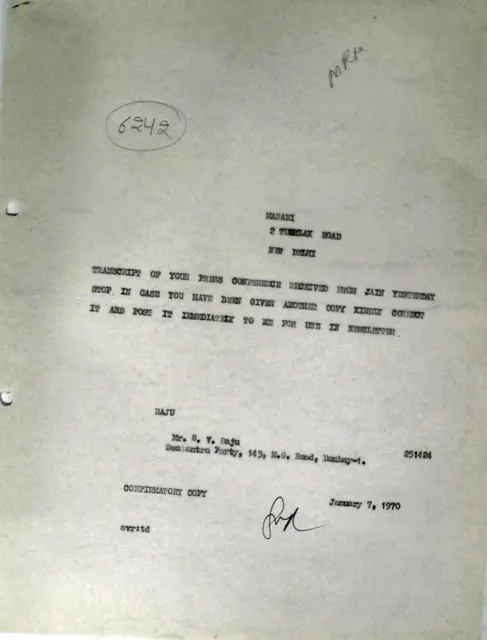
letter
Letter from S V Raju
By S. V. Raju
Swatantra Party — NATIONAL HEADQUARTERS · BOMBAY 1 · 1970
27 pages
Summary
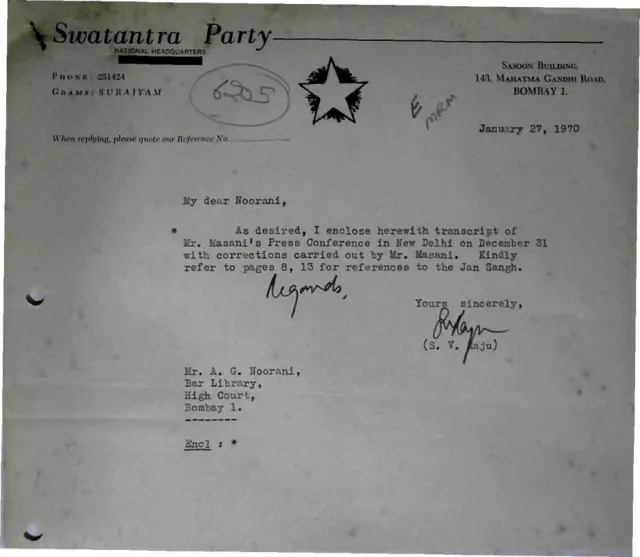
This document is a covering letter from S. V. Raju to A. G. Noorani, dated January 27, 1970, enclosing a corrected transcript of M. R. Masani’s December 31 press conference in New Delhi. The visible enclosure argues that Indira Gandhi’s government has lost the mandate obtained in 1967 after the Congress split and should dissolve Parliament and seek a fresh mandate. It presents the minority government’s dependence on Communist support as a threat to political stability and contends that it is incapable of addressing the country’s principal needs: clean and efficient administration, restoration of law and order, increased production and employment, and a pragmatic, non-ideological approach to economic problems.
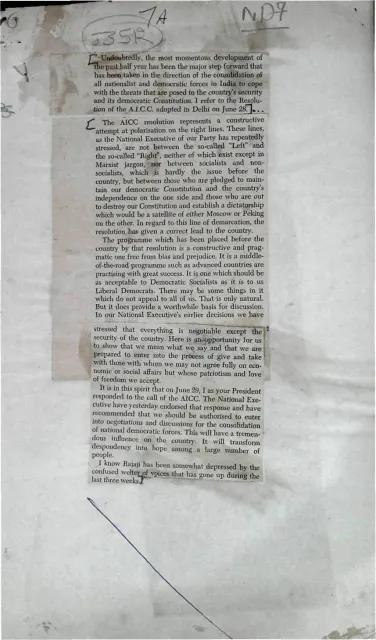
In the rendered pages, Masani criticises inflation, nationalisation, and the economic programme associated with the Bombay Congress session, defending property rights, free competition, and a free-market economy combined with social welfare and equitable distribution. He describes the Swatantra Party as a party of change committed to modernisation, economic liberalisation, and freedom from controls, red tape, and statism. The transcript also proposes a broad democratic coalition of opposition parties, argues that coalition governments are normal in democracies, and distinguishes negotiable economic differences from non-negotiable commitments to national security, independence, constitutional democracy, and resistance to Communist totalitarianism. The final rendered pages continue with questions about dissolution of Parliament, presidential discretion, mandates, coalition politics, and the limits of the Prime Minister’s authority.
Key points
- The covering letter identifies the enclosure as a corrected transcript of M. R. Masani’s December 31, 1969 press conference in New Delhi.
- The transcript argues that the Congress split and the loss of a parliamentary majority had exhausted Indira Gandhi’s 1967 electoral mandate.
- Masani calls for dissolution of Parliament and a fresh appeal to the electorate, while acknowledging that the President retains discretion over dissolution.
- The government is criticised for inflation, inadequate production and employment, nationalisation, weak administration, and failure to restore law and order.
- The Swatantra Party is presented as standing for free competition, a free-market economy, modernisation, and liberation from controls, red tape, and statism.
- Property rights are defended as foundational to other liberties, while Marxist and socialist approaches are criticised as concentrating power and impoverishing society.
- The transcript advocates a broad coalition of patriotic and democratic opposition parties, with economic differences treated as negotiable but constitutional democracy and national security treated as non-negotiable.
- The document closes with further discussion of fresh mandates, coalition governments, presidential powers, and the political implications of Communist support.
Metadata and summary are AI-extracted from the source PDF and reviewed for editorial accuracy. The original work is available via the Read PDF tab above (where present); paragraph-level citation inside the PDF is deferred to a future engagement.