pamphlet
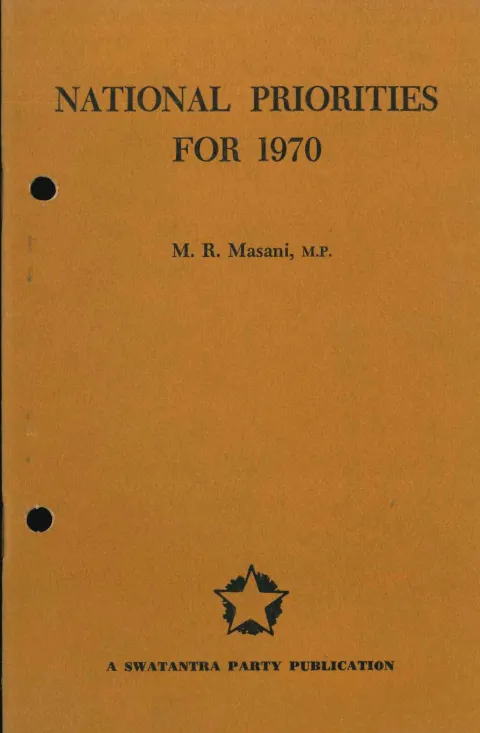
National Priorities for 1970
By Minoo Masani
Swatantra Party · Bombay · 1969
14 pages
Part of Swatantra Party
National Priorities for 1970
By M. R. Masani, M.P. (President, Swatantra Party)
Summary
National Priorities for 1970 is the transcript of a press conference given by M. R. (Minoo) Masani, M.P., newly re-elected President of the Swatantra Party, in New Delhi on 31 December 1969, on the eve of the new year. Speaking in the aftermath of the 1969 split in the Congress, Masani argues that Prime Minister Indira Gandhi’s 1967 mandate has expired: because her party has broken in two and she has lost her majority, he contends she now heads a minority government surviving only on Communist support, and that her constitutional and moral duty is to dissolve Parliament and seek a fresh mandate. He predicts she would be decisively defeated at the polls, and warns that a minority government dependent on the Communists is a threat to the security and stability of the country.
Masani identifies two immediate national needs — a stable price level (a “stable rupee”) and more jobs — and attacks the economic programme that emerged from the Congress’s Bombay session, arguing that its nationalisation measures and expansion of the currency promise only galloping inflation and reduced production. He lists four priorities the country requires: a clean, efficient and prompt administration; the restoration of law and order, especially in Bengal; hard work and increased production; and a pragmatic approach free of ideological preconceptions. Ridiculing Jagjivan Ram’s claim that distribution matters more than production — “Can one distribute what one has not produced?” — he invokes Nehru’s line that socialism in a poor country means only the distribution of poverty, and defends the fundamental right to property as the precondition of every other liberty.
Setting out the creed of the Swatantra Party — founded in 1959 to reverse two decades of imposed socialism — Masani calls for drastic change and the liberation of the people from the shackles of controls, red-tape and Statism. Its basic creed, he says, is free competition and a free market economy combined with Gandhiji’s theory of Trusteeship; he cites Ludwig Erhard’s German miracle and Dubcek’s Czechoslovak liberalisation, and embraces modernism against obscurantism. His central political proposal is a broad-based national democratic front cutting across party lines and leaving out only the Communists: differences of economic emphasis between liberal and social democrats, he insists, are negotiable, but the security of the country against Communist infiltration and totalitarianism is not. In the questions that follow, he elaborates on equitable distribution through fiscal and welfare measures without killing incentives (increasing the size of the cake so everyone gets a bigger slice), the President’s discretion to dissolve Parliament, the independence of All India Radio and the press, the privy purses, and the Orissa coalition as a model — while ruling out any alliance with the Communists or with Mrs Gandhi unless she first breaks with them.
Key points
-
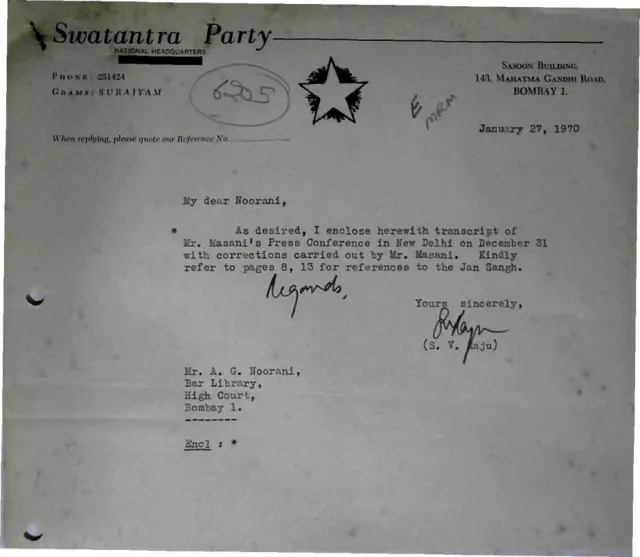
Transcript of a press conference by M. R. (Minoo) Masani, M.P., President of the Swatantra Party, held in New Delhi on 31 December 1969.
-
Argues that after the 1969 Congress split, Indira Gandhi’s 1967 mandate has lapsed and that she now leads a minority government dependent on Communist support.
-
Calls on the Prime Minister to dissolve Parliament and seek a fresh mandate, predicting she would be decisively defeated at the polls.
-
Names two urgent needs — a stable rupee (against galloping inflation) and more jobs — and four priorities: clean administration, law and order, increased production, and a pragmatic, non-ideological approach.
-
Attacks the Congress Bombay session’s nationalisation programme and the primacy of distribution over production, citing Nehru’s remark that socialism in a poor country distributes only poverty.
-
Defends the fundamental right to property as the basis of all other liberties, opposing its proposed abolition.
-
States the Swatantra creed — free competition and a free market economy plus Gandhian Trusteeship — invoking Ludwig Erhard and Dubcek, and championing modernism over obscurantism.
-
Proposes a broad national democratic front of all patriotic, democratic parties excluding the Communists, holding economic differences negotiable but national security against Communism non-negotiable.
Ingested 2026-07-21 from the CCS source archive. AI-drafted summary awaiting editorial review.
Metadata and summary are AI-extracted from the source PDF and reviewed for editorial accuracy. The original work is available via the Read PDF tab above (where present); paragraph-level citation inside the PDF is deferred to a future engagement.