essay
Indias Momentous Development Of Past Half Years
3 pages
Summary
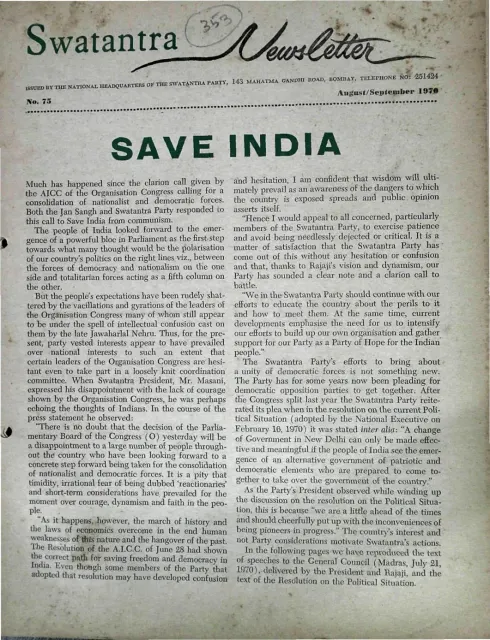
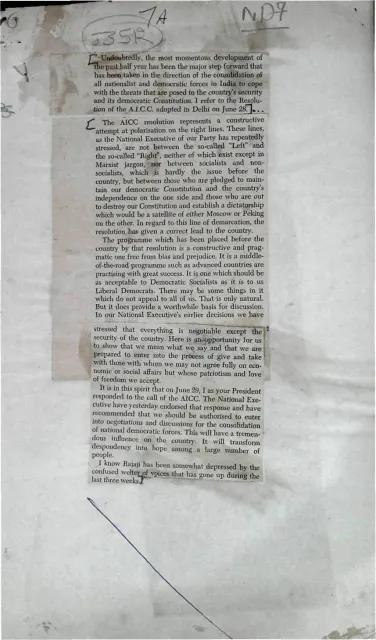
These three rendered pages are a continuation of an untitled political text arguing that India’s democratic and nationalist forces should consolidate around the AICC resolution adopted on June 28. The speaker presents the central political divide as one between those committed to the democratic Constitution and national independence and those seeking dictatorship aligned with Moscow or Peking, rather than a simple contest between Left and Right or between socialists and non-socialists. The proposed programme is described as a pragmatic, negotiable basis for cooperation, with national security treated as the principal exception.
The text calls for negotiations among democratic parties, including the Swatantra Party and Jana Sangh, while acknowledging concerns about Jana Sangh’s communal and anti-modern tendencies. It argues that cooperation must rest on a non-denominational democracy, opposition to discrimination based on religion or ethnicity, equality of opportunity and education, employment provision, and enforceable protections for minorities and disadvantaged communities. The pages also criticise the continuing influence of Nehru-era political categories and orthodox Marxist slogans, and invoke international examples and Edmund Burke to defend a broad democratic coalition. The supplied pages begin and end mid-text, so the larger argument and the speaker’s identity cannot be established from them alone.
Key points
- The AICC resolution is presented as a constructive basis for consolidating nationalist and democratic forces.
- The decisive political distinction is between constitutional democracy and authoritarianism associated with Moscow or Peking.
- The speaker supports negotiation and compromise among democratic parties while treating national security as non-negotiable.
- The text criticises the lingering influence of Jawaharlal Nehru’s political legacy and vulgarised Marxist categories.
- Cooperation with Jana Sangh is defended only if it accepts a modern, non-denominational society and minority protections.
- The proposed programme calls for equality of opportunity and education, employment provision, and removal of discrimination.
- A Commission on Civil Rights is proposed to address discrimination in education, employment, and economic and social life.
Metadata and summary are AI-extracted from the source PDF and reviewed for editorial accuracy. The original work is available via the Read PDF tab above (where present); paragraph-level citation inside the PDF is deferred to a future engagement.