letter
Letter from NH Mapara
Bombay · 1959
10 pages
Summary
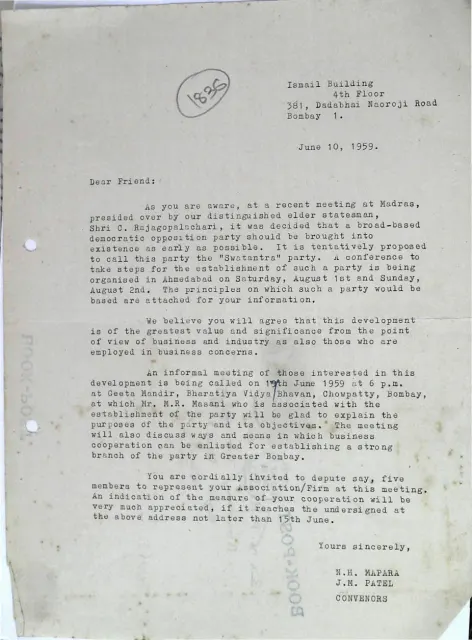
This 10-page English document consists of a letter dated June 10, 1959, from N.H. Mapara and J.M. Patel, convenors writing from Bombay. It reports a recent Madras meeting chaired by C. Rajagopalachari at which participants agreed that a broad-based democratic opposition party should be established as soon as possible, tentatively under the name “Swatantra” Party. The letter announces a founding conference in Ahmedabad on August 1–2, 1959, and invites business associations and firms to send representatives to an informal Bombay meeting at which M.R. Masani would explain the proposed party’s objectives and discuss business support for a Greater Bombay branch.
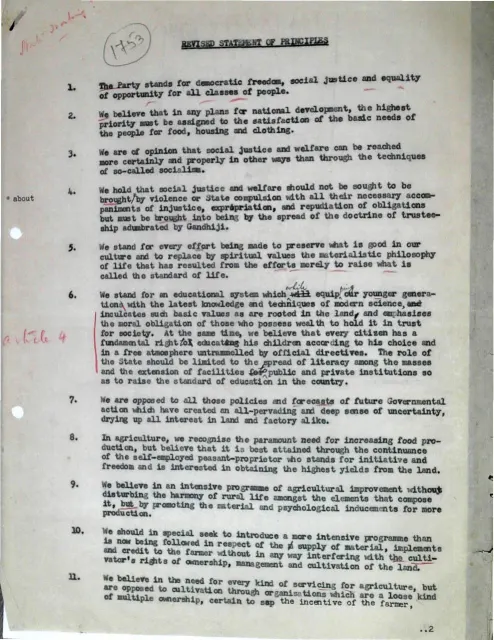
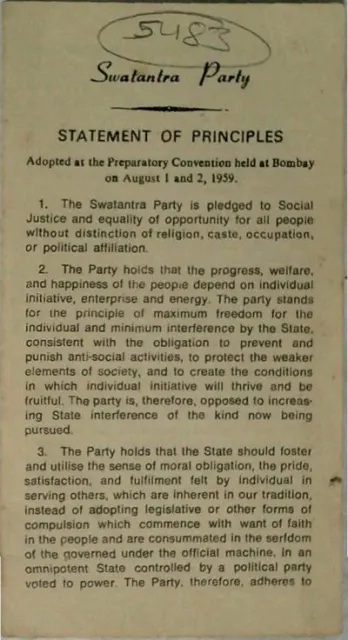
The attached 15-point statement defines the party’s principles. It combines democratic freedom, social justice, equality of opportunity, and priority for basic needs with opposition to coercive state socialism, collectivised agriculture, excessive bureaucracy, expansive state enterprise, deficit financing, excessive taxation, inflation, and the removal of constitutional guarantees concerning property, trade, employment, and compensation. The statement supports self-employed peasant proprietors, incentives and competition in industry, restricted state enterprise, individual freedom, and a state whose regulatory role is limited primarily to preventing and punishing anti-social activity.
Key points
- The letter seeks support for creating a broad-based democratic opposition party, tentatively named the Swatantra Party.
- A founding conference is announced for Ahmedabad on August 1 and 2, 1959.
- The convenors invite business associations and firms to send representatives to a Bombay meeting featuring M.R. Masani.
- The attached principles combine democratic freedom, social justice, equality of opportunity, and satisfaction of basic needs.
- The programme rejects coercive socialism, collectivisation, excessive bureaucracy, and broad state ownership of economic activity.
- It favours self-employed peasant proprietors, private enterprise, production incentives, competition, and reasonable prices for farmers.
- It opposes crippling taxation, unsustainable deficit financing, excessive foreign borrowing, inflation, and the erosion of constitutional economic guarantees.
- It presents individual freedom and limited state regulation as the basis of effective government.
Metadata and summary are AI-extracted from the source PDF and reviewed for editorial accuracy. The original work is available via the Read PDF tab above (where present); paragraph-level citation inside the PDF is deferred to a future engagement.