essay
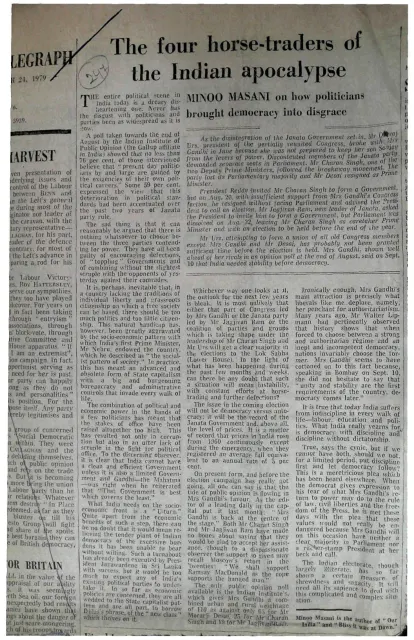
The four horse-traders of the Indian apocalypse
MINOO MASANI on how politicians brought democracy into disgrace
By Minoo Masani
THE DAILY TELEGRAPH · London · 1979
4 pages
Summary
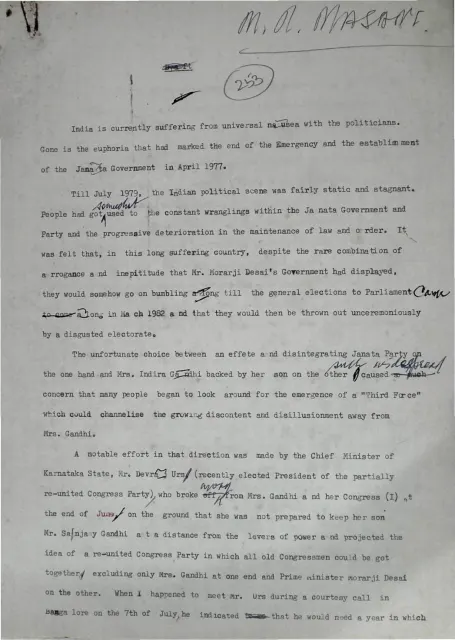
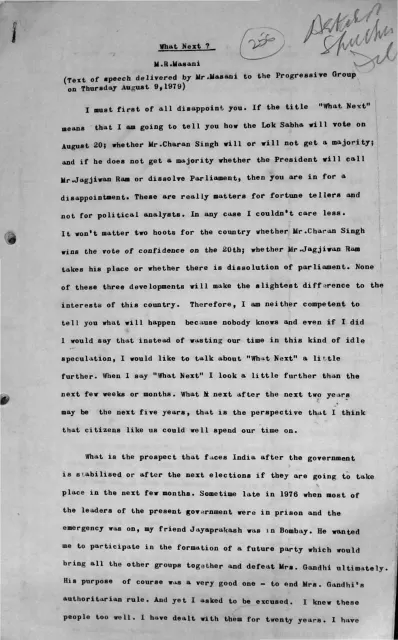
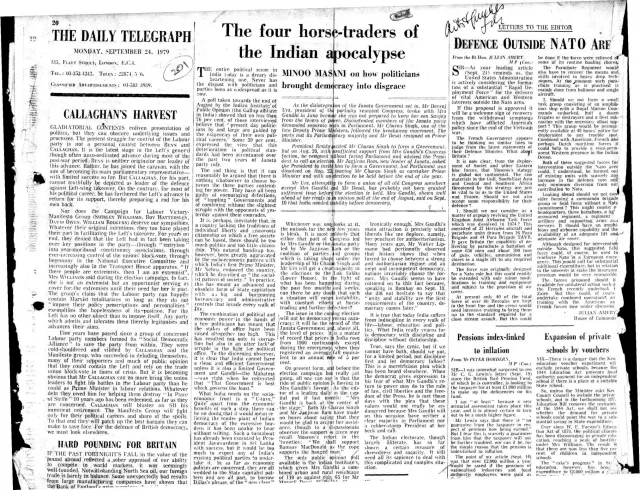
In the rendered article page, Minoo Masani surveys the political collapse of India’s Janata Government and the fragmentation of the Congress opposition. He argues that the country’s politicians have discredited democracy by treating governments as instruments for personal power, encouraging defections, and combining office-seeking with administrative and economic control. The discussion focuses on the breakdown of the Janata coalition, Charan Singh’s brief premiership, Morarji Desai’s resignation, and Indira Gandhi’s return to political prominence.
Key points
- Masani presents the contemporary Indian political scene as marked by widespread public disgust with political parties.
- He attributes the Janata Government’s collapse to defections, factional rivalry, and the absence of a coherent governing purpose.
- The article criticises the concentration of political and economic power in the hands of a small number of politicians.
- Masani links India’s political weaknesses to the erosion of traditions of individual liberty and grassroots citizenship.
- He describes the political order associated with Nehru as a form of State capitalism involving bureaucracy and administrative controls.
- The article argues that the coming election would test whether India’s politics produced democracy or autocracy.
- Masani warns that Indira Gandhi’s electoral appeal rests partly on authoritarian tendencies that liberals oppose.
Metadata and summary are AI-extracted from the source PDF and reviewed for editorial accuracy. The original work is available via the Read PDF tab above (where present); paragraph-level citation inside the PDF is deferred to a future engagement.