Summary
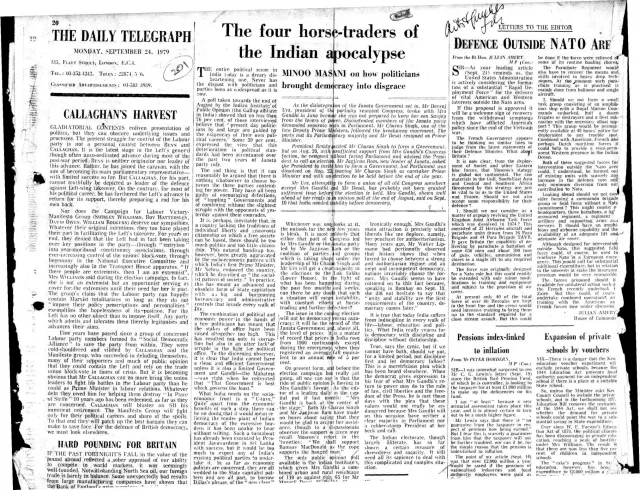
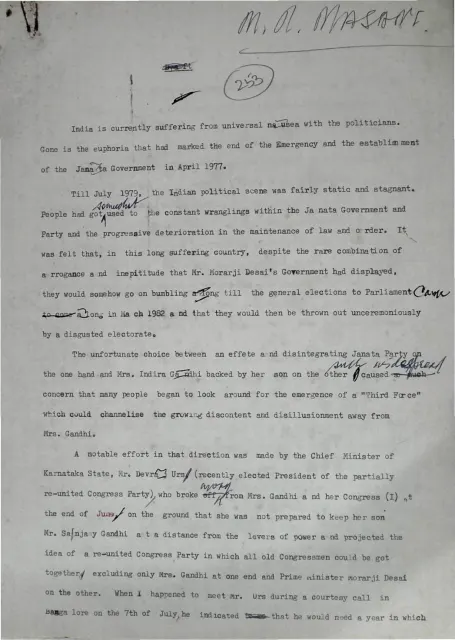
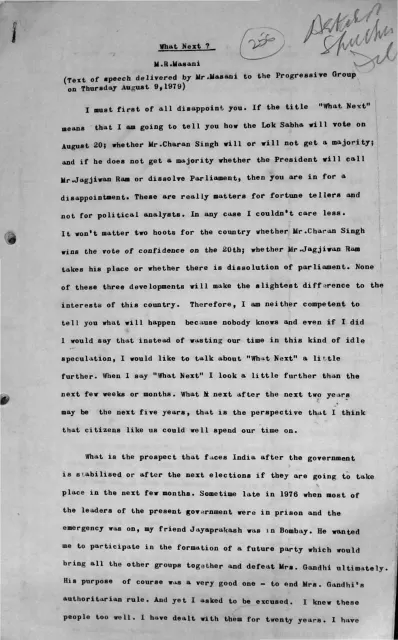
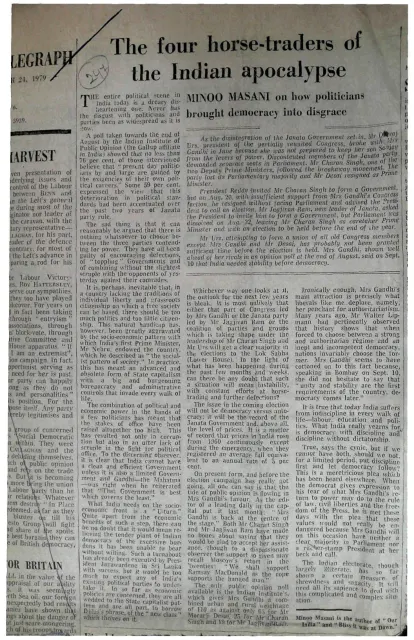
In this 24 March 1979 newspaper article, Minoo Masani surveys the disintegration of the Janata Government and the resulting contest among Indira Gandhi, Charan Singh, and Jagjivan Ram. He argues that public disgust with politicians has become widespread, citing a poll in which 76 per cent of respondents said present-day politicians were guided by their own political careers and that political standards had deteriorated during the Janata period. Masani attributes the crisis to factionalism, office-seeking, and the concentration of political and economic power, set against what he describes as India’s weak traditions of individual liberty and grassroots citizenship.
Masani presents the coming election as a choice between democracy and authoritarianism rather than simply between rival parties. He warns that instability, defections, and the absence of an effective opposition could return Indira Gandhi to power, while insisting that India’s need is for discipline within democracy, not dictatorship. The article closes by defending civil liberties and free expression, arguing that democratic discipline must not become a pretext for suppressing dissent. The page also invokes Jawaharlal Nehru, Mahatma Gandhi, and Walter Lippmann in framing these political and institutional concerns.
Key points
- Masani describes widespread public disgust with politicians and cites an August poll reporting that 76 per cent of respondents distrusted present-day political leadership.
- He portrays the Janata Government’s collapse as the product of factionalism, defections, and competition for office among Charan Singh, Jagjivan Ram, and Morarji Desai.
- The article links political dysfunction to India’s limited traditions of individual liberty, grassroots citizenship, and an effective opposition.
- Masani criticises the concentration of political and economic power and associates it with corruption and bureaucratic controls over everyday life.
- He frames the coming election as a test of democracy versus authoritarianism, rather than merely a contest between parties.
- He argues that India needs democratic discipline without dictatorship and warns against restrictions on civil liberties and freedom of the press.
Metadata and summary are AI-extracted from the source PDF and reviewed for editorial accuracy. The original work is available via the Read PDF tab above (where present); paragraph-level citation inside the PDF is deferred to a future engagement.