pamphlet
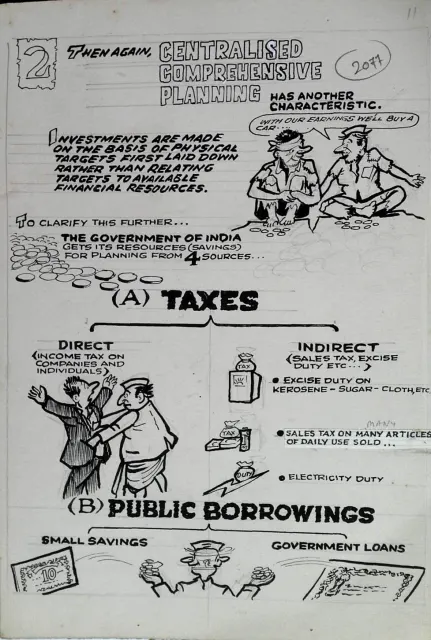
When Again, CENTRALISED COMPREHENSIVE PLANNING HAS ANOTHER CHARACTERSTIC.
1 pages
Summary
The illustrated sheet presents centralised comprehensive planning as an approach in which investments are based on previously established physical targets rather than on available financial resources. It argues that this method generates pressure to mobilise funds through taxation and public borrowing, rather than allowing investment decisions to respond to financial constraints.
The page identifies four sources from which the Government of India obtains planning resources: taxes, public borrowings, deficit financing, and foreign aid, although only the first two are detailed in the visible portion. The taxation section distinguishes direct taxes, such as income tax on companies and individuals, from indirect taxes, including excise duties on kerosene, sugar, and cloth, sales taxes on articles of daily use, and electricity duty. The public-borrowings section identifies small savings and government loans as sources of funds.
Key points
- Centralised comprehensive planning sets physical investment targets before relating them to available financial resources.
- The sheet presents this investment method as creating a need to mobilise funds through taxation and public borrowing.
- It states that the Government of India draws planning resources from four sources.
- Direct taxation includes income tax on companies and individuals.
- Indirect taxation includes excise duty, sales tax, and electricity duty.
- Public borrowings are represented through small savings and government loans.
Metadata and summary are AI-extracted from the source PDF and reviewed for editorial accuracy. The original work is available via the Read PDF tab above (where present); paragraph-level citation inside the PDF is deferred to a future engagement.