circular
CENTRAL OFFICE CIRCULAR NO. 43.
By S. V. Raju
Swatantra Party Central Office · Bombay · 1966
7 pages
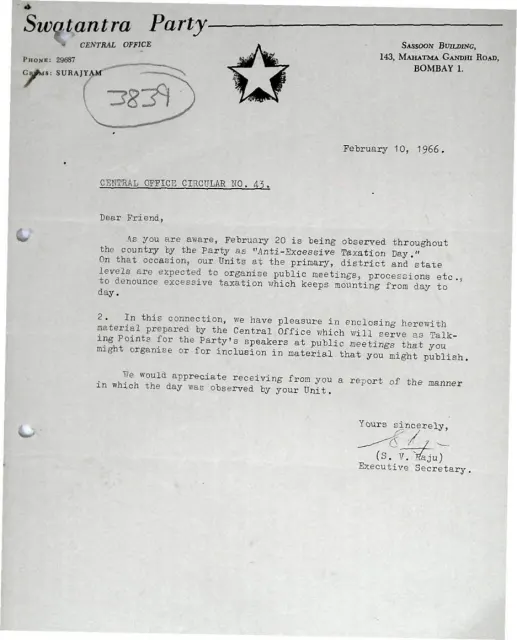
Summary
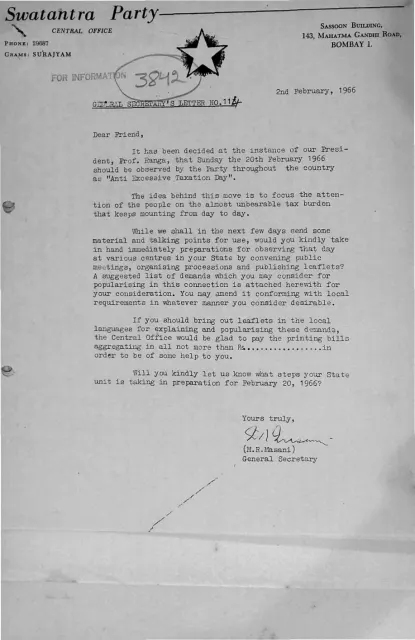
This Central Office Circular, issued by S. V. Raju on February 10, 1966, mobilises Swatantra Party units for an “Anti-Excessive Taxation Day” on February 20. It asks local organisations to hold public meetings and processions denouncing rising taxation, use the enclosed talking points, and report how the day was observed. The accompanying material frames taxation as an economic and political issue, arguing that excessive direct and indirect taxes discourage work, saving, investment, production, and enterprise while imposing disproportionate burdens on agriculturists, small traders, and the middle class.
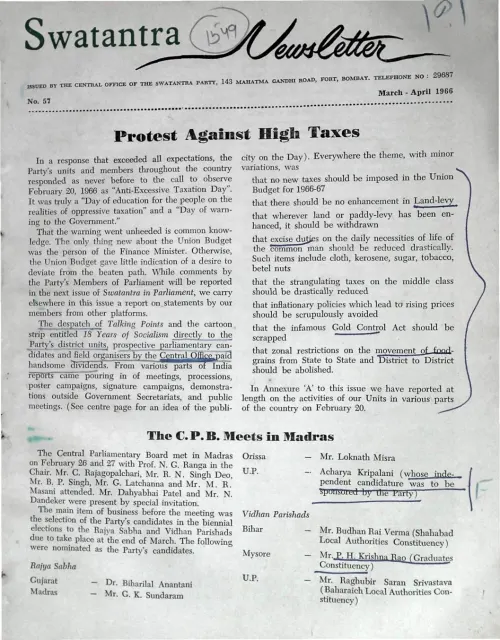
The talking points advocate reducing taxes and government loans by transferring non-essential or unremunerative state enterprises to private enterprise, reforming land-revenue and irrigation laws, reducing excise and sales taxes, and ending inflationary policies. They combine quotations from Mahatma Gandhi and Nani Palkhivala with Swatantra Party policy statements, Reserve Bank data, comparisons with Japan, and tables showing the growth of state revenue and excise duties between the early 1950s and 1965–66. The final handbill turns these arguments into eight demands, including no new Union taxes, withdrawal of enhanced land and paddy levies, sharp reductions in taxes on daily necessities and the middle class, abolition of the Gold Control Act, and removal of zonal restrictions on foodgrain movement.
Key points
- The circular directs Swatantra Party units to organise meetings and processions for Anti-Excessive Taxation Day on February 20, 1966.
- It presents excessive taxation as a deterrent to work, saving, investment, production, and private enterprise.
- It advocates reducing state economic activity, including by transferring non-essential or unremunerative state enterprises to private enterprise.
- It criticises the burden of land revenue, indirect taxation, excise duties, sales taxes, and inflation on agriculturists, small traders, and middle-class taxpayers.
- It uses historical revenue figures, commodity-price data, and Japanese tax policy as evidence for its case against high taxation.
- It identifies instability, complexity, arbitrariness, excessive cumulative burdens, and administrative paralysis as defects of India’s tax system.
- The concluding handbill converts the campaign into eight demands concerning taxation, inflation, the Gold Control Act, and inter-state foodgrain restrictions.
Metadata and summary are AI-extracted from the source PDF and reviewed for editorial accuracy. The original work is available via the Read PDF tab above (where present); paragraph-level citation inside the PDF is deferred to a future engagement.