speech
Mr Masanis Speech At Sundarbai Hall
15 pages
Summary
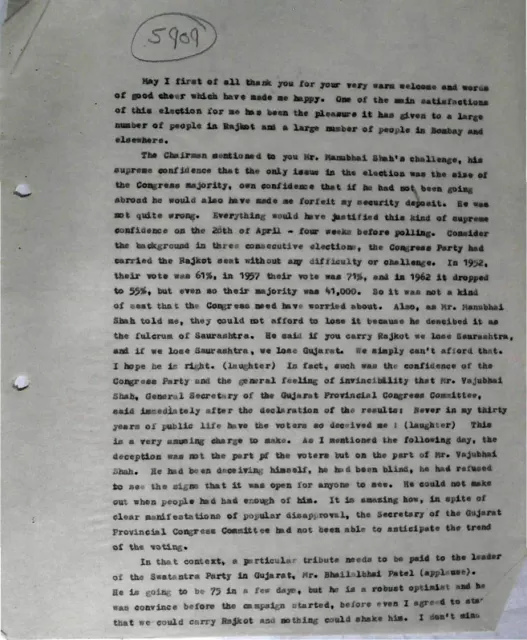
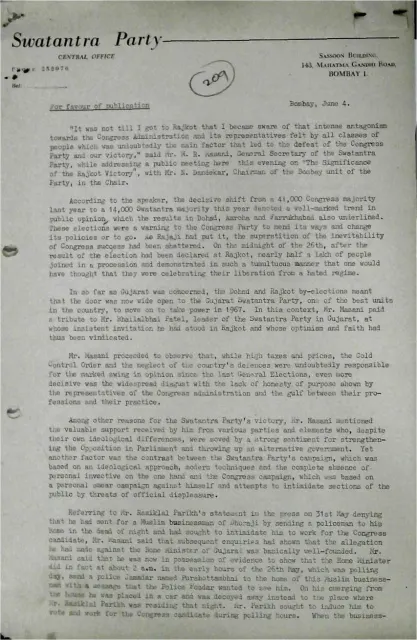
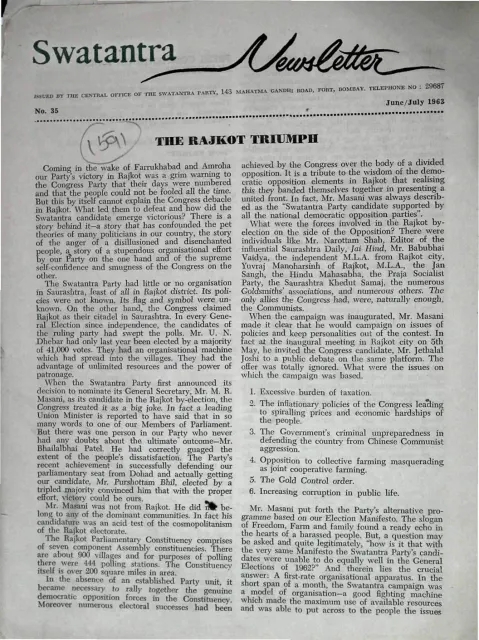
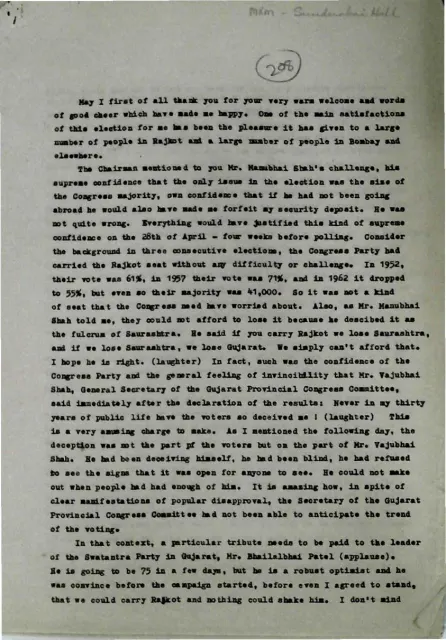
This fifteen-page English transcript is a first-person political address about the Swatantra Party’s victory in the Rajkot election. The speaker attributes the result to widespread dissatisfaction with Congress rule, especially high taxes and prices, the Gold Control Order, perceived neglect of national defence, and the arbitrary or coercive implementation of government policy. He contrasts Congress’s confidence that Rajkot was a safe seat with the Swatantra campaign’s rapid organisation, political messaging, meetings, and mobilisation of young voters and local networks linking Rajkot with Bombay.
The address presents the election as more than a local upset. The speaker describes cooperation among opposition parties, civic and class groups, independent legislators, the press, and members of the former ruling family as a united front against Congress. He also alleges misuse of state authority during the campaign, including an incident in which a Muslim voter was taken from his home under false pretences and pressured to support Congress. The closing pages interpret Rajkot as evidence of a broader shift in public opinion, a warning that Congress must change its policies, and an opportunity for the Swatantra Party to build toward power in Gujarat by 1967. The document has no printed title, byline, date, venue, or publication imprint; the speaker is not formally identified on the rendered pages, although the text refers to “Mr. Masani.”
Key points
- The speaker says Congress’s defeat reflected popular discontent with its administration rather than an accidental local fluctuation.
- The address identifies high taxes and prices, the Gold Control Order, and inadequate defence policy as especially unpopular Congress policies.
- The Swatantra campaign is credited with rapid organisation, modern campaign techniques, political debate, and strong youth participation.
- The victory depended on cooperation among opposition parties, local groups, independent legislators, the press, and other political figures.
- The speech argues that voters wanted a stronger parliamentary opposition and a viable alternative government.
- The speaker alleges that government officials used threats, police, and ministerial influence to pressure voters during the election.
- Rajkot is presented as a warning to Congress to change its policies and as evidence that Swatantra could govern Gujarat by 1967.
Metadata and summary are AI-extracted from the source PDF and reviewed for editorial accuracy. The original work is available via the Read PDF tab above (where present); paragraph-level citation inside the PDF is deferred to a future engagement.