speech
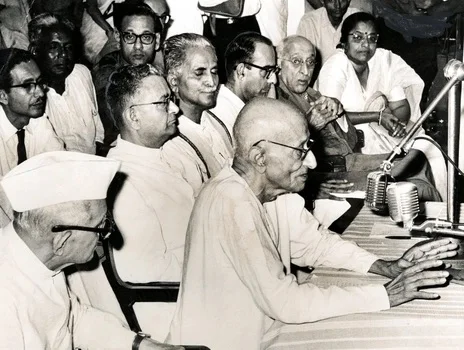
Swatantra Party Meeting
15 pages
Summary
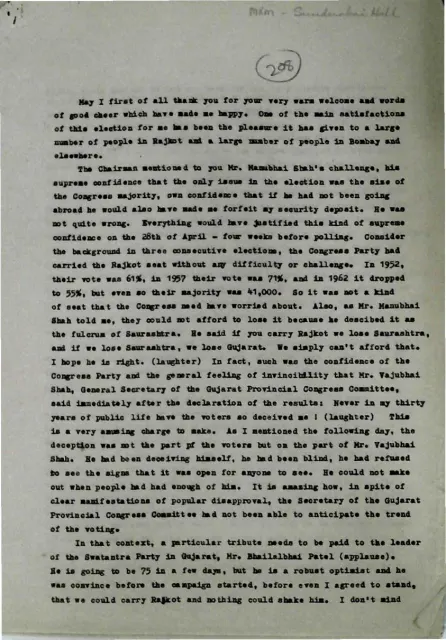
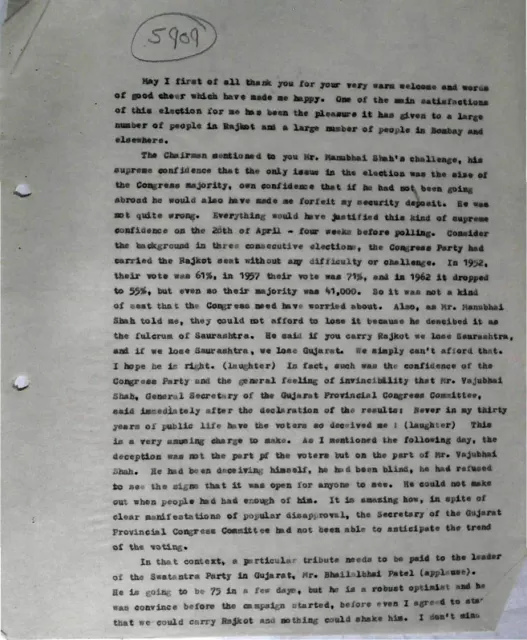
In these fifteen pages, the speaker reflects on the Swatantra Party’s victory in the Rajkot election and explains why the result overturned the Congress Party’s confidence. He recalls that Congress had held the seat in three consecutive elections, but argues that its apparent invincibility concealed deep public dissatisfaction. The speech identifies high taxes and prices, the Gold Control Order, neglect of national defence, administrative arrogance, and the dishonest implementation of policy as central causes of Congress’s defeat. It also describes Rajkot’s poverty, acute water scarcity, and the warmth and hospitality of its residents.
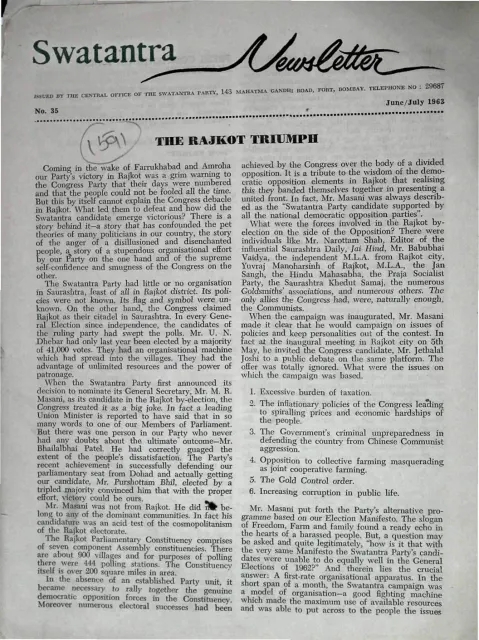
The speaker attributes the victory to an unusually broad United Front: Swatantra campaigners were joined by socialist and Jana Sangh groups, railway workers, independent legislators, disillusioned Congressmen, and the local newspaper Jaihind. He presents the campaign as a form of political education based on meetings, debate, village outreach, and the avoidance of personal attacks. The final pages interpret Rajkot as evidence of a wider national shift against Congress, while also warning that the result gives Congress one more chance to reform its policies. For the Swatantra Party, the election demonstrates that a united opposition could convert a large Congress majority into defeat and potentially build an alternative government by 1967.
Key points
- The speech celebrates the Swatantra Party’s victory in the Rajkot election and explains the collapse of Congress’s confidence.
- The speaker links Congress’s defeat to high taxes and prices, the Gold Control Order, defence neglect, and dissatisfaction with the administration’s conduct.
- Rajkot is depicted as economically poor, severely affected by drought and inadequate water supply, but socially hospitable and politically receptive.
- The victory is attributed to cooperation among Swatantra, socialist, Jana Sangh, labour, independent, dissident Congress, and newspaper forces.
- The campaign is presented as political education: it introduced sustained public debate, addressed villages, attracted younger voters, and avoided personal attacks.
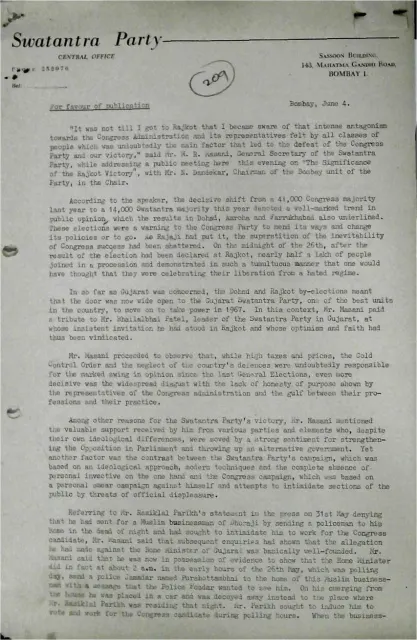
- The speech alleges that Gujarat Home Minister Rasiklal Parikh used police and threats to pressure a Muslim voter to support Congress, and calls for his resignation and an investigation.
- The Rajkot result is interpreted as part of a wider national trend against Congress, not as an isolated local event.
- The speaker argues that a united democratic opposition could provide an alternative government and create a path for Swatantra to seek power in Gujarat and nationally by 1967.
Metadata and summary are AI-extracted from the source PDF and reviewed for editorial accuracy. The original work is available via the Read PDF tab above (where present); paragraph-level citation inside the PDF is deferred to a future engagement.