essay
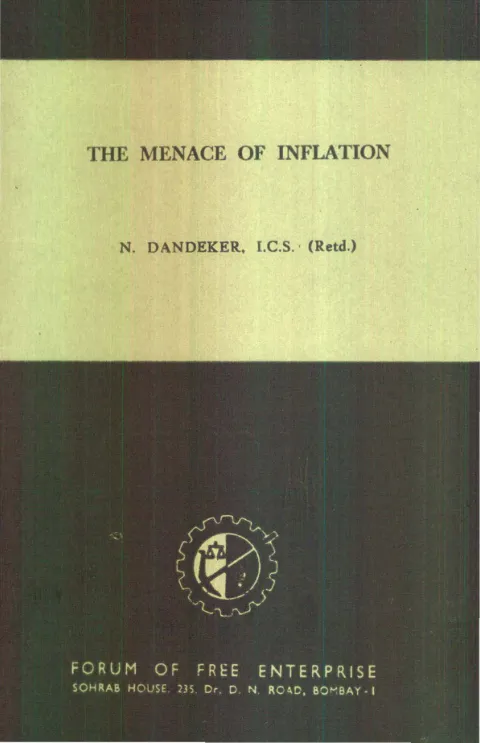
INFLATION
1 pages
Summary
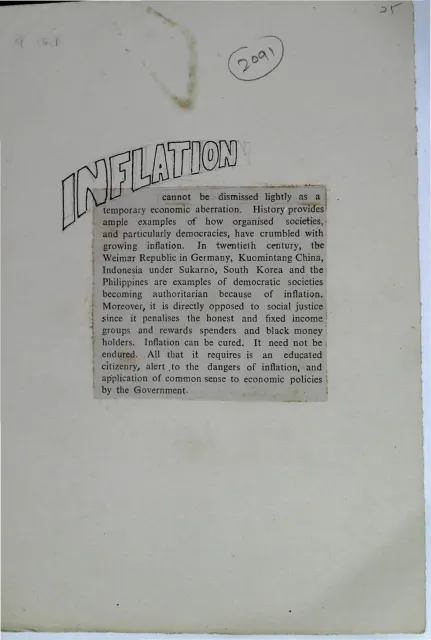
The visible excerpt argues that inflation is not a temporary economic aberration but a serious threat to political and social order. It points to the Weimar Republic, Kuomintang China, Indonesia under Sukarno, South Korea, and the Philippines as examples of democratic societies becoming authoritarian amid rising inflation.
The passage also presents inflation as incompatible with social justice because it penalises people on honest and fixed incomes while benefiting spenders and holders of black money. It concludes that inflation is curable rather than inevitable, requiring an educated and vigilant citizenry together with sensible government economic policy. The author is not identified on the visible page.
Key points
- Inflation is presented as a serious political and social danger, not a temporary economic abnormality.
- The excerpt links growing inflation with the collapse of organised societies and the authoritarian turn of several twentieth-century democracies.
- Examples cited include the Weimar Republic, Kuomintang China, Indonesia under Sukarno, South Korea, and the Philippines.
- Inflation is described as unjust because it penalises honest and fixed-income groups.
- The passage argues that inflation rewards spenders and holders of black money.
- Inflation is portrayed as curable rather than something that must simply be endured.
- The proposed remedies are public education, citizen alertness, and common-sense government economic policies.
Metadata and summary are AI-extracted from the source PDF and reviewed for editorial accuracy. The original work is available via the Read PDF tab above (where present); paragraph-level citation inside the PDF is deferred to a future engagement.