Summary
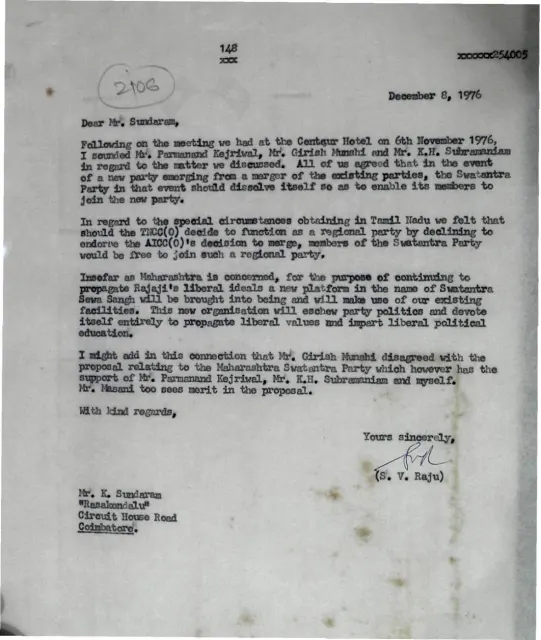
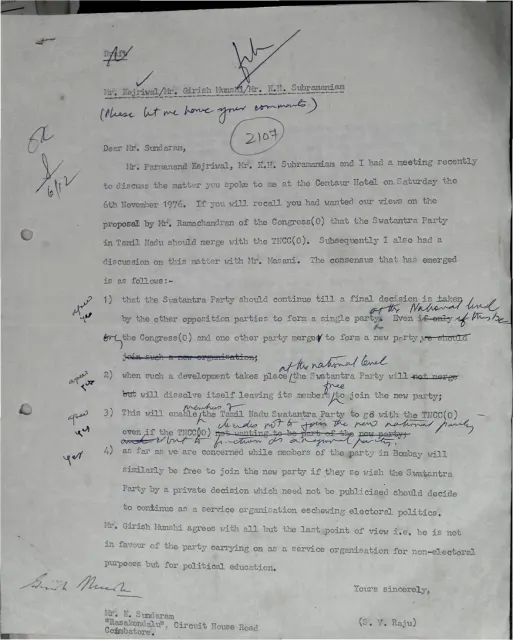
This two-page English correspondence from S. V. Raju to K. Sundaram, dated November 9, 1976, discusses a proposal by Ramachandran of the Congress(O) that the Swatantra Party in Tamil Nadu merge with the TNCC(O). Raju reports discussions with Parmanand Kejriwal, K. H. Subramaniam, and Minoo Masani, and sets out a conditional plan: the Swatantra Party should continue until opposition parties decide to form a single party; if such a party is formed, the Swatantra Party should dissolve and allow its members to join individually.
The letter also distinguishes between Tamil Nadu and Bombay. It proposes that the Tamil Nadu Swatantra Party proceed with the TNCC(O) even if the latter does not join the new national party, while Bombay members would remain free to join. The Swatantra Party could continue as a service organisation without electoral politics, although Girish Munshi preferred political education as its purpose. A separately marked “STRICTLY CONFIDENTIAL” page records the background to the proposal, including the TNCC(O)’s position as a significant opposition party in Tamil Nadu, and seeks a meeting to finalise the arrangement.
Key points
- Raju reports on a proposal for the Tamil Nadu Swatantra Party to merge with the TNCC(O).
- The proposed national opposition arrangement depends on other opposition parties first agreeing to form a single party.
- If a new party is formed, the Swatantra Party would dissolve rather than formally merge, leaving members free to join individually.
- Tamil Nadu and Bombay units are treated differently in the proposed transition.
- The Swatantra Party might continue as a non-electoral service organisation, though Girish Munshi favours political education.
- The confidential memorandum frames the TNCC(O) as the only meaningful opposition party left in Tamil Nadu and discusses practical next steps.
Metadata and summary are AI-extracted from the source PDF and reviewed for editorial accuracy. The original work is available via the Read PDF tab above (where present); paragraph-level citation inside the PDF is deferred to a future engagement.