circular
Swatantra Party Circular
SWATANTRA PARTY- NATIONAL HEADQUARTERS. · Madras—84 · 1976
3 pages
Summary
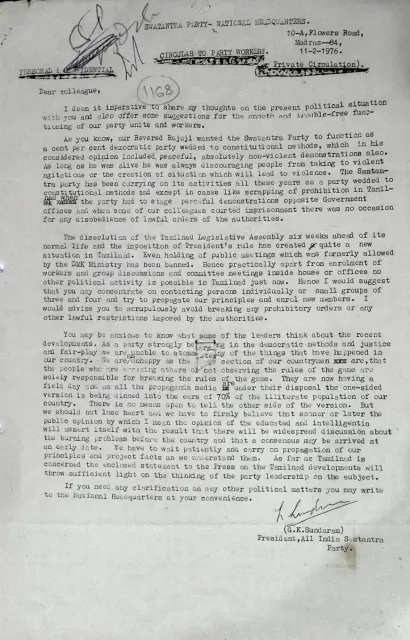
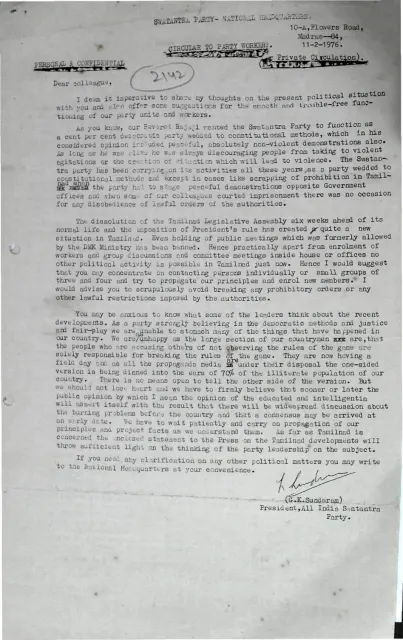
This 11 February 1976 Swatantra Party circular, signed by G. K. Sundaram as President of the All India Swatantra Party, urges party workers to maintain constitutional, non-violent democratic methods during the political crisis in Tamil Nadu. It describes the party’s opposition to violent agitation and its continued adherence to lawful political activity, while noting that the dissolution of the Tamil Nadu Legislative Assembly and the imposition of President’s Rule had sharply restricted public meetings and other political work. Workers are advised to focus on individual or small-group contact, propagate party principles, recruit members, and avoid violating official prohibitions.
The circular also conveys the leadership’s view of the wider political situation. It criticizes one-sided propaganda and expresses confidence that informed public opinion will eventually produce wider discussion and consensus. An enclosed press statement argues that clean, honest, democratic, and efficient government is necessary for national progress, condemns corruption, and welcomes—while calling belated—the Government of India’s appointment of a one-man commission to investigate allegations against former ministers of the erstwhile DMK ministry. It urges similar inquiries into corruption allegations against ministers and former ministers across party affiliations.
Key points
- The circular reaffirms the Swatantra Party’s commitment to constitutional methods, peaceful demonstrations, and non-violence.
- It presents the dissolution of the Tamil Nadu Legislative Assembly and the imposition of President’s Rule as having restricted political activity.
- Party workers are instructed to conduct lawful individual and small-group outreach, propagate party principles, and enrol members.
- The leadership criticizes what it describes as one-sided propaganda reaching a largely illiterate population.
- The document expresses confidence that educated and informed public opinion will eventually lead to broader discussion and political consensus.
- The accompanying press statement links clean and efficient government to national progress under parliamentary government.
- The press statement supports high-power commissions to investigate corruption allegations against ministers, while describing the Government of India’s action as at least five years late.
Metadata and summary are AI-extracted from the source PDF and reviewed for editorial accuracy. The original work is available via the Read PDF tab above (where present); paragraph-level citation inside the PDF is deferred to a future engagement.