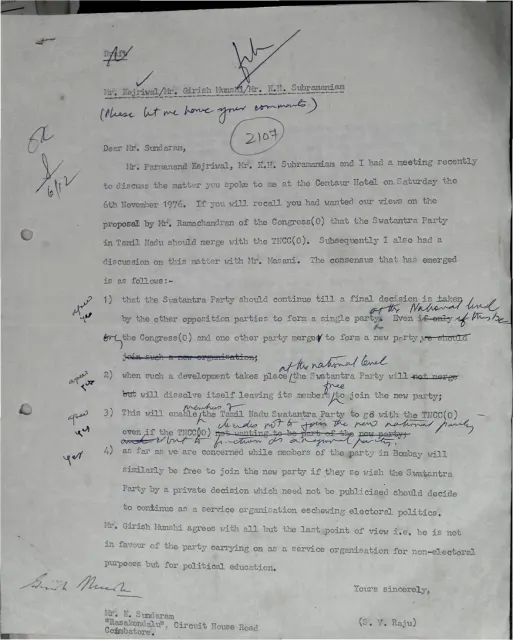
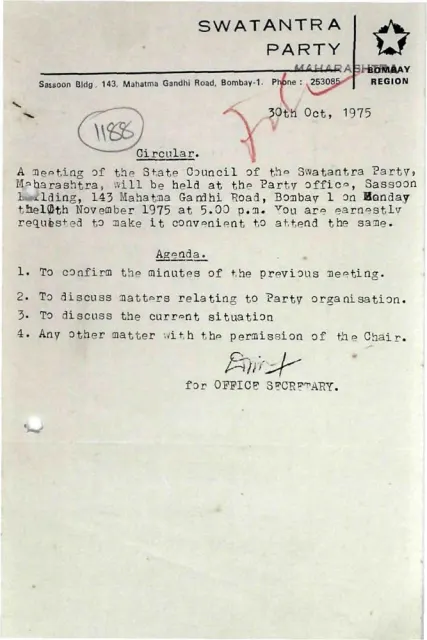
circular
Circular to Party Workers
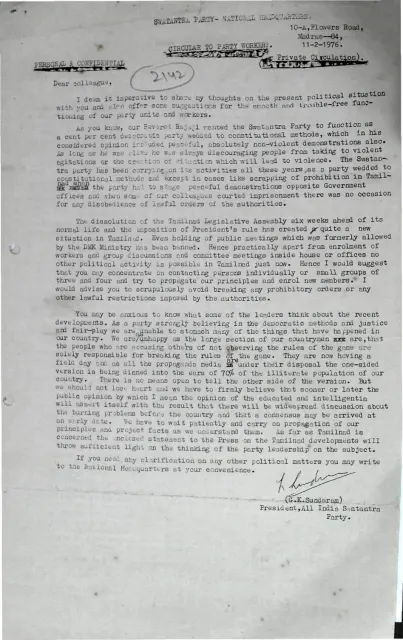
SWATANTRA PARTY - NATIONAL HEADQUARTERS, 10-A, Flowers Road, Madras-84 · Madras · 1976
3 pages
Summary
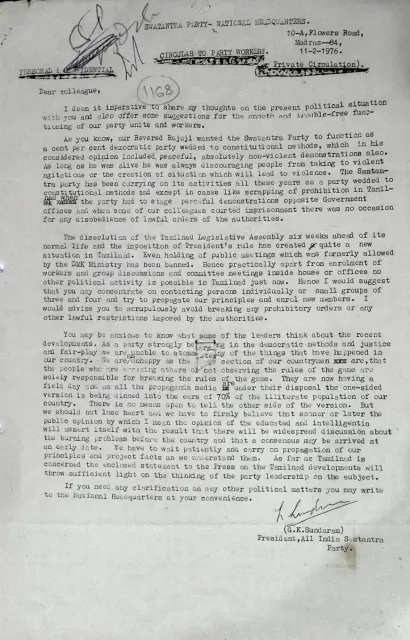
This three-page item bundles two Swatantra Party documents mailed together from the party’s National Headquarters at 10-A Flowers Road, Madras, on 11 February 1976 — eight months into Indira Gandhi’s Emergency. The first is a confidential circular from G. K. Sundaram, President of the All India Swatantra Party, to a fellow party worker, laying out how party units should operate under President’s rule in Tamil Nadu and the wider Emergency clampdown. The second is a press statement issued the same day, welcoming (with sharp qualifications) the Government of India’s decision to set up a one-man commission to investigate corruption charges against former DMK ministers, and demanding that similar commissions be constituted against sitting ministers.
The circular opens by invoking the founding constitutionalism of the late Rajaji, who wanted the Swatantra Party to function as “a cent per cent democratic party wedded to constitutional methods” and who, even in life, discouraged people from resorting to violent agitations. Sundaram reads the recent dissolution of the Tamil Nadu Legislative Assembly six weeks before its natural term, the imposition of President’s rule and the banning of the DMK Ministry as creating a wholly new situation: with public meetings prohibited and party offices closed, workers are advised to shift to contacting persons individually or in small groups of three or four, and to enrol new members while scrupulously avoiding any breach of prohibitory orders. Sundaram acknowledges impatience within the ranks — “a section of our countrymen” think the party is not doing enough about the flouting of democratic rules — but insists that with a one-sided version being pumped into the ears of 70 per cent illiterate voters through a captive media, the party must wait patiently for the educated and intelligentsia to demand wider debate on “the burning problems before the country.”
The accompanying press statement extends the same posture into public argument. The Swatantra Party, it says, has since its inception demanded a high-power commission to investigate corruption in high places; it therefore welcomes the DMK inquiry, though it judges the move to be “at least five years too late” and points out that the reasons for the delay are so obvious they need not be named. The party demands that the Government of India appoint similar commissions in every case where responsible public men, the press or legislators have levelled corruption charges — including against ministers still in office. Together, the two texts document Swatantra’s tactical adaptation to Emergency conditions: a disciplined, non-agitational, membership-building line at the base, combined with pointed institutional demands aimed at converting the regime’s own anti-corruption gestures into a lever against the ruling party.
Key points
- Circular is signed by G. K. Sundaram, President of the All India Swatantra Party, from the party’s National Headquarters at 10-A Flowers Road, Madras-84, and dated 11 February 1976 — during the Emergency.
- Sundaram invokes ‘Revered Rajaji’ as the party’s founding authority for a strictly constitutional, non-violent method of politics, cautioning that even sustained anti-Congress agitation must not slide into extra-legal action.
- With the Tamil Nadu Assembly dissolved six weeks early, the DMK Ministry banned and public meetings prohibited, the party’s advised mode of work shifts to individual and small-group (three or four) contacts and quiet member enrolment, within prohibitory orders.
- Sundaram acknowledges internal frustration that Swatantra is not doing enough in the face of rule-breaking, but argues that a captive propaganda machinery is drumming a one-sided version into ‘70% of the illiterate population’, so patient propagation is the only realistic path until the educated public demands wider debate.
- The circular encloses, for wider Press circulation, a Swatantra press statement of the same date that welcomes the Union Government’s one-man high-power commission on corruption charges against former DMK ministers.
- The press statement judges the commission ‘at least five years too late’ and insists corruption cases against ministers still in office deserve equally high-powered inquiry.
- The item is marked ‘Personal & Confidential’ and ‘Private Circulation’; the outer wrapper is addressed by hand to ‘Sri M. R. Masani, 148 Mahatma Gandhi Road, Bombay-23’ and bears Madras and Bombay ‘Book-Post’ postmarks from February 1976.
- Together the two documents show Swatantra’s Emergency-era stance: disciplined constitutional restraint at the base, combined with institutional demands that turn the regime’s own anti-corruption gestures back on the ruling party.
Metadata and summary are AI-extracted from the source PDF and reviewed for editorial accuracy. The original work is available via the Read PDF tab above (where present); paragraph-level citation inside the PDF is deferred to a future engagement.