
Summary
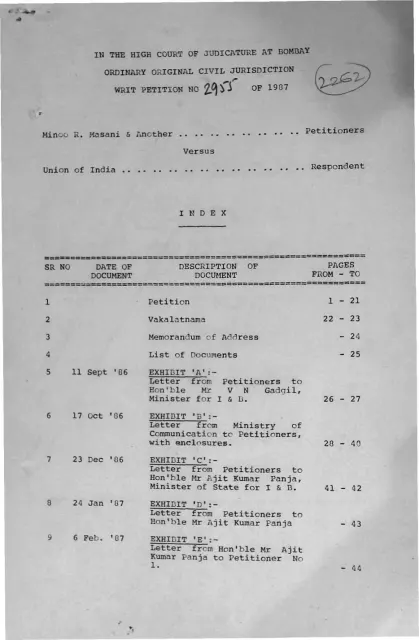
In the rendered pages, this writ petition before the Bombay High Court challenges the Union Government’s monopoly over radio and television broadcasting through All India Radio and Doordarshan. Minoo R. Masani and P. C. Chatterjee state that they sought permission to establish independent medium-power radio and television stations in Bombay and the western region, operating alongside the government services. The petition presents the proposal as an effort to supplement government broadcasting with objective, non-official news and information rather than to acquire or operate a private wireless transmitter alone.
In the rendered pages, the petition argues that the refusal to permit these stations violates Articles 14, 19(1)(a), and 19(1)(g) of the Constitution. It maintains that freedom of speech and expression includes the ability to communicate through radio and television, and that restrictions must be imposed by law, be reasonable, and fall within the purposes listed in Article 19(2). In the rendered pages, the petition further contends that the Indian Wireless Telegraphy Act, 1933 and the Indian Telegraph Act, 1885 regulate apparatus and licensing but do not authorise an exclusive state broadcasting monopoly. It seeks declarations that the monopoly and refusal of a licence are unconstitutional, together with a writ directing the respondents to withdraw the refusal and permit the proposed stations.
Key points
- In the rendered pages, the petitioners identify themselves as Minoo R. Masani, a former parliamentarian and advocate of individual freedom, and P. C. Chatterjee, a former Director-General of All India Radio.
- In the rendered pages, they propose a public limited company with an independent board to establish radio and television stations initially headquartered in Bombay.
- In the rendered pages, the proposed stations are presented as complementary to All India Radio and Doordarshan and as a means of providing objective information outside official government control.
- In the rendered pages, the petition alleges that executive or administrative creation of a broadcasting monopoly violates freedom of speech and expression under Article 19(1)(a).
- In the rendered pages, the petition links private broadcasting to the right to carry on an occupation, trade, or business under Article 19(1)(g).
- In the rendered pages, the petition argues that the relevant wireless and telegraph legislation concerns licensing and possession of apparatus, not the creation of a state monopoly.
- In the rendered pages, the petition invokes Article 14, arguing that the refusal to license the proposed stations is arbitrary, unreasonable, and contrary to the public interest.
- In the rendered pages, the petition asks the High Court for mandamus or other appropriate relief, including permission to establish the stations and a valid licence.
Metadata and summary are AI-extracted from the source PDF and reviewed for editorial accuracy. The original work is available via the Read PDF tab above (where present); paragraph-level citation inside the PDF is deferred to a future engagement.
People in this work
Related across the archive
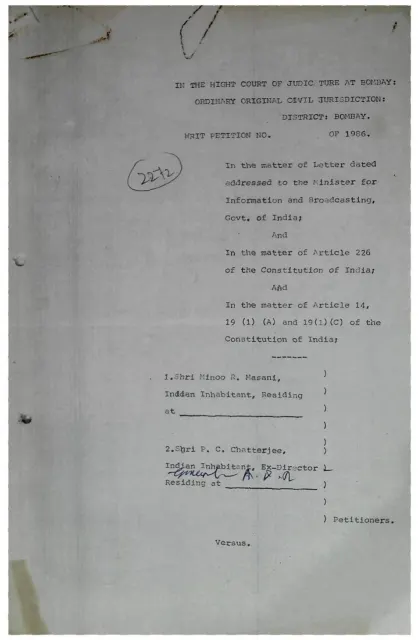 Primary workThe High Court Of Judicature At Bombay Civil Jurisdication Writ Petition No-2955
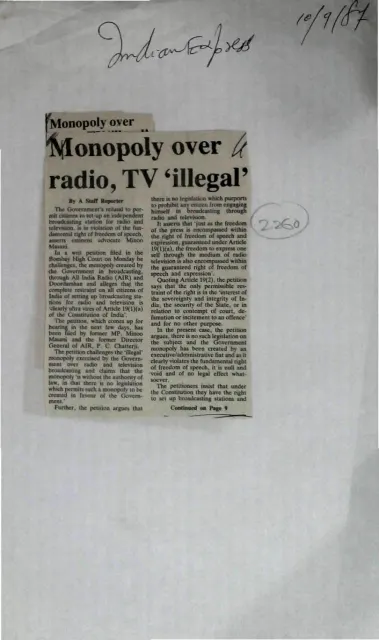 Primary workMonopoly over radio, TV ‘illegal’
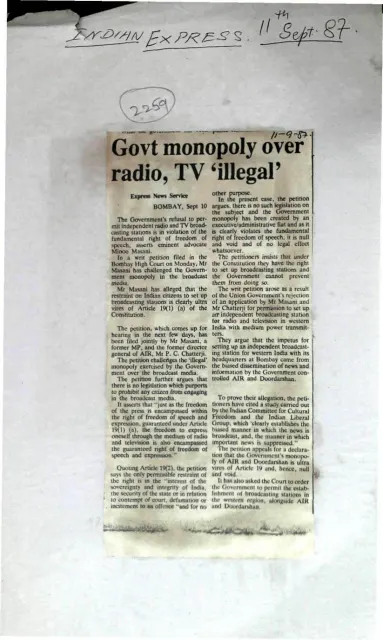 Primary workGovt monopoly over radio, TV ‘illegal’
 ExcerptPitfalls in Our Industrial Policy
 ThePrintPrivate enterprise built India’s industries. Now it’s strangled by Gods in Delhi