legal filing
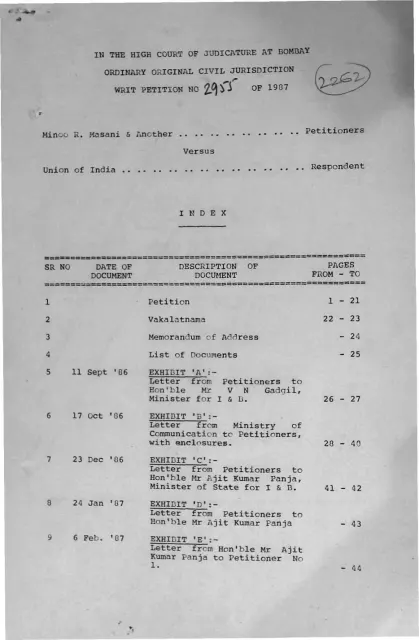
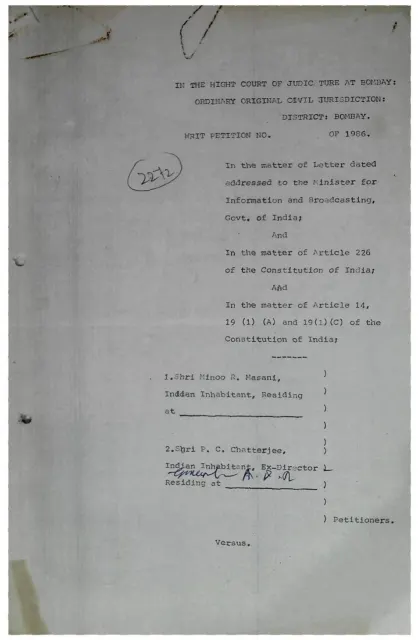
The High Court Of Judicature At Bombay Civil Jurisdication Writ Petition No-2955
By Minoo Masani
Bombay · 1986
35 pages
Summary
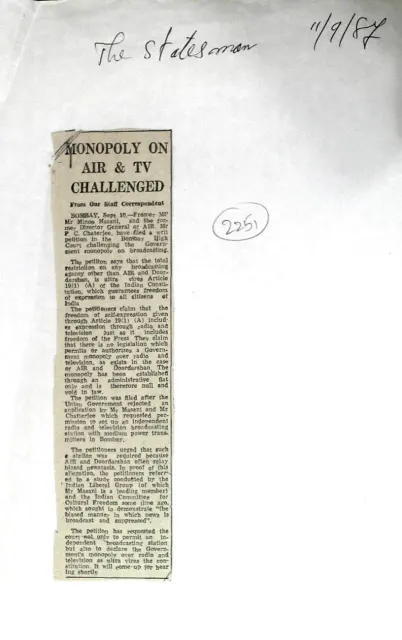
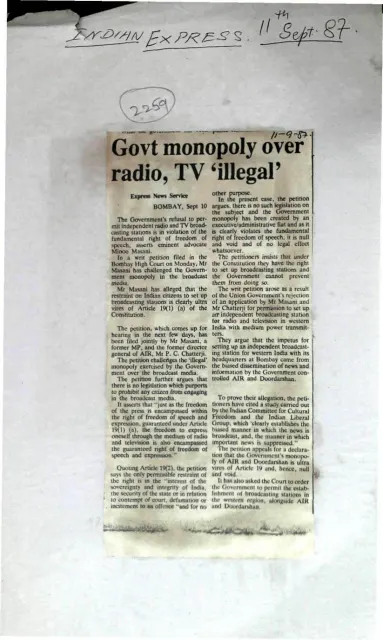
This court-filed writ petition before the High Court of Judicature at Bombay challenges the Union government’s refusal to license independent radio and television broadcasting stations. Petitioners Minoo R. Masani and P. C. Chatterjee propose establishing medium-power stations in Bombay alongside All India Radio and Doordarshan, subject to reasonable government regulation of frequencies and statutory or quasi-judicial supervision. The petition describes Masani as a public figure, former Constituent Assembly and Lok Sabha member, and former General Secretary and President of the Swatantra Party; Chatterjee is identified as a former Director-General of All India Radio with technical knowledge of broadcasting.
The visible grounds argue that the government’s broadcasting monopoly is discriminatory and lacks statutory authority. The petition invokes Articles 14, 19(1)(a), and 19(1)(g) of the Constitution, claiming that access to radio and television is part of freedom of expression, that citizens should be free to choose their medium of communication, and that exclusion from broadcasting unlawfully restricts the petitioners’ occupation, business, and trade. It also relies on the Union List’s treatment of broadcasting and wireless communication, contending that existing legislation regulates wireless transmission but does not authorize a state monopoly over broadcasting. The petition seeks a licence, a declaration that the government monopoly is illegal, invalidation of the rejection letter, and creation of an independent quasi-judicial authority to regulate broadcasters.
Key points
- The petition challenges the government’s rejection of a request to establish independent radio and television stations.
- The proposed stations would operate alongside All India Radio and Doordarshan, initially from Bombay using medium-power transmitters.
- The petitioners offer to accept reasonable controls over frequencies, supervision, and broadcasting standards.
- The constitutional challenge relies principally on equality under Article 14 and freedoms under Articles 19(1)(a) and 19(1)(g).
- The petition treats broadcasting as a vital means of communication and propagation of different points of view.
- It argues that the Union’s legislative authority over communication does not include power to confer an exclusive broadcasting monopoly on government agencies.
- The relief sought includes a broadcasting licence, a declaration against the monopoly, quashing of the impugned rejection, and an independent regulatory authority.
Metadata and summary are AI-extracted from the source PDF and reviewed for editorial accuracy. The original work is available via the Read PDF tab above (where present); paragraph-level citation inside the PDF is deferred to a future engagement.