report · report
DOORDARSHAN
A Study of its "News in English"
Bombay · 1987
13 pages
Summary
This report, commissioned by the Indian Committee for Cultural Freedom and the Indian Liberal Group, examines Doordarshan’s English-language news broadcasts against The Times of India during approximately ninety days between April and August 1986. It assesses the broadcaster against standards of objectivity, fairness, and good reporting, arguing in the rendered pages that a state-controlled medium has been used to favour the establishment and the Prime Minister. The study’s method combines monitoring selected broadcasts with comparison of their priorities, omissions, and framing against newspaper coverage.
In the rendered pages, the report identifies three recurring problems: excessive projection of ministers, suppression or censorship of inconvenient news, and loaded or distorted reporting. Its examples describe extensive coverage of routine ministerial appearances alongside omissions of politically sensitive events, including the Arwal firing, the Karnataka–Maharashtra border dispute, Chinese incursions in Arunachal Pradesh, communal violence, and criticism of the government. It also criticises economic reporting for highlighting official successes while excluding failures and adverse facts, and concludes that Doordarshan generally presents the government’s point of view rather than the range of perspectives required of a publicly funded broadcaster. The rendered pages do not include the report’s later tabulated statements or the continuation of the final analytical section.
Key points
- The study compares Doordarshan’s English news with The Times of India over randomly selected days spread across April–August 1986.
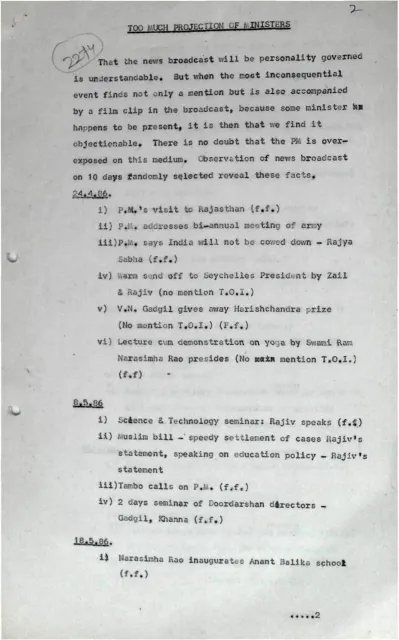
- It argues that Doordarshan gives disproportionate attention to ministers, especially the Prime Minister, even when the underlying events are insignificant.
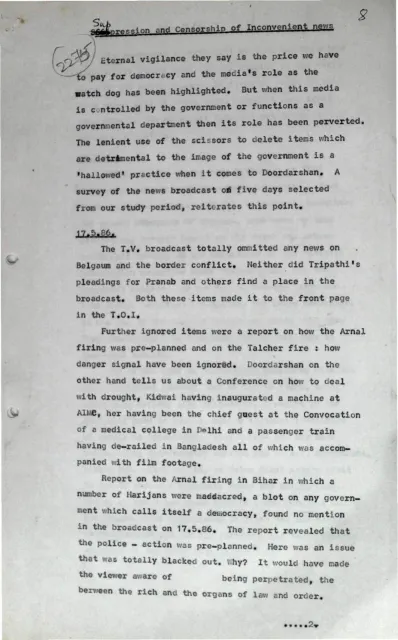
- The report documents omissions of politically inconvenient stories, including the Arwal firing, border conflicts, Chinese incursions, communal clashes, and criticism of government performance.
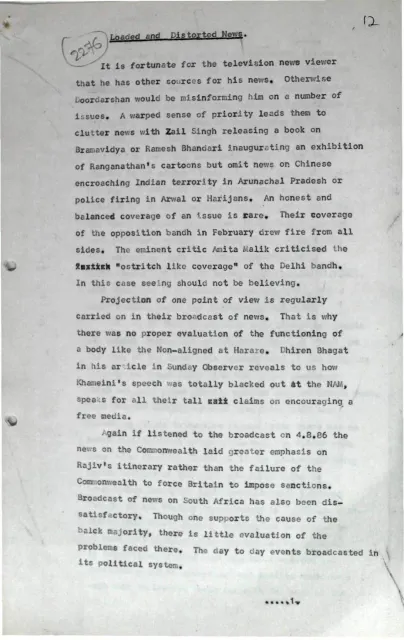
- It contends that Doordarshan’s reports are frequently one-sided, partially true, or distorted through selective emphasis and omission.
- Economic coverage is described as official promotional language that foregrounds successes while excluding failures, losses, and institutional ineptitude.
- The report invokes the AIR Code and argues that criticism of government is permissible, but that Doordarshan routinely presents only the government’s perspective.
- The visible pages call for news to be treated as a process and presented from the perspectives of diverse social, economic, and political groups.
Metadata and summary are AI-extracted from the source PDF and reviewed for editorial accuracy. The original work is available via the Read PDF tab above (where present); paragraph-level citation inside the PDF is deferred to a future engagement.