essay
Suppression and Censorship of Inconvenient news
1986
4 pages
Summary
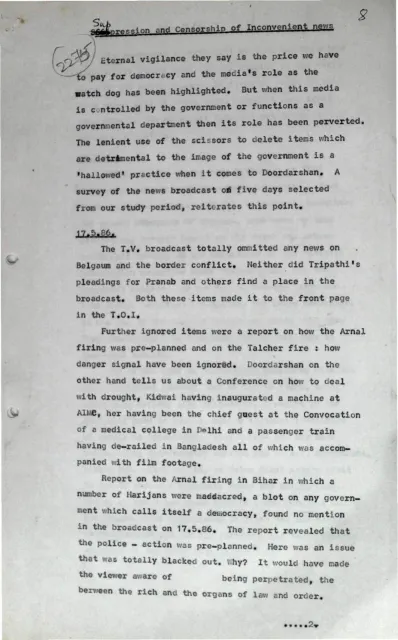
The work examines the suppression and censorship of inconvenient news in Doordarshan broadcasts, arguing that a government-controlled media outlet reverses the democratic function of the press as a watchdog. It compares television news with newspaper coverage across selected dates in May and July 1986, identifying repeated omissions of politically damaging stories, including the Karnataka–Maharashtra border conflict, the Arnal firing in Bihar, reports of a pre-planned police action, and the Talcher fire.
The pages argue that Doordarshan substituted politically harmless or ceremonial items for news of greater public importance. On 15 July, for example, the broadcast covered routine administrative and cultural events while omitting a major Chinese intrusion into Arunachal Pradesh; on 17 July it foregrounded official statements and diplomatic gestures while ignoring newspaper reports concerning terrorism, Pakistan, and China. The concluding discussion links these omissions to a broader loss of credibility, citing the non-coverage or delayed coverage of the Gurkhaland issue, Ahmedabad clashes, the border conflict, the Arnal firing, Sobharaj’s escape, and the Chernobyl disaster. The text presents this pattern as an ingrained practice of public-relations broadcasting rather than independent news reporting.
Key points
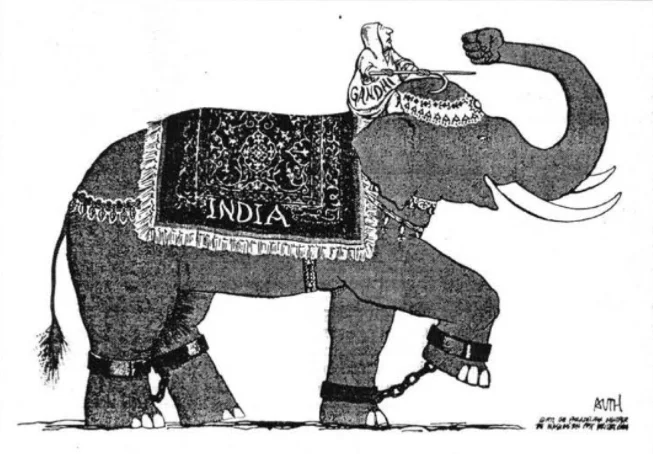
- The text presents government control of the media as a perversion of the press’s watchdog role.
- A comparison of Doordarshan broadcasts with newspaper front pages identifies repeated omissions of politically inconvenient news.
- The Arnal firing in Bihar, including the allegation that the police action was pre-planned, is described as being blacked out.
- The Karnataka–Maharashtra border conflict received newspaper coverage but no corresponding place in the television broadcasts examined.
- The 15 July broadcast omitted a major Chinese intrusion into Arunachal Pradesh, despite the event’s prominence in newspapers.
- The 17 July broadcast is criticized for prioritizing official and ceremonial items over reports on terrorism, Pakistan, and China’s claims.
- The concluding argument is that censorship and selective omission made Doordarshan’s news broadcasts appear focused on public relations and reduced their credibility with viewers.
Metadata and summary are AI-extracted from the source PDF and reviewed for editorial accuracy. The original work is available via the Read PDF tab above (where present); paragraph-level citation inside the PDF is deferred to a future engagement.