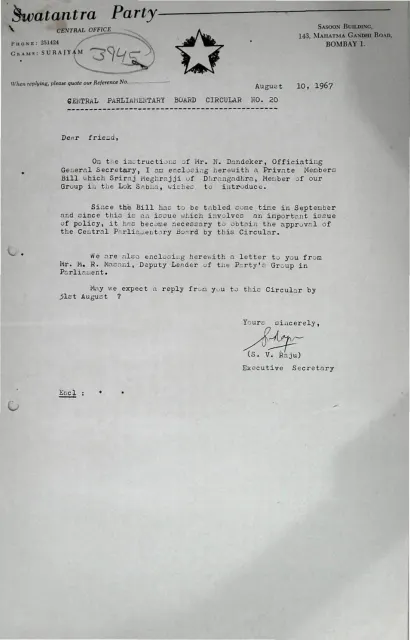
speech · convention address
THE FUNDAMENTAL RIGHTS UNDER THE CONSTITUTION AND THE SUPREME COURT
Printed at the Kalki Press, Chetput, Madras-31 and Published by S.V. Raju for the Adult Education Institute, 143, Mahatma Gandhi Road, Bombay-1 · Bombay
25 pages
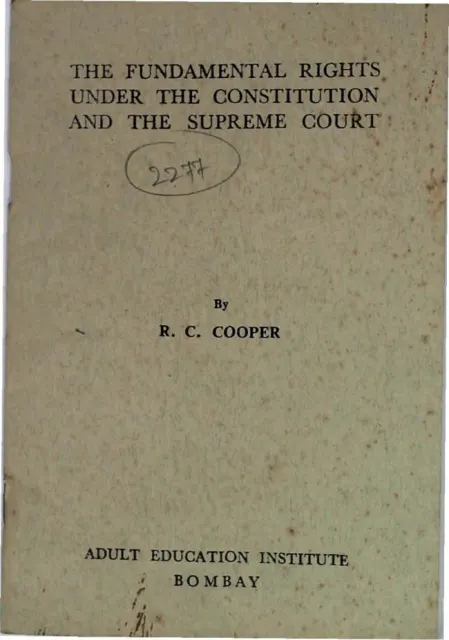
Summary
In the rendered pages, R. C. Cooper presents Fundamental Rights as constitutional safeguards designed to protect individual liberty from changing political majorities, executive arbitrariness, and bureaucratic interference. He traces the Indian demand for such guarantees from the 1895 Swaraj Bill and Annie Besant’s Commonwealth of India Bill through the Indian National Congress’s 1927 declaration and the Motilal Nehru Committee’s 1928 report. The speech argues that the experience of colonial repression and the insecurity of communal divisions made enforceable rights central to the Constitution’s legitimacy.
In the rendered pages, Cooper focuses especially on the right to property and the constitutional controversy surrounding Mr Nath Pai’s Bill, which sought to restore Parliament’s power to amend or remove Fundamental Rights after the Supreme Court’s Golaknath judgment. He rejects parliamentary supremacy, maintains that sovereignty rests with the people rather than Parliament, and emphasizes the Supreme Court’s role as guardian of constitutional limits. He treats property broadly—as including a small farm, tenancy rights, a village shop, savings, bank deposits, and personal effects—and argues that the proposed amendment would expose every citizen to legislative overreach. The speech also links Fundamental Rights with minority security, judicial independence, due process, and the balance between Parts III and IV of the Constitution.
Key points
- The rendered pages trace the historical development of demands for Fundamental Rights in India from 1895 through the framing of the Constitution.
- Fundamental Rights are presented as protections against both executive and legislative arbitrariness.
- Cooper argues that an independent judiciary must be constitutionally entrusted with guarding individual rights.
- The speech defends the right to property as a protection relevant to ordinary citizens, not only wealthy proprietors or industrialists.
- The discussion criticizes the proposed Nath Pai Bill for seeking to restore Parliament’s power to abridge Fundamental Rights.
- Cooper rejects the idea that Parliament is sovereign under the Indian Constitution; sovereignty is vested in the people.
- The rendered pages connect Fundamental Rights with minority security, due process, constitutional stability, and the prevention of authoritarian rule.
Metadata and summary are AI-extracted from the source PDF and reviewed for editorial accuracy. The original work is available via the Read PDF tab above (where present); paragraph-level citation inside the PDF is deferred to a future engagement.