essay
What stirred us?
Himmat · 1969
1 pages
Summary
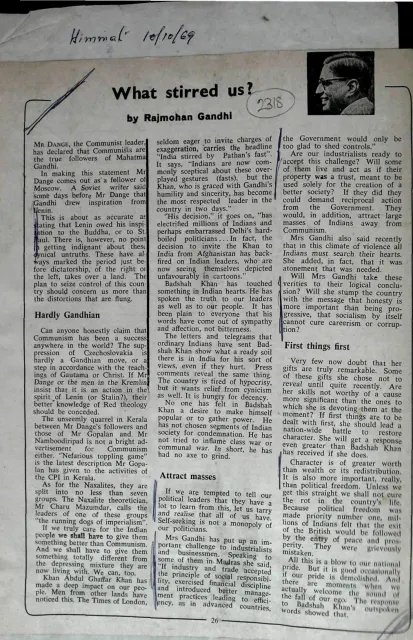
In the rendered page, Rajmohan Gandhi challenges the claim that Communists are the true followers of Mahatma Gandhi. He argues that Communist practice—including the suppression of Czechoslovakia—cannot plausibly be reconciled with the teachings of Gandhi, Gautama, or Christ, and criticizes factional conflict among Communist groups in Kerala and the Naxalite movement. The article presents Khan Abdul Ghaffar Khan’s visit to India as a contrasting example: Khan’s humility, sincerity, and lack of appetite for power have elicited an unusually warm public response. In the rendered page, Gandhi then turns to the political and economic implications of this response. He reports Indira Gandhi’s challenge to industrialists to accept social responsibility and improve management, while asking whether Indian business can operate as a trust for the creation of a better society. The article concludes by arguing that political freedom and moral character must come before economic redistribution, and that honesty, decency, and freedom from corruption are more fundamental than socialism by itself.
Key points
- The article rejects the assertion that Communist politics represents the spirit of Mahatma Gandhi. It criticizes Communist repression, factionalism in Kerala, and the Naxalite movement. Khan Abdul Ghaffar Khan is presented as a figure whose humility and sincerity have moved Indian public opinion. The article interprets the public response to Khan as evidence of a desire for decency and relief from political cynicism. Indira Gandhi’s appeal to industrialists is framed around social responsibility, financial discipline, and better management. The author argues that industrialists should treat property as a trust directed toward social improvement.
- Political freedom, honesty, and character are presented as prior to redistribution and socialism.
Metadata and summary are AI-extracted from the source PDF and reviewed for editorial accuracy. The original work is available via the Read PDF tab above (where present); paragraph-level citation inside the PDF is deferred to a future engagement.