periodical issue
Freedom First
By A. G. Mulgaokar, H. R. Pardivala, M. R. Masani, M.P., A. G. Noorani, Moin Shakir, Analyst
Edited and published for the Democratic Research Service by V. B. Karnik at 127 Mahatma Gandhi Road, Bombay 1, and printed by him at Inland Printers, 55 Gamdevi Road, Bombay 7. · Bombay · 1970
12 pages
Freedom First
Summary
Freedom First No. 212 (January 1970), the Bombay-based liberal monthly edited by V. B. Karnik for the Democratic Research Service, opens with A. G. Mulgaokar’s lead editorial-essay warning against the move — backed by fifty A.I.C.C. members of the Indira Gandhi group — to delete the constitutional right to property, which he frames as a dangerous erosion of fundamental rights disguised as a step toward socialism. The issue’s other pieces range across contemporary politics and history: H. R. Pardivala calls for a new Gandhian political party to rescue the country from corrupt professional politicians; M. R. Masani, M.P., attacks the Monopolies and Restrictive Trade Practices Bill as a fraud that exempts state monopolies while doing nothing to curb them; A. G. Noorani reviews two new histories of partition; Moin Shakir profiles Badshah Khan (Khan Abdul Ghaffar Khan) and the Khudai Khidmatgar movement; and a Bengal Report column by ‘Analyst’ tracks the West Bengal United Front government’s hunger-strike politics. The issue closes with letters to the editor, a review of a Leslie Sawhny/Indian Liberal Group colloquium report on democracy and development, and the regular ‘With Many Voices’ column of press quotations.
Key points
-
A. G. Mulgaokar’s lead essay warns against the campaign, backed by fifty A.I.C.C. members of the Indira Gandhi faction, to delete the constitutional right to property, arguing that once one fundamental right can be abridged by ordinary majority, none remains truly fundamental.
-
H. R. Pardivala’s “The Need Of The Hour” blames professional politicians for corruption and communal exploitation, endorsing a proposal by Khan Abdul Ghaffar Khan and Vinoba Bhave for a new Gandhian political party and appealing to Jayaprakash Narayan to lead it.
-
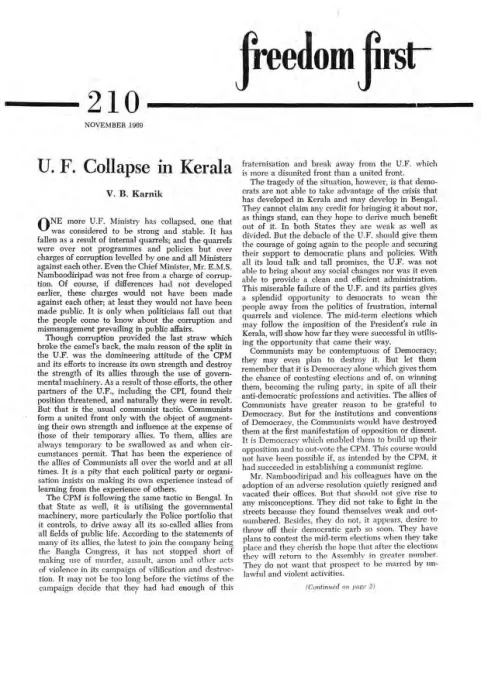
M. R. Masani’s “Monopolies: State Or Private?” attacks the Monopolies and Restrictive Trade Practices Bill for exempting the only real monopolies in India, government enterprises like LIC and Indian Railways, while targeting private firms, calling the resulting regime “industrial feudalism.”
-
A. G. Noorani reviews two new histories of Partition, R. C. Majumdar’s Struggle for Freedom and B. N. Pandey’s The Break-up of British India, concluding both point toward greater Congress culpability for the failure to compromise around the 1946 Cabinet Mission Plan.
-
Moin Shakir profiles Khan Abdul Ghaffar Khan (“Badshah Khan”) and the Khudai Khidmatgar movement, recounting how the Muslim League branded him a Congress agent for rejecting the two-nation theory and his post-1947 lament that Pakistan was “founded on hatred.”
-
Writing as “Analyst,” a “Bengal Report” covers Chief Minister Ajoy Mukherjee’s hunger-strike satyagraha over law and order and his standoff with CPM Home Minister Jyoti Basu.
-
M. R. Chandvadkar reviews a report on an international colloquium on “Democracy and Development” at Coonoor, which concluded liberal democracy pairs individual liberty with a competitive economy more effectively than dictatorship.
Essays
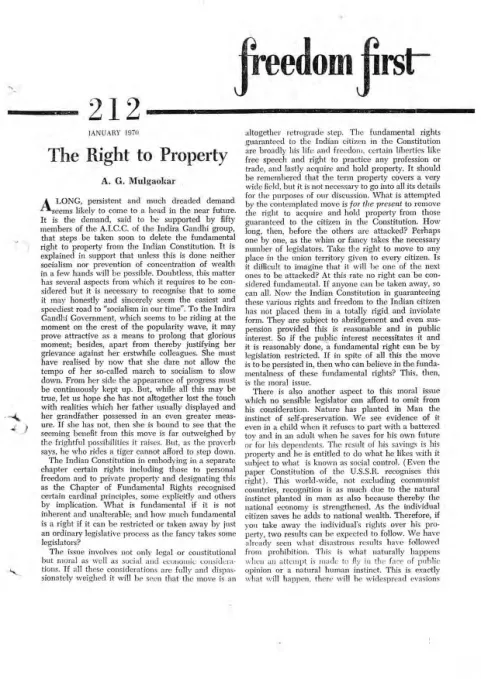
The Right to Property
By A. G. Mulgaokar
A. G. Mulgaokar’s lead article argues against the campaign, backed by fifty members of the Indira Gandhi faction of the A.I.C.C., to delete the fundamental right to property from the Indian Constitution. He calls the move a step toward ‘socialism in our time’ that appeals to the Prime Minister’s political needs rather than sound policy, and warns that once one fundamental right can be stripped away by ordinary legislative majority, no right can be considered truly fundamental — property today, other freedoms tomorrow. He reviews the constitutional and legal background (the Supreme Court ruling that Parliament cannot abridge fundamental rights under Article 13(2), and the alternative of convening a new Constituent Assembly), invokes the British precedent of Asquith’s 1910 constitutional confrontation with the House of Lords as a lesson in respecting the electorate’s mandate before major constitutional change, and closes by arguing that the individual’s right to hold and dispose of property is rooted in a natural human instinct for self-preservation whose suppression — as with prohibition — will only produce widespread evasion and economic dislocation.
- Fifty A.I.C.C. members aligned with Indira Gandhi are pushing to delete the constitutional right to property.
- Mulgaokar argues the move is presented as a path to socialism but is really a political tool to outflank rivals within Congress.
- If one fundamental right can be abridged by ordinary legislative majority, none can be considered truly fundamental.
- A Supreme Court ruling held that Parliament cannot use Art. 368 to abridge fundamental rights protected under Art. 13(2); the only clean alternative is a new Constituent Assembly.
- Mulgaokar cites Asquith’s 1910 general election over the House of Lords’ powers as a precedent for requiring a specific electoral mandate before major constitutional change.
- He frames property rights as flowing from a natural instinct of self-preservation, whose suppression (as with prohibition) breeds evasion and economic harm.
The Need Of The Hour
By H. R. Pardivala
H. R. Pardivala surveys the political crisis of the day, blaming professional politicians across the spectrum for corruption, communal and casteist exploitation, and betrayal of the poverty-stricken masses two decades after independence. He argues the country risks losing faith in non-violent, democratic methods and drifting toward extremism, and endorses a suggestion attributed to Khan Abdul Ghaffar Khan (‘Badshah Khan’) and Acharya Vinoba Bhave — since taken up for consideration by Jayaprakash Narayan — that a new political party embodying Gandhian ideals and values, backed by a Gandhian ‘Lok Sevak Sangh’, should be formed to rescue the country. He appeals directly to Narayan to abandon his aloofness from active politics and lead such an effort, framing Gandhi’s birth centenary as an apt moment for this political ‘resurrection’.
- Pardivala blames the ‘utter failure’ of India’s professional politicians for the country’s poverty, corruption, and communal exploitation in the two decades since independence.
- He warns that democratic and non-violent methods are losing credibility with the masses, who may turn to anti-democratic or violent alternatives.
- He endorses the proposal by Khan Abdul Ghaffar Khan and Vinoba Bhave for a new Gandhian political party backed by a ‘Lok Sevak Sangh’.
- He notes Jayaprakash Narayan has begun to consider this suggestion ‘worthy of further examination’ after years of resisting a return to active politics.
- The essay closes with a direct appeal to Narayan to lead the new party, timed to Gandhi’s birth centenary.
Monopolies: State Or Private?
By M. R. Masani, M.P.
M. R. Masani, M.P., delivers a sharp critique (evidently based on a Parliament speech) of the Monopolies and Restrictive Trade Practices Bill, arguing it is not a genuine anti-monopoly measure at all. He contends that by any strict definition of monopoly, the only real monopolies in India are Government enterprises — LIC, Indian Airlines, Air India, Indian Railways, Posts and Telegraphs, All India Radio, and others — all of which the Bill specifically excludes from its purview, while it targets private enterprises that hold no real monopoly. He calls this a ‘fraud on the people of India’ and likens the regime it creates to ‘industrial feudalism’, arguing government monopolies are worse than private ones because they combine economic and police power with no external check or appeal. He further criticizes the Bill for downgrading the proposed Monopolies Commission to a toothless advisory body while concentrating real power in the Minister, and for conflating firm size with monopoly power, thereby restricting rather than fostering competition.
- Masani argues the Bill exempts the only real monopolies in India — Government enterprises like LIC, Indian Airlines, Railways, and All India Radio — while targeting private firms that are not monopolies.
- He calls government monopolies worse than private ones because they combine market power with police/state power and face no external appeal.
- He labels the regime created by the Bill ‘industrial feudalism of the most reactionary kind’.
- The Bill downgrades the proposed Monopolies Commission to a mere advisory body, concentrating real power in the Minister.
- He argues the Bill confuses firm size with monopoly, restricting competition between private and state enterprises and among private enterprises via permit-licence powers.
- He references Milovan Djilas’s concept of a ‘New Class’ as an analogy for a politically connected exploiting class (continued on page 8).
Freedom And Partition
By A. G. Noorani
A. G. Noorani reviews two newly published histories of the partition of India — R. C. Majumdar (assisted by A. K. Majumdar)‘s ‘Struggle for Freedom’, the eleventh volume in the Bhavan’s ‘History and Culture of the Indian People’ series, and B. N. Pandey’s ‘The Break-up of British India’ in Macmillan’s ‘Making of the Twentieth Century’ series. Noorani finds Pandey’s work more lucid and objective than Majumdar’s, though both illuminate the same underlying failure: the unwillingness of the Congress and the Muslim League to share power or compromise, especially around the 1937 provincial elections and the 1946 Cabinet Mission Plan. He argues that neither the ‘one-nation’ theory nor the ‘two-nation’ theory was sound, that India was ‘a nation in the making’, and holds both Congress and the League responsible — the League for pushing partition, and the Congress for arrogance in the 1937 ministry-making and for undermining a realistic 1946 compromise — with Congress bearing the greater share of culpability in Noorani’s reading of both historians’ verdicts.
- Noorani reviews R. C. Majumdar’s ‘Struggle for Freedom’ (Bharatiya Vidya Bhavan) and B. N. Pandey’s ‘The Break-up of British India’ (Macmillan), covering the partition era from the 1905 Bengal partition agitation onward.
- He judges Pandey’s account more lucid and objective, while Majumdar’s is a more encyclopedic ‘mighty tome’ covering economy, art, press, and social reform alongside politics.
- Noorani argues partition was not inevitable by mid-1946, faulting the Congress’s handling of the Cabinet Mission Plan.
- He rejects both the ‘one-nation’ and ‘two-nation’ theories as unsound, describing India as ‘a nation in the making’.
- He concludes both historians’ own verdicts point toward greater Congress culpability, despite their reluctance to state this plainly.
Badshah Khan And His Movement
By Moin Shakir
Moin Shakir profiles Khan Abdul Ghaffar Khan (‘Badshah Khan’) and the Pakhtoon nationalist movement he led among the North-West Frontier Province’s Pathans. The essay traces Badshah Khan’s campaign against illiteracy and for education, his engagement with Khilafat- and Hijrat-movement leaders, and his 1929 founding of the Khudai Khidmatgar (‘Servants of God’) movement, which combined non-violence, social service, and Pakhtoon self-respect with alliance to the Indian National Congress. Shakir details the tension between the Khudai Khidmatgar and the Muslim League, which branded Badshah Khan a Congress agent and ‘Hindu’ for rejecting the two-nation theory, and recounts the shattering of his post-1947 hopes as Pakistan, in his view, was ‘founded on hatred’ rather than the pluralist, democratic federation he had sought for the Pathans.
- Badshah Khan built a ‘Pakhtoon nationalism’ rooted in cultural pride, non-revivalist reform, and opposition to illiteracy, working against Mullah opposition to modern education.
- In 1929 he founded the Khudai Khidmatgar movement, emphasizing non-violence, humility, social service, and rejection of anti-social Pathan customs.
- The Khudai Khidmatgar allied with the Indian National Congress, shaping N.W.F.P. politics, while the Muslim League withheld support for anti-British movements.
- Badshah Khan rejected the two-nation theory and was branded ‘Hindu’ and a Congress agent by League leaders as a result.
- After 1947 his hopes for a pluralist federation for the Pathans were shattered; Shakir quotes him lamenting that Pakistan was ‘founded on hatred’.
- The essay closes by comparing Badshah Khan’s defiance under British and Pakistani authority to Prometheus’s refusal to submit to Zeus.
Bengal Report: Hunger-Strike And After
By Analyst
Writing under the byline ‘Analyst’ in the ‘Bengal Report’ column, this piece surveys West Bengal’s United Front politics through November-December 1969, centered on Chief Minister Ajoy Mukherjee’s hunger-strike satyagraha over the deteriorating law-and-order situation and his standoff with Home Minister Jyoti Basu of the CPM. The article details rising inter-party clashes and forcible harvesting in colliery areas, the political effect of the hunger-strike in cooling CPM-Congress tensions, rumours that Indira Gandhi’s Centre discouraged the UF government’s collapse, and Ajoy Mukherjee’s wavering rhetoric toward Basu. It closes by pressing the constitutional question of whether Mukherjee, as Chief Minister, has the personal responsibility to force Basu to relinquish the Home portfolio if he believes law and order has broken down, rather than hiding behind a private inter-party agreement.
- Ajoy Mukherjee, Chief Minister of West Bengal, led a hunger-strike satyagraha beginning December 1 over the breakdown of law and order, with volunteer numbers reportedly doubling to 100,000 within a week.
- The CPM’s Jyoti Basu, Deputy Chief Minister and Home Minister, denies any breakdown of law and order and rejects the premise of the hunger-strike.
- Rumour holds that Indira Gandhi’s Centre discouraged the UF government’s collapse in early December because she needed CPM support at the Centre.
- ‘Analyst’ argues Mukherjee has not taken any concrete step as Chief Minister, citing a private inter-party agreement on portfolio allocation as the obstacle.
- The column concludes Mukherjee has the constitutional right and duty to ask Basu to relinquish the Home portfolio if he judges law and order to have broken down, and that his hunger-strike is meaningless without this step.
- Ajoy Mukherjee planned a second, simultaneous hunger-strike at 1,000 centres on December 28.
Letter to the Editor: P.M. and Party President
By R. Vanchinathan; reply by A. G. Mulgaokar
A short ‘Letter to the Editor’ exchange: reader R. Vanchinathan of Tamil Nadu challenges A. G. Mulgaokar’s October 1969 article for appearing to grant ‘totalitarian’ powers to a Prime Minister, arguing collective Cabinet responsibility and party discipline constrain a P.M.’s power. Mulgaokar replies that he only discussed the P.M.’s constitutional position and used British constitutional history as illustration, and that as cabinet government takes greater root in India the pattern (citing Macmillan’s dismissal of senior colleagues) will likely tilt toward Prime-Ministerial dominance, though he had not meant to suggest anything imminent.
- Reader R. Vanchinathan argues collective Cabinet responsibility and party control over the P.M. rule out ‘totalitarian’ Prime-Ministerial power.
- Mulgaokar responds that he addressed only the P.M.’s constitutional position, using British precedent for illustration, not a claim about imminent events.
- He cites Macmillan’s dismissal of eight senior colleagues (‘Night of the Long Knives’) as evidence that cabinet government tends toward Prime-Ministerial government over time.
Review: Democracy and Development (report on International Colloquium, Indian Liberal Group)
By M. R. Chandvadkar
M. R. Chandvadkar reviews ‘Democracy and Development’, a report on an international colloquium held at Coonoor and published by the Indian Liberal Group, in which thirty-five liberals from fourteen Asian and European countries (gathered under the Leslie Sawhny Programme and the Friedrich Naumann Foundation) discussed the relationship between democracy and economic development. The review summarizes the colloquium’s core conviction that democracy is not only morally superior but more progressive and efficient than dictatorship, while cautioning that democratic development requires internal stability and security from external aggression — including a warning against the temptation of pursuing nuclear weapons as a ‘prestige symbol’ at the cost of basic economic stability.
- The reviewed report covers an International Colloquium on ‘Democracy and Development’ held at Coonoor, sponsored by the Leslie Sawhny Programme of Training for Democracy, the Indian Liberal Group, and the Friedrich Naumann Foundation of West Germany.
- Thirty-five liberal participants from fourteen countries across Asia and Europe took part.
- The report’s core argument: dictatorship guarantees neither bread nor freedom, while liberal democracy pairs individual liberty with a competitive free market economy.
- The colloquium warned against pursuing nuclear weapons as a prestige symbol at the expense of basic economic stability.
- Chandvadkar praises the editor’s compilation and calls the report valuable reading for ‘thinking people in the country’.
Generated by the v1.5 extraction pipeline. Awaiting editorial review.
Metadata and summary are AI-extracted from the source PDF and reviewed for editorial accuracy. The original work is available via the Read PDF tab above (where present); paragraph-level citation inside the PDF is deferred to a future engagement.