Summary
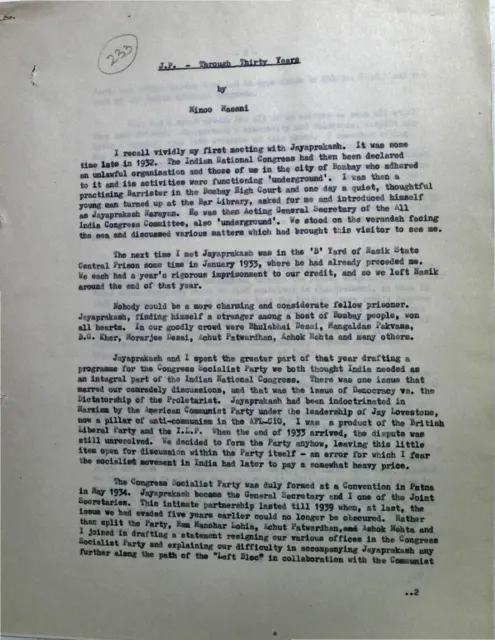
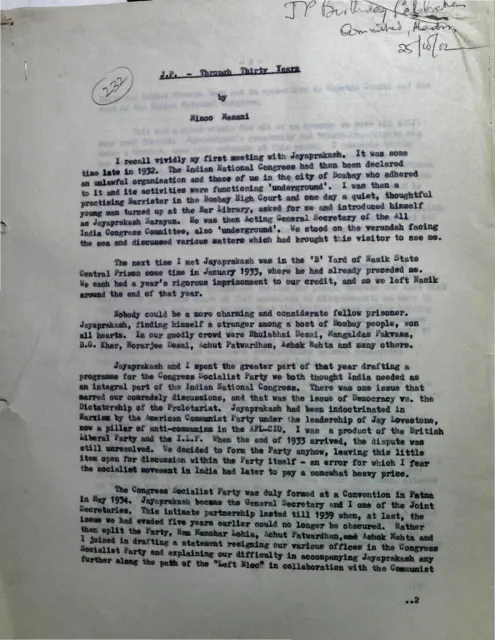
In “J.P. — Through Thirty Years,” Minoo Masani offers a personal and political reminiscence of Jayaprakash Narayan, beginning with their first meeting in Bombay in 1932 and their imprisonment together at Nasik in 1933. Masani recalls their collaboration in drafting a programme for the Congress Socialist Party, including their disagreement over democracy versus the “Dictatorship of the Proletariat,” and describes the eventual 1939 break with the Congress Socialist Party over cooperation with communists. He presents Narayan as generous, tolerant, intellectually serious, and capable of acknowledging his own political mistakes.
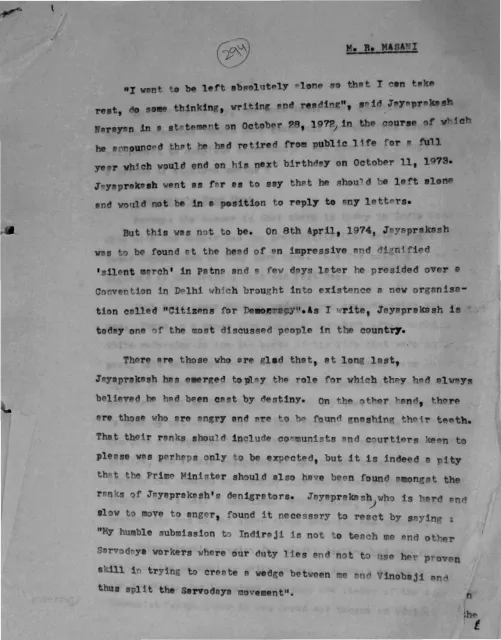
Masani then traces their continued friendship despite disagreements over independence, electoral cooperation with the Communist Party, and Narayan’s withdrawal from conventional party politics. He rejects the criticism that Narayan “deserted” politics, arguing that his work in non-partisan organisations and public affairs remained deeply political. The essay closes by defending Narayan’s slow transition from Marxism toward Gandhi, and by predicting that his significance would lie not in holding office but in constructive work for the common good, human advancement, and freedom. The rendered pages constitute the complete four-page essay.
Key points
- Masani recalls meeting Jayaprakash Narayan in Bombay in 1932 while Narayan was working underground for the Indian National Congress.
- The two men were imprisoned together at Nasik in 1933 and collaborated on the programme of the Congress Socialist Party.
- Their central early disagreement concerned democracy versus the “Dictatorship of the Proletariat.”
- Masani describes Narayan’s generosity, tolerance, and later public admission that he had been mistaken in the 1939 controversy over communist cooperation.
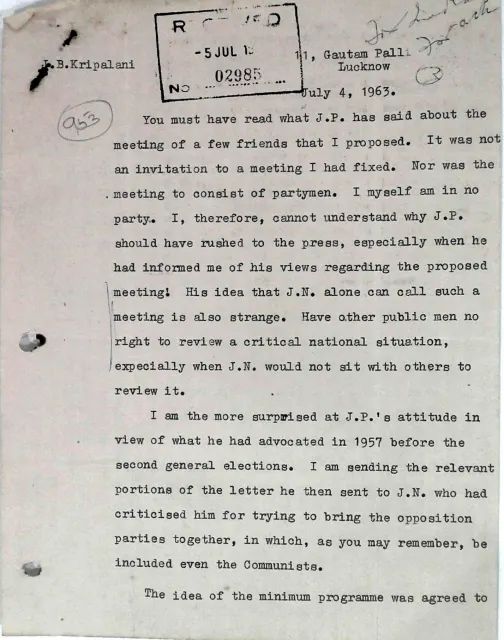
- Their personal friendship survived political disagreements over independence, the Constituent Assembly, and cooperation between democratic opposition parties and communists.
- Masani defends Narayan’s non-partisan public work against accusations that he had abandoned politics.
- The essay portrays Narayan’s movement from Marxism toward Gandhi as gradual and grounded in deep conviction.
- Masani argues that Narayan’s future importance would depend on constructive service and commitment to human freedom rather than political office.
Metadata and summary are AI-extracted from the source PDF and reviewed for editorial accuracy. The original work is available via the Read PDF tab above (where present); paragraph-level citation inside the PDF is deferred to a future engagement.